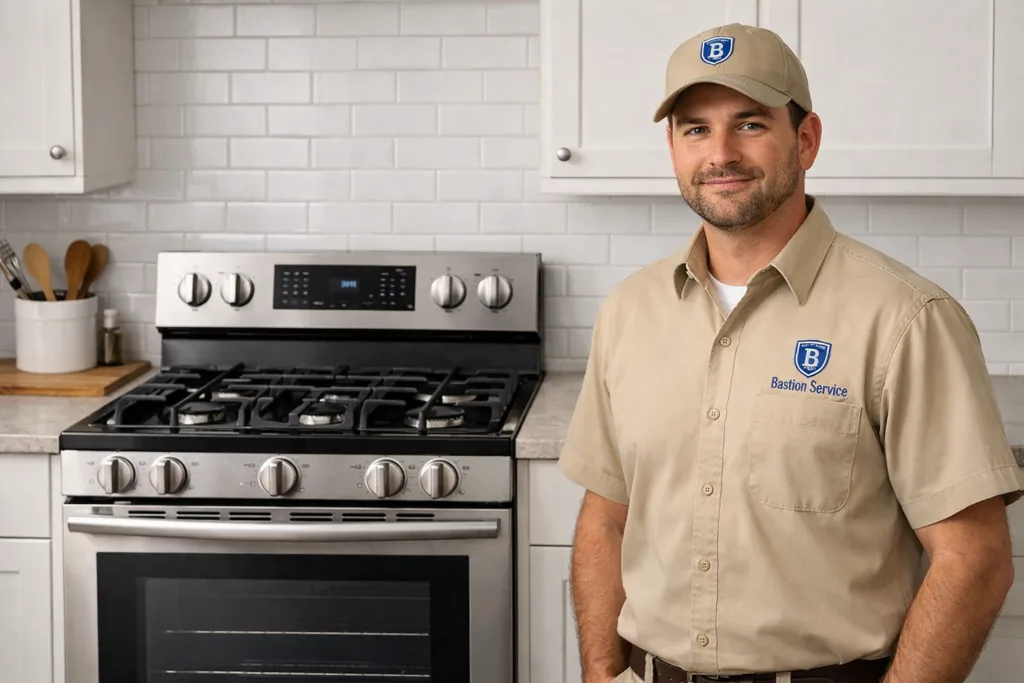
Range problems rarely stay confined to a single symptom. A burner that clicks too long, an oven that preheats slowly, or a control panel that responds inconsistently can all point to different underlying failures, even when the appliance looks normal from the outside. For homeowners in Beverly Hills, the most useful approach is to evaluate the exact pattern of the problem before deciding on a repair.
Common Samsung range symptoms and what they often suggest
Samsung ranges combine cooktop burners, oven heating components, sensors, ignition parts, and electronic controls in one appliance. Because those systems work together, one failure can show up in several ways during everyday cooking. Paying attention to the specific symptom can help narrow down whether the issue is likely mechanical, electrical, ignition-related, or control-related.
Burner clicks but does not light
On a gas range, repeated clicking without ignition often points to a spark or burner-area problem. Misaligned burner caps, debris around the burner head, moisture after cleaning, or a weak igniter can all interfere with normal lighting. If one burner is affected while others work normally, the problem may be isolated to that burner assembly. If several burners are acting up, the issue may involve a broader ignition system fault.
Delayed ignition should not be ignored. If gas is present but the burner does not light quickly, stop using that burner until it has been checked. A strong gas odor is a safety issue and should be treated as one immediately.
Burner flame is weak, uneven, or unstable
A burner does not have to fail completely to need service. Low flame, uneven heating, yellow flame, or a burner that sputters can make routine cooking frustrating and can affect pans unevenly. In some cases, the cause is limited to blockage or burner assembly alignment. In others, gas flow, ignition consistency, or component wear may be involved.
Homeowners often notice this first when water takes longer to boil or pans develop hot and cool sections during stovetop cooking. When that change becomes consistent, repair is usually more effective than continuing to work around it.
Oven will not heat or takes too long to preheat
If the oven stays cool, heats very slowly, or never reaches the selected temperature, the likely causes depend on whether the range is gas or electric. A gas oven may have a weak bake igniter that no longer opens the gas valve properly. An electric oven may have a failed bake or broil element, wiring issue, or relay problem. Temperature sensors and electronic controls can also cause inaccurate heating behavior.
This kind of problem often shows up before complete failure. You may notice longer preheat times, pale baked goods, or food that needs extra cooking time even though the display appears normal.
Oven temperature drifts or cooks unevenly
Some ranges still heat, but not accurately. Cookies may brown more on one side, casseroles may look done on top but stay cool in the center, or roasting times may become unpredictable. These symptoms can be tied to sensor problems, weak heating performance, convection issues, or control calibration errors.
Uneven oven behavior matters because it affects more than convenience. Once a range stops maintaining stable temperature, it becomes harder to trust results from meal to meal, especially in households that cook often.
Display problems, beeping, or error codes
An unresponsive keypad, flashing display, unexplained beeping, or recurring code usually indicates an electronic issue rather than a simple heating failure. Depending on the model, the fault may involve the control board, touch interface, sensor feedback, or communication between components.
Power cycling the range can sometimes clear a temporary glitch, but repeated errors usually mean the problem has not actually been resolved. If the same code or display behavior keeps returning, further use often leads to the same interruption again.
Signs the problem is getting worse
Many range failures begin intermittently. A burner may light on the second try, the oven may heat properly one day and not the next, or the panel may only freeze occasionally. Intermittent operation is often a warning sign that a component is weakening rather than a sign that the appliance is fine.
- Burners take longer and longer to ignite
- Clicking continues after flame appears
- Preheat times increase over time
- Cooking results become less consistent from week to week
- Error codes appear, clear, and then return
- One function fails first, followed by others
When a symptom becomes less predictable, diagnosis becomes more important. Intermittent failures can be harder to identify if they are left too long, especially when heat, moisture, or repeated use begin affecting additional parts.
When to stop using the range until it is checked
Some problems are inconvenient. Others raise safety concerns and should not be worked around. Stop using the appliance and arrange service if you notice any of the following:
- A persistent gas smell
- Delayed ignition with repeated clicking
- Sparking that continues abnormally
- An oven that overheats or will not shut off properly
- Visible damage to elements or wiring areas
- A breaker trips when the range is used
These symptoms can indicate more than normal wear and should be evaluated before the appliance is put back into regular use.
What helps make diagnosis faster
If service is needed, a few details can make the visit more productive. It helps to note whether the issue affects the cooktop, the oven, or both. Also pay attention to whether the problem is constant or intermittent, whether an error code appears, and whether the symptom began suddenly or developed gradually.
Useful observations include:
- Which burner or oven mode is affected
- Whether the failure happens only during preheat or throughout cooking
- Whether the display stays on normally
- Whether cleaning or a recent power outage happened before the issue started
- Whether the problem changes after the range has been running for a while
Those details can help separate a simple burner-area issue from a sensor, ignition, or control problem.
Repair or replace: how homeowners usually decide
Whether repair makes sense depends on the failed part, the overall condition of the range, and how many systems are involved. A single burner ignition issue, sensor fault, or heating component failure is often a reasonable repair. A range with recurring electronic problems, multiple nonworking functions, and heavy overall wear may be harder to justify.
Age matters, but condition matters just as much. A newer Samsung range with one identifiable failure is a different situation than an older unit with oven problems, cooktop issues, and recurring control faults at the same time. In Beverly Hills homes where the range is used daily, the goal is usually to restore reliable cooking without putting money into a pattern of repeat breakdowns.
Why symptom-based repair matters on Samsung ranges
Ranges can produce similar complaints for very different reasons. “Not heating,” for example, might mean a failed element, a weak igniter, a bad sensor, a relay issue, or a control fault. “Burner not working” could be caused by ignition failure, cap misalignment, contamination, or a switch issue. Replacing parts based only on the most visible symptom can lead to extra cost without solving the actual problem.
That is why symptom-based testing is so important. It helps determine whether the failure is isolated, whether another component has been affected, and whether the repair path is likely to hold up under normal household use.
What homeowners in Beverly Hills usually want from range service
Most households are not looking for a temporary workaround. They want to know why the range changed, whether it can be repaired without unnecessary parts replacement, and whether the result is likely to be dependable for everyday cooking. That is especially true when the issue affects dinner prep, baking, or multiple cooking functions at once.
When a Samsung range starts behaving differently, acting early often helps keep the repair simpler. Problems involving ignition, temperature regulation, or controls are usually easier to address before they spread into broader performance issues.