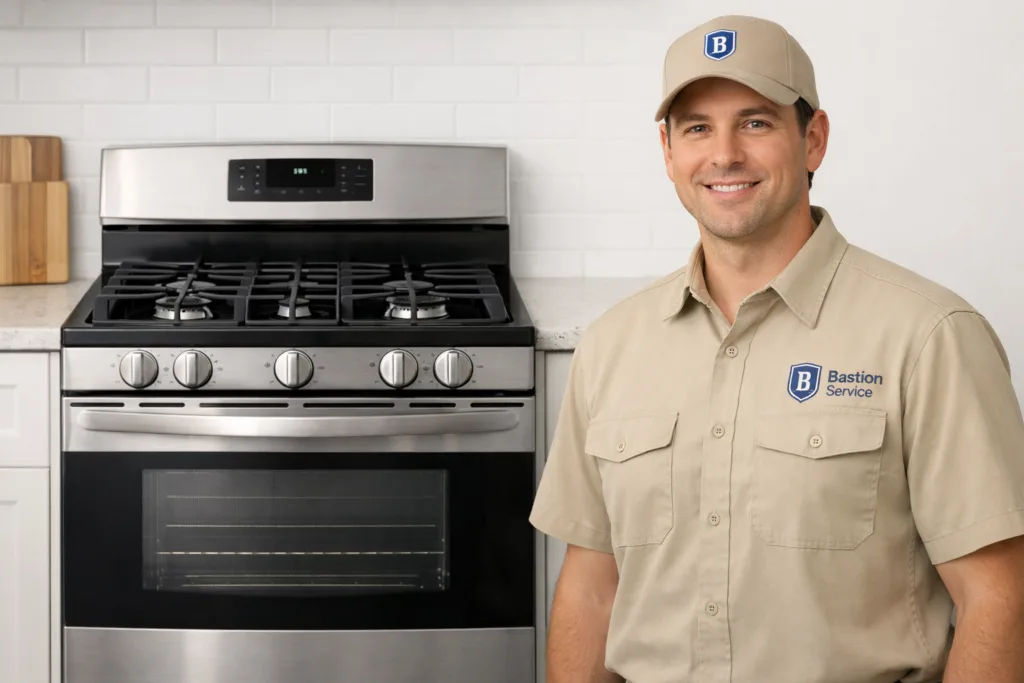
Range problems tend to interrupt the whole kitchen routine because one symptom can affect several cooking functions at once. If a Kenmore range has a burner that will not light, an oven that will not hold temperature, or controls that respond unpredictably, the most useful next step is to match the repair approach to the exact way the problem is showing up.
Start with the symptom, not the part
Many homeowners assume a no-heat or poor-heating problem must come from one obvious failed component, but ranges do not always fail that neatly. Similar symptoms can be caused by ignition trouble, a weak element, a temperature-sensing issue, damaged wiring, a failing switch, or an electronic control fault. Looking at the full symptom pattern helps narrow down whether the issue affects the cooktop, the oven, or the appliance more broadly.
That distinction matters in Westwood homes where the range is used daily and reliability is more important than trial-and-error part swapping. A burner that clicks but does not ignite raises different concerns than an oven that overheats, and each points to a different repair path.
Common Kenmore range problems and what they often mean
Gas burner will not ignite or keeps clicking
When a gas surface burner clicks repeatedly, lights only sometimes, or needs several tries to ignite, the problem may involve the igniter, burner cap positioning, moisture around the ignition area, or a fault in the spark system. If the clicking continues after ignition or the burner does not light at all, it is a sign the issue should not be ignored.
Homeowners sometimes notice this problem after cleaning or after a spill, but if the symptom keeps returning, there may be more than a simple alignment issue. Intermittent ignition is especially frustrating because it can seem minor one day and become a complete burner failure the next.
Oven will not heat or takes too long to preheat
A Kenmore range oven that stays cold, heats very slowly, or never reaches the selected temperature may have a bad bake element, weak igniter, sensor problem, control issue, or power-related fault. The cause often depends on whether the oven shows partial heat, no heat at all, or inconsistent temperature during cooking.
If preheat times keep getting longer, that usually means performance is declining rather than fluctuating normally. Waiting too long to address it can lead to more uneven cooking and extra strain on related components.
Food cooks unevenly or burns unexpectedly
Uneven baking is one of the most common complaints because it develops gradually. Meals may come out overdone on one side, undercooked in the center, or inconsistent from rack to rack. This can point to a temperature sensor issue, weak heating component, calibration drift, or a control problem that is no longer regulating heat accurately.
What makes this symptom tricky is that the oven may still appear to work. It turns on, gets warm, and completes the cycle, but the actual cooking performance is no longer dependable.
Electric burners heat poorly or not at all
On electric Kenmore ranges, a surface element that will not heat, heats unevenly, or only works on certain settings can indicate a failed element, switch failure, wiring damage, or terminal block wear. In some cases, the burner may cycle erratically or stop heating after reaching a low temperature.
These symptoms are worth checking early. A weak connection can create heat damage where the element plugs in, and that can turn a simpler repair into a larger one if the range keeps being used that way.
Display or controls are not responding
If the control panel is blank, buttons do not respond, settings change on their own, or the range powers on inconsistently, the issue may involve the electronic control, user interface, or incoming power supply. Control problems can affect both oven and cooktop functions, especially on models where multiple systems depend on the same board.
Unpredictable controls are more than a convenience issue. If temperature selection or cooking mode is not responding normally, it becomes much harder to use the appliance safely and consistently.
Signs the problem is getting worse
Some range issues stay manageable for a short time, but others tend to escalate. It is usually smart to schedule service when you notice:
- Longer preheat times than usual
- A burner that works only intermittently
- Repeated clicking at ignition
- Temperature swings that affect cooking results
- Error codes or a blank display
- Sparking, burning smells, or breaker trips
These are not symptoms to dismiss as normal aging. They often mean a part is failing or a connection is no longer stable.
When to stop using the range until it is checked
Some conditions call for more caution than others. If the range is sparking, tripping the breaker, producing a burning electrical smell, overheating, or showing unreliable gas ignition behavior, it is better to stop using the affected function until the cause is identified. Continuing to use the appliance can increase damage and create avoidable safety concerns.
Even when the issue seems limited to one area, the underlying fault may affect more than that single burner or heating function. A proper diagnosis helps determine whether the problem is isolated or part of a larger electrical or control failure.
Repair or replacement depends on the overall condition
Many Kenmore range problems are still worth repairing when the fault is tied to one specific component and the appliance is otherwise in solid shape. Burner ignition issues, failed elements, certain sensor problems, and some control-related faults can often be addressed without replacing the entire range.
Replacement becomes more likely when the appliance has multiple major failures, recurring electronic problems, significant internal wear, or repair costs that start approaching the value of the unit. The age of the range matters, but condition matters just as much. A targeted repair on a well-kept appliance may make more sense than replacing a unit with one isolated failure.
What homeowners in Westwood usually want from service
Most people are not looking for a technical lecture. They want to know why the range is acting up, whether it is safe to keep using, and whether repair is practical. For Kenmore range repair in Westwood, the best service outcome is usually a straightforward explanation of the fault, the likely repair path, and what to expect from the appliance afterward.
That is especially helpful when the symptom is not a complete failure but a pattern of declining performance. A range that still turns on but no longer cooks reliably can be harder to judge than one that stops working altogether. In those cases, symptom-based troubleshooting is often the fastest way to make a confident repair decision.
A focused diagnosis saves time and frustration
Ranges can develop problems that appear simple from the outside but have different underlying causes. Replacing parts based on guesswork can waste time, add cost, and leave the original problem unresolved. A focused diagnosis helps sort out whether the issue is mechanical, electrical, ignition-related, or electronic before deciding what should actually be repaired.
For households in Westwood, that usually means less downtime, fewer surprises, and a better sense of whether the Kenmore range can be restored to reliable everyday cooking.