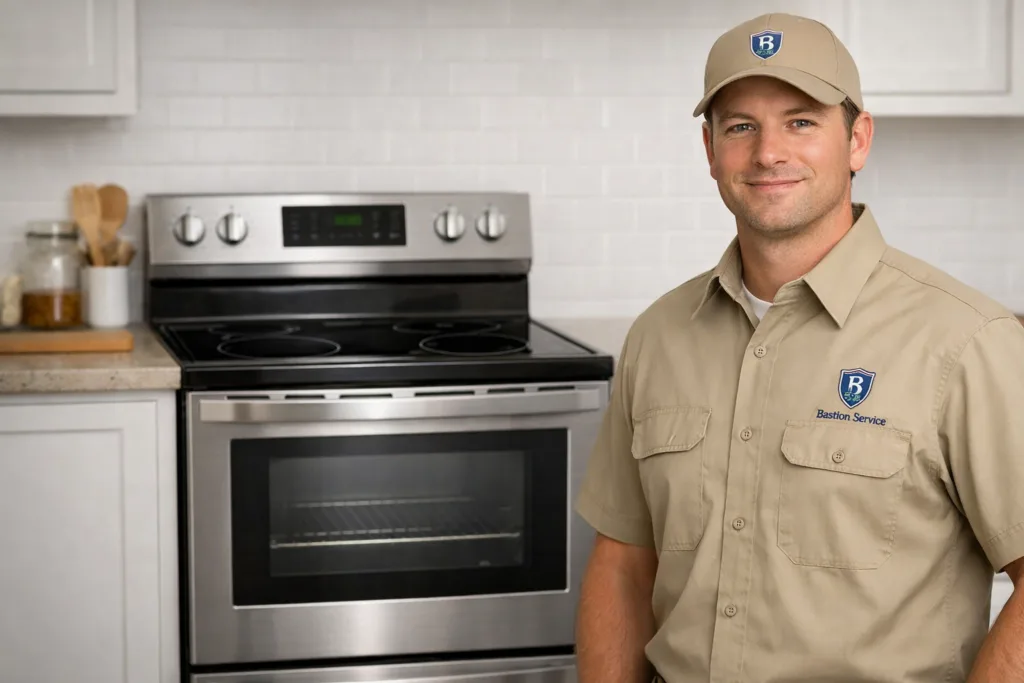
Range problems are easiest to solve when the symptom is described exactly as it happens. An oven that never preheats, a front burner that clicks every time, or a control panel that works one day and not the next can each point to different parts and different repair paths. For Westwood homeowners, that symptom-first approach helps avoid guessing and keeps the decision focused on what will actually restore normal cooking.
Start with the exact problem you are seeing
Amana ranges can fail in ways that seem similar at first but come from very different causes. “Not heating” might mean no heat at all, slow preheating, uneven baking, or a range that reaches temperature and then drops off. “Burner trouble” might mean no flame, delayed ignition, weak heat, or a surface element that cycles incorrectly. The more specific the pattern, the easier it is to narrow down the likely fault.
It also helps to notice whether the issue affects just one cooking function or the whole appliance. If the oven is failing but the cooktop works normally, that usually points in a different direction than a range with both heating and control problems at the same time.
Common Amana range symptoms and what they may mean
Oven will not heat
When the oven stays cold, the cause often depends on whether the range is gas or electric. On gas models, a weak or failed igniter is a common reason the oven will not start heating. On electric models, a damaged bake element, broil element, wiring issue, or control fault may be involved. If the display appears normal but the cavity never warms, the failure is often deeper than a simple setting problem.
Oven heats, but cooking results are inconsistent
If food comes out underdone in the center, overbrowned on top, or takes much longer than expected, the range may be struggling to maintain temperature. That can happen with a drifting sensor, a weak heating component, calibration issues, or an electronic control problem. Uneven cooking is not always obvious during preheat, which is why some households notice the issue only after several meals turn out poorly.
Gas burner clicks but does not light
Repeated clicking without ignition may be caused by moisture, food debris, a blocked burner path, or a failing ignition-related component. Sometimes the burner lights after several tries, which can make the problem seem minor even when it is becoming more consistent. If the clicking continues after the flame appears, the range should be checked before routine use continues.
Electric burner does not heat properly
On electric Amana ranges, a surface element that stays cool, overheats, or works only on certain settings may be tied to the element, switch, receptacle, or internal connection. A burner that cuts in and out can sometimes show heat-related wear that gets worse under load. If one burner works normally and another does not, that comparison can be useful during diagnosis.
Control panel is blank or unresponsive
When the display goes dark, buttons stop responding, or settings change unpredictably, the problem may involve the user interface, main control, or incoming power issue. Control failures can also overlap with heating complaints, especially when the oven appears to start a cycle but never actually completes it properly.
What repeated clicking, gas odor, or sparking should tell you
Some symptoms call for extra caution. If a gas burner keeps clicking or fails to ignite reliably, it is best not to keep retrying it as part of everyday cooking. If clicking is paired with a strong gas smell, stop using the appliance and address safety first. On electric models, visible sparking, scorching near an element connection, or a burner that suddenly gets hotter than normal should also be treated as a stop-use condition until the range is inspected.
These issues do not always mean the range is beyond repair, but they do mean the problem should be taken seriously before more damage develops.
Signs the problem may be getting worse
- Preheat times keep getting longer from week to week
- A burner needs multiple tries before it lights
- The oven reaches temperature only part of the time
- The display resets, flickers, or loses settings
- Heat levels feel less predictable than they used to
- Cooking results vary even when you use the same settings
These gradual changes often show up before a complete breakdown. Catching them earlier can make the repair simpler than waiting until the appliance stops working altogether.
When repair usually makes sense
Many Amana range issues are worth repairing when the failure is isolated to one part or one system. Igniters, surface elements, bake elements, sensors, switches, and some control-related faults are common examples where repair can restore normal use without requiring replacement of the whole appliance.
Repair tends to be less appealing when the range has several major problems at once, shows heavy overall wear, or has an expensive control failure combined with additional heating or wiring concerns. In those cases, the most useful question is not just whether the range can be fixed, but whether the repair is likely to bring back stable everyday performance.
How homeowners can describe the issue more clearly
Before scheduling service, it helps to note a few details:
- Does the problem affect the oven, the cooktop, or both?
- Is the symptom constant or intermittent?
- Did the issue begin suddenly or get worse over time?
- Does it happen on one burner or all burners?
- Is the oven failing during preheat, during baking, or after reaching temperature?
- Are there sounds, smells, or display errors that appear with the problem?
Those observations can make the diagnosis faster and help separate a simple wear-related issue from a broader electrical or control failure.
What a service visit should help you decide
A well-handled range appointment should do more than confirm that something is wrong. It should identify the failed component or system, explain how that failure matches the symptom, clarify whether continued use risks further damage, and help you decide if repair is sensible for the appliance’s condition. That is especially important when the range is still partly working, because partial operation can make a problem seem smaller than it is.
For households in Westwood, the goal is straightforward: restore dependable burner operation, consistent oven performance, and controls that work the way they should. When an Amana range starts missing one of those basics, a practical repair plan based on the actual symptom pattern is the best place to start.