
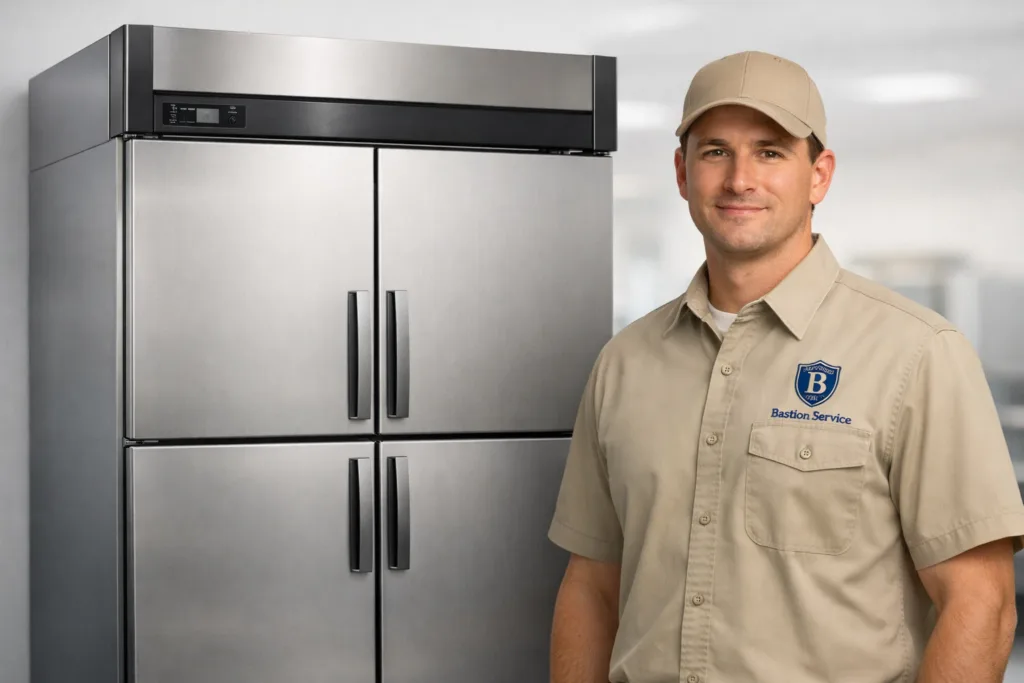




Freezer problems rarely fail in just one obvious way. A Hoshizaki unit may start with mild temperature drift, develop frost on the evaporator cover, begin running longer than normal, and then turn into a product-risk issue during a busy day. For businesses in Torrance, service is most useful when the visit is centered on the actual symptom pattern, how the freezer is being used, and whether the problem points to airflow, controls, door sealing, defrost, fan operation, or a deeper refrigeration fault. Bastion Service provides Hoshizaki freezer repair for businesses that need a repair decision based on what the equipment is doing now, not guesswork.
Related commercial service paths in Torrance include Hoshizaki Commercial Repair in Torrance, Commercial Freezer Repair in Torrance, and Hoshizaki Refrigerator Repair in Torrance.
Common Hoshizaki Freezer Problems That Need Service
Not staying cold enough
If the cabinet temperature rises above its normal range, the cause may be as simple as restricted condenser airflow or as serious as a failing compressor or sealed-system issue. In many cases, businesses first notice soft product, uneven temperatures from top to bottom, or longer recovery after the door is opened. A unit that cools part of the time but cannot hold temperature during normal use often needs more than a thermostat adjustment. Fan performance, frost buildup, door gasket condition, sensor accuracy, and heat exchange all need to be checked together.
Frost buildup inside the cabinet
Heavy frost is more than a cosmetic issue. It can reduce airflow across the evaporator, crowd storage space, interfere with doors, and force the freezer to run longer to maintain temperature. Repeated frost buildup may point to a defrost problem, air leaks at the gasket, a door that is not closing fully, or moisture entering the cabinet during frequent access. If frost returns quickly after being cleared, the root problem is still active and the unit should be inspected.
Freezer runs constantly
A Hoshizaki freezer that seems to never shut off is usually compensating for another problem. Dirty condenser coils, poor airflow, weak cooling performance, warm air infiltration, sensor errors, or blocked evaporator circulation can all keep the unit in a prolonged run cycle. Constant operation increases wear on major components and can mask a larger cooling problem until product temperatures become unstable.
Fan noise, rattling, or buzzing
Unusual sound often shows up before total failure. A noisy evaporator fan can indicate ice interference, worn motor bearings, blade damage, or loose mounting. Buzzing or clicking near the compressor area may suggest electrical stress, relay problems, or startup issues. Rattling panels and vibrating lines can sometimes be minor, but they can also signal a system under strain. When noise changes suddenly, it is usually worth addressing before it becomes a no-cool call.
Water leaks or ice in the wrong places
Water around the freezer or ice accumulating outside normal frost zones can indicate a drainage issue, a defrost problem, door leakage, or excessive moisture entering the cabinet. In a working kitchen or storage area, that can create both workflow and safety concerns. Drain restrictions and ice migration also tend to trigger secondary problems, including fan obstruction and poor air circulation.
Error codes or inconsistent control behavior
Display alarms and erratic readouts can help narrow the fault, but they do not always identify the exact failed part. A sensor issue, wiring problem, board fault, or cooling performance problem elsewhere in the system may produce similar symptoms on the controller. When the displayed temperature does not match actual cabinet conditions, the unit should be tested instead of reset repeatedly.
Why Hoshizaki Freezers Lose Temperature
Temperature loss usually comes from one of a few categories: insufficient airflow, excessive frost, control or sensor problems, door sealing issues, or refrigeration-side performance loss. The reason diagnosis matters is that these categories can overlap. A freezer with a weak gasket may also develop frost. A freezer with frost may then lose airflow. A freezer with poor airflow may appear to have a larger cooling failure than it really does.
For businesses in Torrance, the practical question is not just why the temperature changed, but whether the issue can be corrected quickly, whether inventory is at risk, and whether continued operation could damage other components. That is why symptom-based service is more useful than replacing parts based on a single visible clue.
Signs the Problem Is Getting Worse
- Product softens even though the display still looks normal
- Recovery after door openings becomes noticeably slower
- Frost returns within a short time after clearing
- The compressor runs longer or sounds strained
- Fans become louder or stop moving air normally
- Water appears beneath the unit or around the door area
- Alarms repeat after resets
- Door gaskets no longer seal tightly along the full edge
These signs often mean the unit is no longer operating within a normal margin, even if it has not stopped cooling completely.
How a Service Visit Helps Narrow the Repair
A useful freezer service call should sort the problem into a repair path that matches the equipment’s actual condition. That typically means checking cabinet temperature behavior, airflow through the evaporator and condenser sections, frost pattern, fan operation, drain condition, gasket sealing, control response, and the way the compressor is cycling. The goal is to identify whether the issue is isolated to a support component or whether the freezer is showing signs of broader refrigeration stress.
This matters because similar complaints can lead to very different repairs. A warm cabinet may come from a fan motor, a defrost component, a door leak, a sensor, or a sealed-system issue. Those are not equivalent in urgency, cost, or expected downtime. A focused inspection helps businesses make a better decision about repair timing and next steps.
When to Stop Using the Freezer Until It Is Repaired
Some problems allow short-term operation while service is arranged, but others suggest the unit should be taken out of use. If product temperature is no longer safe, the compressor is short cycling, breakers are tripping, ice is blocking airflow, or the cabinet cannot recover after loading, continued use may increase product loss and equipment damage. The same is true when the freezer shows repeated alarms with unstable internal temperature.
In those cases, the repair decision is not just about convenience. It is about limiting downtime, protecting inventory, and avoiding a more expensive failure.
Repair or Replace?
Many Hoshizaki freezer issues are repairable, especially when the problem is tied to fans, controls, sensors, gaskets, door hardware, drainage, or defrost components. Replacement becomes a stronger consideration when the freezer has repeated major failures, poor long-term reliability, cabinet deterioration, or a refrigeration problem that does not make financial sense relative to the unit’s age and condition.
The right decision usually depends on more than whether the unit can be made to run again. Businesses often need to weigh expected reliability after repair, urgency of current downtime, parts condition around the original failure, and whether the freezer still matches storage needs.
What to Have Ready Before Scheduling Service
- The model and serial information if available
- A brief description of the main symptom
- Whether the issue is constant or only happens during busy periods
- Any recent alarms, codes, or unusual noises
- Whether frost, leaking water, or door sealing problems are present
- How long the unit has been struggling to maintain temperature
That information can help speed up the diagnostic process and make the service visit more productive.
Hoshizaki Freezer Repair for Businesses in Torrance
When a freezer problem starts affecting daily operations, the most helpful next step is to schedule service around the real symptom, not wait for a complete shutdown. Hoshizaki freezer repair in Torrance is often most successful when the issue is addressed while it is still limited to one system instead of after frost, airflow loss, and temperature instability have created a larger equipment failure. For businesses in Torrance, timely diagnosis and repair planning can reduce disruption, protect product, and clarify whether the right answer is a direct repair or a broader equipment decision.


