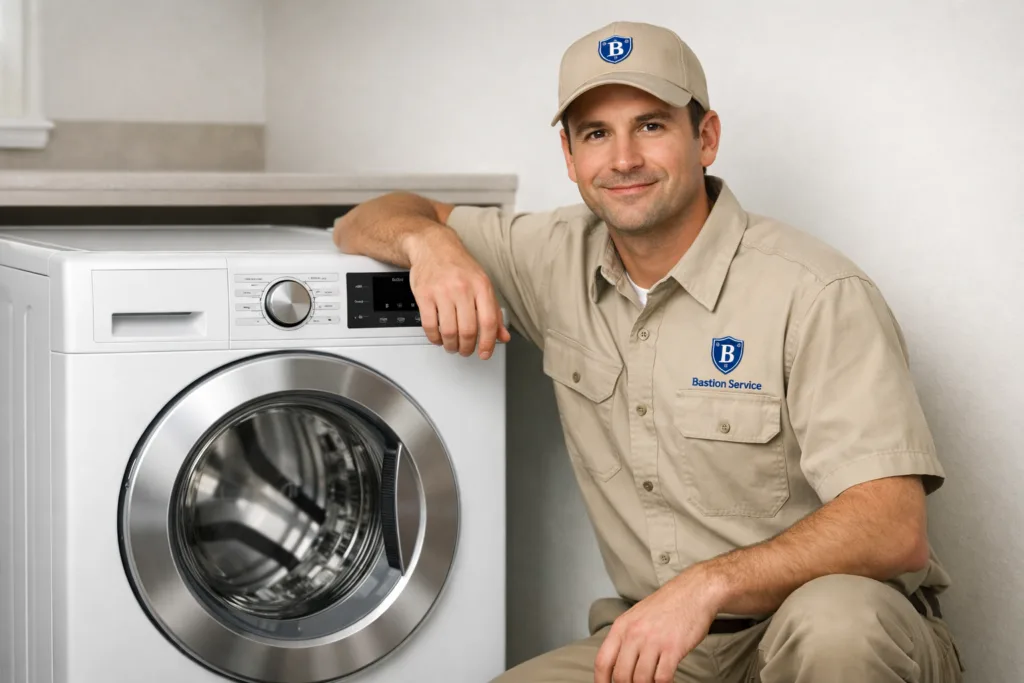
Bosch washers often give early warning signs before they fail completely. A cycle that suddenly takes much longer, a door that clicks more than once before locking, or damp clothes after the final spin can all point to a developing issue. Addressing those changes early can help prevent a minor drain, fill, or latch problem from turning into a larger repair.
Common Bosch washer problems in Mar Vista homes
Washer problems tend to show up in familiar ways, but the cause is not always obvious from the symptom alone. Bosch models rely on multiple sensors, control inputs, and safety checks, so one fault can affect several parts of the cycle.
Washer will not start
If the display responds but the cycle will not begin, the problem may involve the door lock, control response, selector input, or a condition that prevents the washer from moving past startup checks. If the machine appears completely unresponsive, power supply issues, internal wiring faults, or a failed electronic component may need to be tested directly.
Washer fills slowly or not at all
Low fill or no fill can be caused by restricted inlet screens, faulty water valves, pressure sensing problems, or control issues. On some Bosch washers, homeowners may assume the machine is simply using less water by design, but if loads are not washing well or the cycle stalls, the washer may not be filling correctly.
Washer will not drain
Water left in the drum usually points to a blocked drain path, clogged filter area, drain hose restriction, or a weak or failed drain pump. Some machines hum without moving water, while others stop and show an error before the spin phase. Poor draining should not be ignored, because trapped water can contribute to odor, residue, and repeat cycle failures.
Washer will not spin properly
If clothing comes out unusually wet, the issue may be tied to drainage, load balance detection, motor performance, suspension wear, or a control fault that prevents full-speed spin. A spin complaint does not always mean the spin system itself has failed. In many cases, the washer is skipping or limiting spin because another problem is still unresolved.
Leaks during or after a cycle
Leaks may come from the door boot, internal hoses, pump connections, detergent oversudsing, or drain installation issues. The timing matters. A leak during fill can suggest one source, while water appearing only during drain or spin can suggest another. Even a small recurring leak can lead to damage around the laundry area if it continues unnoticed.
Cycle stops before completion
When a Bosch washer repeatedly stops at the same point, the cause may involve heating, draining, door lock feedback, sensor readings, or electronic control behavior. This is one of the more frustrating symptoms because the machine may seem partly functional while still failing to complete loads consistently.
What certain washer symptoms can mean
Specific symptoms can help narrow down which system needs attention, but they should be viewed as clues rather than final answers.
- Clicking at the door or repeated locking attempts: often suggests a latch problem or control communication issue.
- Long wash times: can indicate slow filling, delayed draining, heating-related faults on some models, or sensor feedback problems.
- Standing water and a locked door: often points to a drain problem that is preventing the machine from unlocking safely.
- Bad odors from the drum: may come from trapped water, incomplete draining, residue buildup, or repeated short-cycling.
- Banging or walking during spin: can be related to leveling issues, worn suspension parts, or unbalanced loads that the machine cannot correct.
- Recurring error codes: may identify the affected system, but the code does not always identify the exact failed part.
Drain and spin problems deserve quick attention
Among the most common service calls are washers that leave water behind or fail to spin clothing dry. These problems are easy to put off for a few more loads, but ongoing use can place extra strain on the pump, motor, and control system. If the machine struggles through one cycle, then behaves worse on the next, it is usually a sign that the underlying fault is progressing.
Drain-related problems are especially important to address when the washer smells musty, the door stays locked because water remains inside, or the unit stops before the final rinse and spin. In those cases, the symptom affects both performance and usability.
Why Bosch washer issues can be tricky to judge by symptom alone
Bosch washers are designed to monitor load balance, water level, drainage, door status, and cycle progress closely. That means one failed component can trigger symptoms that seem unrelated. For example, a drain issue can look like a spin problem, and a door lock fault can appear to be a startup problem or cycle interruption.
That is why testing matters more than replacing parts based on the most common online guess. A symptom-based explanation can be helpful, but the actual repair path depends on what the machine is doing during fill, wash, drain, and spin in real conditions inside the home.
When it makes sense to schedule service
It is usually time to schedule service when the washer is no longer reliable, not just when it has stopped completely. Intermittent failures often worsen over time and can be harder on both the appliance and your laundry routine.
Service is especially worth arranging when:
- The washer stops at the same point in multiple cycles
- Clothes remain much wetter than usual after washing
- The drum still contains water after the cycle ends
- The door does not unlock normally
- Leaks appear around the machine
- New grinding, humming, or rattling sounds develop
- Error codes return soon after resetting the washer
- The machine trips a breaker or shuts off unexpectedly
If there is visible leaking, a burning smell, or any sign of electrical interruption, the washer should not continue to be used until it has been checked.
Repair or replacement: how to think about the decision
For many households in Mar Vista, the real question is whether repair is the better investment. That depends on the washer’s age, overall condition, the parts involved, and whether the current problem appears isolated or part of a longer pattern.
Repair is often reasonable when the issue is limited to a drain component, inlet valve, latch assembly, pump, hose, or another targeted part and the rest of the machine is in solid condition. Replacement becomes more likely when there are repeated electronic failures, severe leak history, major drum or bearing wear, or signs that multiple systems are failing close together.
A good evaluation should look at the full picture rather than only the current symptom. That helps homeowners decide whether the washer has a straightforward repair path or whether the cost and risk of continued repairs are starting to outweigh the value of keeping the machine.
What homeowners can note before service
A few simple observations can make diagnosis faster and more accurate. Before service, it helps to note whether the washer fails during fill, wash, drain, or spin, whether water remains in the drum, and whether any code appears consistently. It is also useful to notice whether the problem happens with every load or only with certain cycle settings.
Other details that can help include:
- Whether the door locks normally at the start
- Whether the washer makes a humming sound while trying to drain
- Whether leaks appear at the front, rear, or underneath
- Whether the machine shakes more with heavier loads
- Whether cycle times have gradually increased over time
These details do not replace testing, but they can help narrow the likely cause and support a more efficient visit.
Bosch washer repair focused on the actual fault
The most effective repair approach is to match the service plan to the exact failure rather than the broad symptom. With Bosch washers, that means looking closely at how the machine fills, drains, locks, senses, and responds throughout the cycle. For homeowners in Mar Vista, that kind of exact-fit diagnosis helps separate a manageable repair from a washer that may be nearing the end of its practical service life.
When the problem is identified accurately, the next step becomes much clearer: repair the specific failed component, address the condition causing the symptom, and restore normal laundry performance without unnecessary part changes.