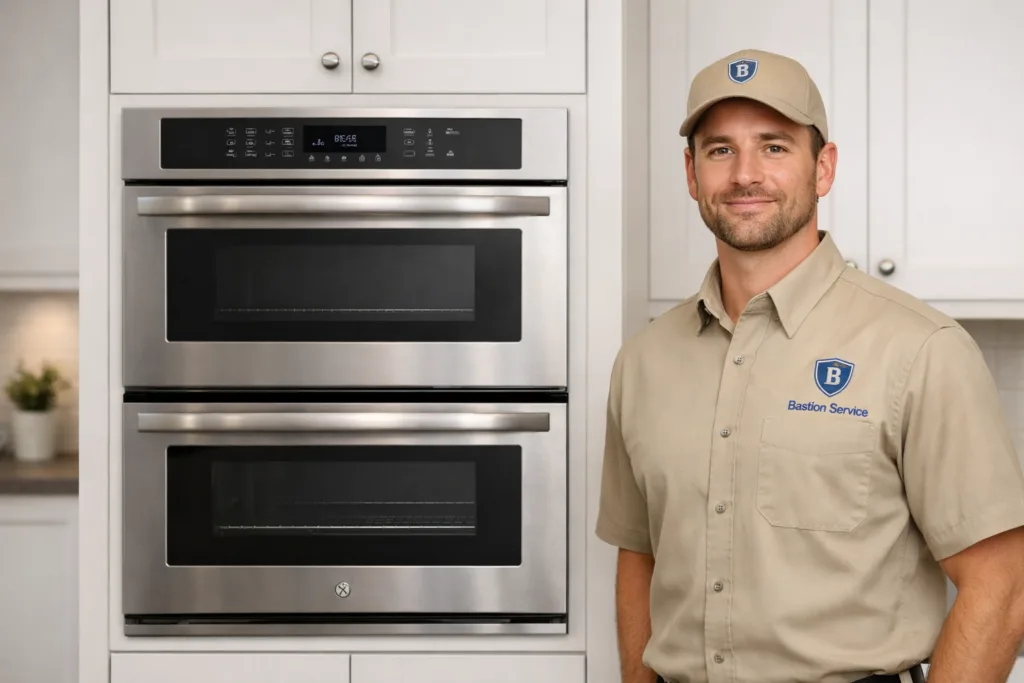
Built-in ovens often show warning signs before they fail completely. A GE wall oven that takes longer to preheat, bakes unevenly, or starts flashing codes may still run for a while, but those changes usually point to a component that is weakening rather than a one-time glitch. Paying attention to the pattern can make the repair decision much easier.
What common GE wall oven symptoms usually point to
Not heating at all
If the display works but the cavity stays cold, the problem may involve a failed bake element, broil element, temperature sensor, relay, wiring connection, or electronic control. On some models, one part of the heating circuit can fail while lights and controls still appear normal, which is why a no-heat complaint needs actual testing instead of assumption.
Slow preheat
Long preheat times are often blamed on normal aging, but they can signal a weak element, sensor drift, voltage-related issues, or a control problem that is not energizing heat correctly. In daily use, this symptom tends to show up first with foods that used to cook on time but now need extra minutes every time.
Uneven baking
When one side browns faster, the top cooks differently from the bottom, or results vary from rack to rack, the issue may be tied to an inconsistent heating element, a faulty sensor, poor convection performance, or a calibration problem. This is especially frustrating because the oven can seem close to normal while still producing unreliable results.
Temperature swings during cooking
Some cycling is normal, but wide swings are not. If the oven overshoots, drops too low, or seems to alternate between too hot and too cool, the likely causes include sensor errors, control board faults, relay trouble, or heat distribution issues. These problems can make baking unpredictable even when the oven eventually reaches the set temperature.
Display, keypad, or control issues
Unresponsive buttons, random beeping, blank displays, or repeated error messages often point to a failing interface, control board, communication fault, or moisture and heat damage around the console area. A power reset may temporarily clear the symptom, but recurring behavior usually means the underlying fault is still there.
Why the exact symptom pattern matters
Two ovens can appear to have the same problem and need completely different repairs. For example, poor heating may come from a bad element, but it can also come from a sensor sending incorrect readings or a control board failing to power the circuit properly. The timing matters too: whether the issue starts during preheat, after the oven gets hot, only in bake mode, or only after self-clean.
That is why the most useful service approach starts with what the oven is actually doing in the home, not just the broad complaint. Details like intermittent failure, repeated codes, partial heat, or shutdown during use can quickly narrow the likely cause.
Problems that often show up after self-clean
Self-clean cycles place heavy heat stress on wall oven components. If a GE unit works differently after self-clean, common trouble spots include door latch assemblies, thermal safety parts, electronic controls, and nearby wiring connections. In some cases, the door may stay locked, the oven may not heat afterward, or the control may begin displaying faults that were not present before.
If the oven is already showing signs of control instability, running another self-clean cycle can make the condition worse. For households in Westwood that rely on the wall oven regularly, it is usually better to address the fault first than to keep testing the appliance under high-heat conditions.
When to stop using the oven until it is checked
Some problems are inconvenient. Others can create risk or cause more damage if ignored. It is wise to stop using the oven if you notice:
- the breaker trips during preheat or cooking
- burning or electrical odors from the control area
- sparking, arcing, or visible damage
- the oven overheating well past the set temperature
- the unit shutting off unexpectedly during use
- a locked door that will not release after cooling
Continued operation under those conditions can damage controls, wiring, or adjacent components and may turn a limited repair into a larger one.
Repair or replacement: how to think it through
Many GE wall oven repairs are worthwhile when the issue is isolated to a heating element, sensor, fan motor, latch assembly, keypad, or another confirmed component and the rest of the appliance is in good shape. Built-in units are significant household appliances, so replacement is not automatically the better answer just because a problem appears electronic.
Replacement becomes more reasonable when there are multiple major failures, severe cavity or door damage, recurring control issues that keep returning after prior work, or a repair path that approaches the value of keeping the oven in service. The right decision depends on the oven’s overall condition, not just its age.
What helps speed up diagnosis
If service is needed in Westwood, a few details can make troubleshooting more efficient:
- whether the oven fails in bake, broil, convection, or all modes
- if the issue started suddenly or worsened over time
- any error code shown on the display
- whether the problem began after a power outage or self-clean cycle
- if the oven partially heats or never heats at all
- whether the door locks, unlocks, and closes normally
Those details often reveal whether the likely problem is in heating, sensing, control, or door-latch functions.
Household impact of waiting too long
Wall oven problems do not always stay minor. A slow preheat issue can progress to incomplete heating. Temperature inconsistency can place extra strain on elements and relays as the appliance struggles to regulate itself. What starts as occasional uneven baking can turn into repeated cooking failures, especially during heavy household use.
For homeowners who cook frequently, early attention usually means a better chance of resolving the issue before additional components are affected. Bastion Service helps Westwood homeowners review the symptom, appliance condition, and likely repair path so the next step is based on how the oven is actually performing.