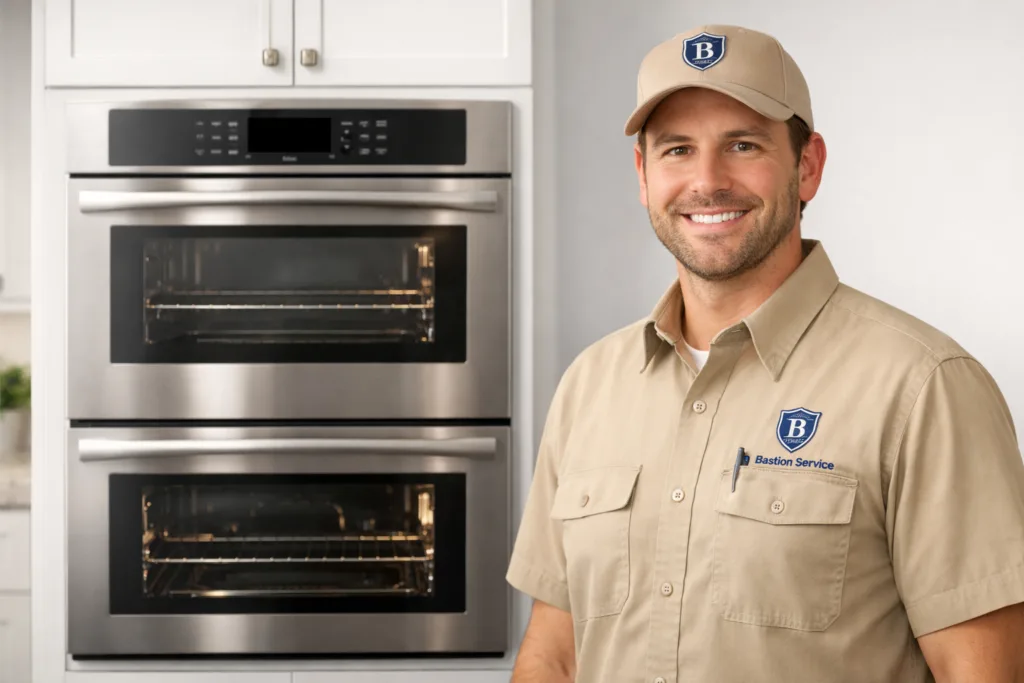
Wall oven problems are often easiest to solve when the symptom is described as specifically as possible. If your GE unit is taking twice as long to bake, browning one side of a dish faster than the other, or showing a code after preheating, those details help narrow the fault quickly. In many cases, what seems like a simple heating issue can involve the sensor circuit, control relays, door hardware, or power supply to the oven.
Common GE Wall Oven Problems in Venice Homes
GE wall ovens rely on coordinated heat, airflow, temperature sensing, and electronic control. When one part falls out of spec, cooking results usually change before the oven stops working completely. These are some of the issues homeowners notice most often.
Oven will not heat
If the cavity stays cold or only warms slightly, the problem may involve a failed bake element, broil element, sensor, wiring connection, thermal cutoff, or control board. On some models, the display appears normal even though the oven is not energizing the heating circuit correctly. A no-heat condition is usually a strong sign that the appliance should be inspected before further use.
Slow preheat
A GE wall oven that eventually reaches temperature but takes much longer than usual may have a weak heating element, inaccurate sensor readings, voltage-related issues, or relay problems on the control. Slow preheat can also show up alongside uneven baking, because the oven is struggling to cycle heat normally once it gets close to the set temperature.
Uneven baking or roasting
When cookies brown more on one rack than another, casseroles finish on the outside but stay cool in the center, or one side of the oven runs hotter, the issue may point to sensor drift, convection fan trouble, damaged door seals, or heat distribution problems. Uneven results are especially frustrating because the oven may seem functional while still producing unreliable cooking performance.
Temperature swings and overheating
Some ovens run cooler than the display setting, while others overshoot and scorch food. Repeated temperature swings often trace back to a failing sensor, calibration issue, sticking relay, or electronic control fault. If the oven is overheating, that should be taken seriously, since excessive heat can stress internal components and create a safety concern.
Display, keypad, and control issues
An unresponsive keypad, random beeping, blank display, or recurring fault code can indicate a user interface problem, control board failure, communication issue, or latch-related error. These faults can interrupt baking cycles, prevent the oven from starting, or make settings difficult to trust during normal use.
Door latch or closing problems
If the door will not close firmly, will not unlock after self-clean, or does not seal properly during use, cooking performance can suffer. Heat loss around the door can cause long cook times and poor browning, while latch failures may prevent certain cycles from running at all.
What Different Symptoms Usually Point To
Symptom-based diagnosis matters because similar complaints can come from very different causes. A few examples:
- Food undercooks even at the right setting: often related to inaccurate temperature sensing or weak heating output.
- Food burns on top or bottom: may suggest an element that is stuck on, a control issue, or disrupted heat cycling.
- The oven trips a breaker: can indicate an electrical short, wiring failure, or component drawing power improperly.
- The fan runs oddly or constantly: may involve the cooling fan circuit, thermostat controls, or board-related faults.
- Error codes appear during preheat or self-clean: often tied to sensor, latch, or control communication problems.
The more consistent the pattern, the more useful it is in identifying the real cause. Intermittent problems can still be diagnosed, but details like when the issue starts, whether it happens during preheat or later in the cycle, and whether the display changes are especially helpful.
When a GE Wall Oven Needs Service Soon
Some issues are more urgent than others. It is wise to stop using the oven and arrange service if you notice burning smells that are not related to food, visible sparking, breaker trips, a door that remains locked, overheating, or a control panel that starts acting unpredictably. These signs can point to electrical faults or heat regulation problems that should not be ignored.
Service is also worth scheduling when performance problems become repeatable. A single off baking result may be cookware or recipe related, but several inconsistent results in a row usually indicate the appliance is no longer regulating temperature correctly.
Repair or Replace: What Usually Makes Sense
Many GE wall oven problems are repairable when the unit is otherwise in solid condition and the failure is limited to a serviceable part. Heating elements, sensors, some fans, door components, and certain control-related issues can often be addressed without replacing the appliance.
Replacement may deserve stronger consideration when the oven has multiple failures at once, ongoing electronic issues, severe interior wear, or a repair cost that approaches the value of the appliance. Age matters, but condition matters just as much. A well-kept oven with one isolated fault is a very different situation from a unit with stacked problems and declining reliability.
How to Prepare Before the Appointment
You do not need to troubleshoot the oven yourself, but a few notes can make the visit more productive:
- Write down any fault codes exactly as shown.
- Note whether the problem affects bake, broil, convection, or all functions.
- Pay attention to whether the issue happens every time or only during certain cycles.
- Check if the display stays on when the oven fails to heat.
- Remove cookware from the cavity so operation and airflow can be tested.
For households in Venice, this kind of detail often makes the difference between a broad guess and a focused repair recommendation.
What to Expect From a Service Visit
A service appointment should center on the exact complaint rather than a generic parts-swapping approach. That typically includes verifying the symptom, checking heating response, evaluating temperature sensing, inspecting door and latch operation, and testing the relevant electrical and control components for the model involved. Once the fault is confirmed, the next step is reviewing whether the repair is straightforward, cost-effective, and likely to restore normal oven performance.
Practical Guidance for Venice Homeowners
If your GE wall oven is still running but producing inconsistent results, waiting too long can turn a manageable repair into a more expensive one. Components that cycle improperly can place extra stress on controls, elements, and wiring over time. Addressing the problem once the pattern is clear usually gives you the best chance of restoring dependable cooking without unnecessary repeat issues.