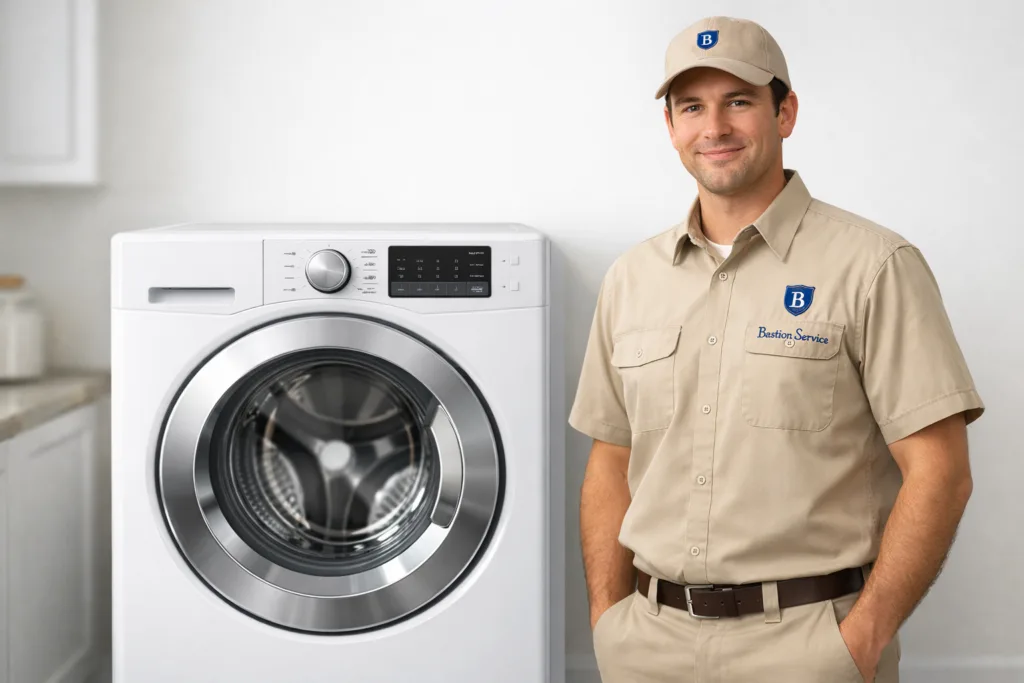
Washer symptoms often overlap, which is why the details matter. A GE washer that stops with water in the tub may have a pump problem, a blockage in the drain path, a lid-lock issue that prevents spin, or a control fault that interrupts the cycle at the wrong point. Looking at when the problem happens during the cycle is usually the fastest way to narrow down the cause.
How GE washer problems usually show up in real homes
Most service calls start with one of a few patterns: the machine will not start, it fills but does not wash, it will not drain, it leaks, or it becomes unusually loud. Some issues are constant, while others appear only on certain loads or cycles. That intermittent behavior can still be meaningful, especially when a washer works on small loads but struggles on towels, bedding, or heavier items.
GE washers can develop faults in the inlet valves, pressure sensing system, drain pump, door or lid lock assembly, suspension, motor circuit, or electronic controls. The symptom alone does not confirm which part has failed, but it does point to the right area to test first.
Common GE washer symptoms and what they may indicate
The washer will not start at all
If nothing happens when you press start, the problem may be as simple as a power issue, but it can also involve the lid switch, door lock, control panel, or main control. On many GE models, the washer must confirm that the door or lid is properly secured before it will begin the cycle. A weak latch or failed lock mechanism can make the machine appear dead even when other functions seem normal.
It fills with water but does not agitate, tumble, or spin
When a washer fills and then sits still, the issue often points toward the drive system, motor function, shift mechanism on certain designs, or the control that sends commands to those components. In some cases, the machine is detecting a lock or balance issue and refusing to move into the next phase. Testing matters because the repair can range from a targeted part replacement to a deeper electrical diagnosis.
It will not drain
Standing water at the end of the cycle is one of the most common washer complaints. A clogged pump filter area, restricted hose, failing pump, or control problem can all leave water behind. If the machine hums during drain but water does not move, that often suggests the pump is obstructed or weakening. If it never even attempts to drain, the fault may be elsewhere in the system.
Repeatedly restarting a washer that cannot drain can put extra strain on the pump and leave clothes sitting in dirty water longer than necessary.
It leaks during fill, wash, or drain
Leak timing is one of the most useful clues. A leak that starts as the tub fills may point to an inlet hose, valve, dispenser path, or internal hose issue. A leak that shows up later in the cycle may involve the drain system, pump housing, or door boot on front-load models. Excessive detergent or the wrong detergent type can also contribute to overflow or sudsing-related leaks.
It makes banging, grinding, scraping, or thumping noises
Not every noise means a major repair, but sharp or repeated mechanical sounds should not be ignored. Banging during spin may relate to suspension wear, load balance, or a tub movement problem. Grinding can point to pump obstruction, bearing wear, or another rotating component under stress. Scraping may happen when something is trapped where it should not be, or when a part has shifted out of alignment.
Clothes come out too wet
If laundry is still soaked at the end of the cycle, the washer may not be reaching proper spin speed or fully draining before spin begins. That can happen because of a drain issue, a balance problem, a lid-lock fault, or a control issue that interrupts spin. Households in Venice often notice this first when drying times suddenly get much longer.
Cycles take too long or stop mid-cycle
A washer that runs far longer than usual or pauses repeatedly may be struggling to fill, sense the water level correctly, drain in time, or complete a spin phase. Some models will keep trying to rebalance a load or repeat parts of a cycle when the machine detects a problem. Mid-cycle stopping can also be related to control errors or overheating components.
Signs the problem may be getting worse
Some washer issues stay minor for a while, but others tend to escalate quickly. It is smart to stop and have the machine checked if you notice any of the following:
- Water leaking onto the floor
- Burning smells or repeated breaker trips
- Loud grinding, banging, or metal-on-metal noise
- Standing water after every load
- The door staying locked with laundry trapped inside
- Error codes combined with poor washing or spinning performance
Continuing to run the washer in those conditions can lead to added pump, motor, suspension, or control damage.
What to check before scheduling GE washer repair in Venice
A few quick observations can make the next step easier. You do not need to disassemble anything, but it helps to note what the washer is doing at each stage.
- Does it power on normally?
- Does the lid or door lock?
- Does it fill with the expected amount of water?
- Does the basket move at all during wash or spin?
- Does it drain partially or not at all?
- Is the noise present only during spin?
- Does the leak happen right away or near the end of the cycle?
If the issue is intermittent, even a short description of which cycle was running and what the machine did next can be useful.
Repair or replace: what usually determines the better choice
Many GE washer problems are still worth repairing, especially when the fault is limited to a pump, valve, latch, hose, drain component, or suspension part. The decision becomes more complicated when the washer has multiple developing issues, repeated electronic failures, severe bearing wear, or signs of structural deterioration.
Age matters, but condition matters more. A well-kept washer with one identifiable failure is different from a machine that has been noisy, leaking, and stopping unpredictably for months. The most practical repair plan is based on the exact failed component, the overall state of the appliance, and whether the expected repair restores reliable operation.
Why symptom-based diagnosis matters
Part swapping based on a guess is one of the most expensive ways to handle washer trouble. A machine that will not spin can be misdiagnosed as a motor problem when the real issue is the lock assembly or drain system. A washer that appears to have a fill problem may actually be reacting to incorrect sensing data. Testing the symptom path first is what separates a useful repair recommendation from trial and error.
Residential GE washer service focused on the actual problem
For homeowners in Venice, the goal is not just getting the washer running for one more load. It is finding out why it failed, whether continued use risks more damage, and whether repair makes sense for the household. Bastion Service helps identify the fault pattern, explain what the symptom is pointing to, and recommend the next step based on the machine’s real condition rather than assumption.