





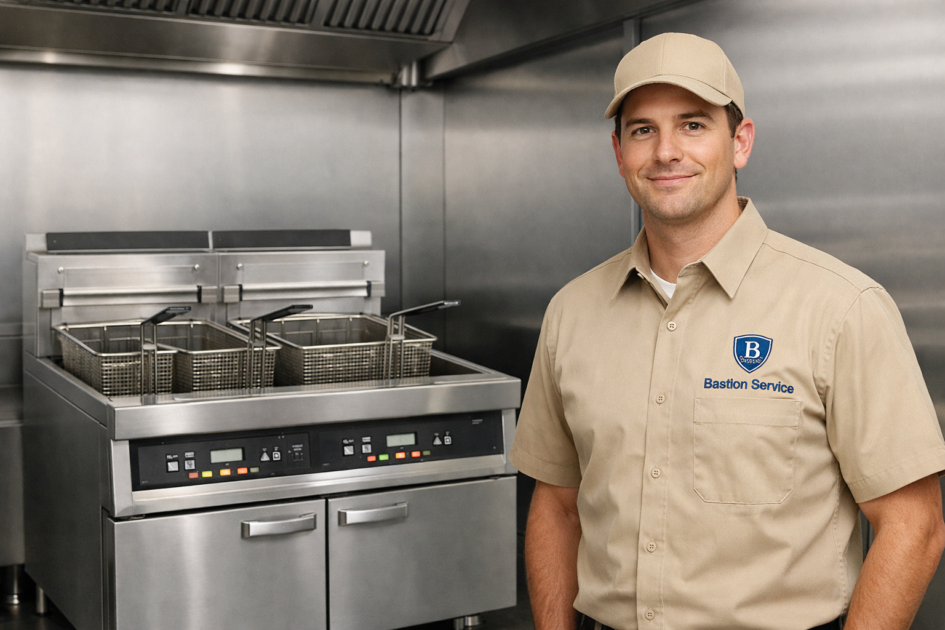
When a Frymaster fryer starts missing temperature, recovering too slowly, or shutting down during a busy shift, the repair decision should be based on the exact failure pattern rather than guesswork. For businesses in Mid-Wilshire, fryer problems affect ticket times, food consistency, staffing pace, and oil use, so service needs to identify what is actually causing the disruption before parts are replaced. Bastion Service handles Frymaster fryer issues with symptom-based troubleshooting, repair planning, and scheduling that reflects the unit’s role in daily kitchen operations.
Related commercial service paths in Mid-Wilshire include Frymaster Commercial Repair in Mid-Wilshire, Commercial Fryer Repair in Mid-Wilshire, and Pitco Fryer Repair in Mid-Wilshire.
Why Frymaster fryer problems need symptom-based diagnosis
Several different faults can produce similar results at the fryer. A unit that is not heating properly may have an ignition issue, a gas supply problem, a temperature sensing fault, a control failure, or a high-limit condition. A fryer that seems to work at startup but loses performance later in the shift may point to intermittent electrical faults, burner issues, or heat-response problems that only appear under load.
That is why a useful service visit should answer a few practical questions:
- Is the fryer failing to generate heat, or failing to regulate it correctly?
- Is the problem constant, or does it appear only after the oil is hot and production increases?
- Are the controls reporting a real component failure, or only a related operating condition?
- Can the unit remain in limited use, or is continued operation likely to create a larger repair?
Getting those answers early helps reduce repeat downtime and avoids replacing parts that are not actually causing the issue.
Common Frymaster fryer symptoms and what they usually mean
Not heating or failing to reach set temperature
If the fryer powers on but never gets the oil up to the programmed temperature, the fault may involve ignition components, gas flow, flame sensing, the control board, temperature probes, wiring, or a tripped safety condition. In some cases the fryer heats partway and then stops climbing, which can be especially frustrating because it looks functional while still slowing production.
For a kitchen team, this often shows up as longer cook times, inconsistent browning, or staff trying to compensate by changing batch timing. Those workarounds usually reduce consistency and can hide a worsening mechanical or control problem.
Slow recovery between batches
Recovery issues are one of the most important fryer complaints because they directly affect throughput. If oil temperature drops too far after each batch and takes too long to recover, the fryer may be dealing with burner performance problems, weak heating response, sensor drift, control issues, airflow restrictions, or maintenance-related conditions affecting heat transfer.
Slow recovery is not just an annoyance. It can create production bottlenecks during peak periods and push staff to change loading patterns to keep up.
Oil temperature swings and uneven cooking results
When food starts coming out too dark, too light, or inconsistent from one batch to the next, the fryer may not be controlling oil temperature accurately. This can point to problems with sensing, calibration, control response, or heating system behavior. Large swings are especially important because they affect both product quality and oil life.
If the fryer overshoots or undershoots repeatedly, the issue should be addressed before it begins affecting every shift in the same way.
Ignition failure, lockout, or intermittent startup
A Frymaster fryer that clicks, attempts to ignite, and then locks out may have issues related to ignition hardware, flame proving, gas train components, controls, or safety circuits. Intermittent startup problems can be harder to catch because the fryer may seem normal during one test and then fail again under actual cooking demand.
Repeated resets are a sign that the root issue still needs to be found. If staff members are restarting the unit throughout the day, the fryer is already beyond a minor inconvenience.
Unexpected shutdowns during operation
If the fryer heats normally and then shuts down mid-shift, the cause may involve overheating protection, unstable sensing, control faults, electrical interruption, or a component that fails once it reaches operating temperature. This is one of the more disruptive symptom patterns because it can create uncertainty about whether the fryer is safe to keep using between shutdowns.
Shutdowns that appear random often become easier to identify once the service call focuses on exactly when the unit drops out and what the fryer was doing immediately beforehand.
Oil leaks, drain valve issues, or filtration-related problems
Oil where it should not be, slow draining, difficult filtration cycles, or recurring mess around valves and fittings should be checked promptly. Leaks and drainage faults can affect sanitation, staff safety, cleanup time, and nearby components. They also tend to worsen if the fryer continues operating with worn seals, damaged fittings, or unresolved filtration issues.
Even when the fryer still heats, oil management problems can make the unit less practical to use and more expensive to keep in service.
Error codes and control panel faults
Display alerts and fault codes are helpful starting points, but they are not complete diagnoses by themselves. A code may indicate a failed circuit, an out-of-range reading, or an operating condition created by another component. Good repair work confirms the code against testing and actual performance so the service decision is based on evidence, not assumptions.
Why continued use can increase downtime
Some fryer issues stay relatively stable for a short period, but many get worse when the unit is pushed through additional shifts. A fryer with unstable temperature control can waste oil and reduce food consistency. An ignition problem can become a full no-heat failure without much warning. A small leak can spread into a cleanup and safety problem. Repeated lockouts can also put more strain on staff workflow because the fryer becomes unreliable even before it becomes completely inoperable.
For managers in Mid-Wilshire, the key question is whether the fryer is still supporting production normally. If the answer is no, delaying service often means a larger interruption later.
How to evaluate repair versus replacement
Not every major fryer symptom means the unit should be replaced. In many cases, repair is the right choice when the problem is limited to a specific component group and the rest of the fryer remains in solid condition. On the other hand, replacement may deserve consideration when the fryer has a long pattern of shutdowns, multiple failing systems, corrosion, repeat control issues, or ongoing service history without stable results.
A useful repair assessment should consider:
- Age and overall condition of the fryer
- Whether the current fault is isolated or part of a recurring pattern
- Condition of burners, controls, sensors, valves, and related systems
- Impact of downtime on kitchen output
- Likelihood that the repair will restore reliable operation rather than only short-term function
This kind of evaluation helps operators make a business decision, not just a parts decision.
What to note before scheduling fryer repair
When a service call is being scheduled, a few details can make diagnosis faster and more accurate. It helps to note whether the fryer fails at startup or after it has been running, whether the oil temperature seems low or unstable, whether any error messages are appearing, and whether the problem affects every shift or only heavy production periods.
Other useful observations include:
- Whether the fryer still powers on
- Whether burners ignite and then drop out
- How long recovery now takes compared with normal operation
- Whether staff have noticed unusual smells, sounds, or repeated resets
- Whether leaks, drainage problems, or filtration issues are also present
Those details help connect the symptom pattern to the likely fault path and can shorten the time needed to determine next steps.
Service expectations for businesses in Mid-Wilshire
Most businesses in Mid-Wilshire do not just need a fryer to turn back on. They need to know whether the unit can return to consistent production, whether it should stay offline until repair is completed, and whether the issue suggests a one-time failure or a broader reliability problem. Fryer service is most helpful when it addresses real operating impact, including output, food quality, staff workflow, and downtime risk.
If your Frymaster fryer is showing no-heat symptoms, ignition trouble, unstable oil temperature, slow recovery, control faults, or shutdowns, the best next step is to schedule repair based on the specific behavior of the unit. A focused service assessment in Mid-Wilshire can clarify the fault, define the repair path, and help you decide how to protect kitchen uptime before a manageable problem turns into a full outage.


