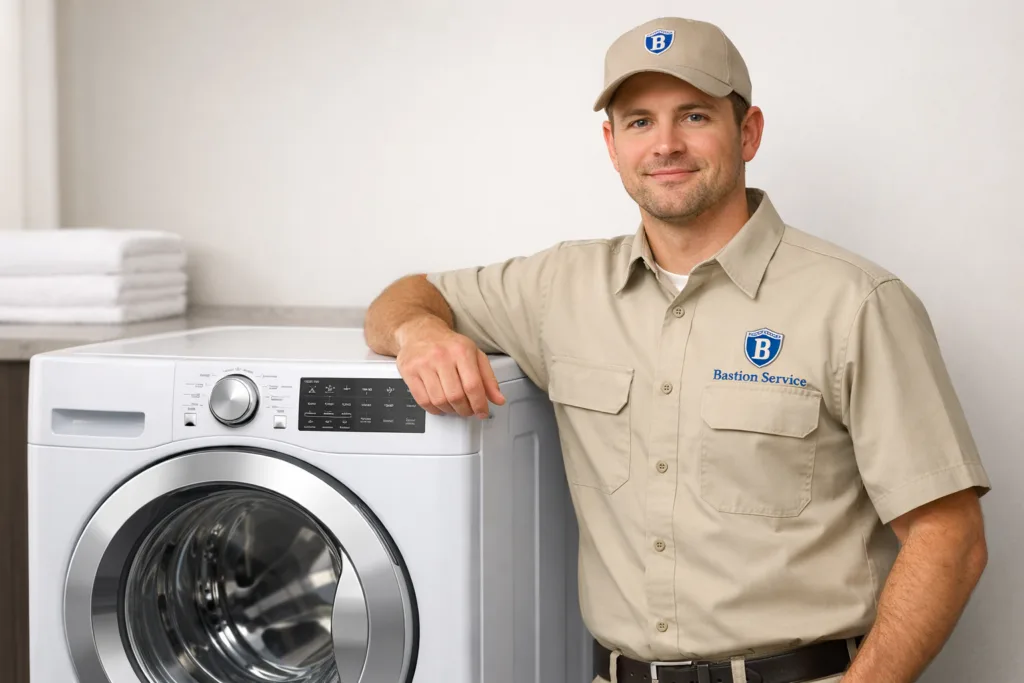
A Frigidaire washer can show the same symptom for several different reasons, which is why the details matter. A machine that stops with water inside may have a drain restriction, a pump issue, a lid or door lock fault, or a control problem that prevents the cycle from finishing. A washer that shakes violently may be overloaded once, but repeated movement can point to worn suspension parts or a tub support problem that should be addressed before more damage occurs.
How Frigidaire washer problems usually show up
Most washer calls begin with a symptom the homeowner can clearly describe. Clothes come out too wet, the tub never fills properly, the unit leaks during rinse, or the cycle gets stuck and will not advance. Those clues help narrow the cause, especially when the problem happens at the same point in every load.
In Fairfax homes, the most disruptive washer issues usually involve one of these patterns:
- The washer will not start at all
- The tub fills but the cycle does not continue
- Water stays in the drum after the cycle ends
- The machine spins poorly or not at all
- There is leaking from the front, rear, or underneath
- The washer makes banging, grinding, or scraping noises
- Clothing comes out with residue, odor, or poor wash results
- Error codes return even after restarting the machine
The useful next step is to match the symptom to the point of failure rather than replace parts based on guesswork.
Common symptoms and what they can mean
Washer will not start
If the controls appear dead or the cycle will not begin, the problem may involve the power supply, door or lid lock system, control panel, wiring, or main control. On many Frigidaire models, the washer will not start if it cannot confirm that the door is securely locked. If lights come on but nothing happens after pressing start, that often points to a fault in the lock circuit or user interface rather than a complete loss of power.
Washer fills slowly or not at all
Fill problems can come from kinked hoses, restricted inlet screens, valve failure, pressure-sensing issues, or a control fault that interrupts water flow. If the washer starts but does not bring in enough water, wash performance usually drops quickly. Clothing may come out with detergent residue, dry patches, or uneven cleaning because the load never had the correct water level for the cycle.
Washer will not drain
Standing water in the tub often points to a blocked drain path, a failing drain pump, or a problem that prevents the washer from moving into the drain portion of the cycle. If the machine hums but does not remove water, the pump may be obstructed or weakened. If it does nothing at all, the issue may be electrical or related to cycle control.
This is one problem that should not be ignored. Continued use can strain the pump, leave clothing trapped in dirty water, and create overflow risk if the machine is repeatedly restarted.
Washer will not spin properly
A spin complaint may be obvious, such as soaking-wet towels at the end of the cycle, or more subtle, such as heavier fabrics staying damp while lighter items seem normal. Causes can include imbalance sensing, suspension wear, drive system problems, motor issues, or a door lock fault that keeps the unit from entering high-speed spin. If the washer drains but leaves laundry unusually wet, the machine may be skipping or reducing spin speed rather than failing completely.
Leaking during the cycle
Leaks can come from more than one location, and where the water appears is often a helpful clue. Front leaks may involve the door boot, dispenser area, or oversudsing. Rear leaks may point to hose connections or inlet issues. Water underneath the washer can suggest pump housing damage, internal hose problems, or a tub-related issue. A leak that happens only during fill, drain, or spin helps identify where the fault is likely to be.
Shaking, banging, or walking across the floor
Not every vibration problem means a failed part. A single bulky load can throw a washer badly off balance. But if a Frigidaire washer repeatedly bangs in spin with normal loads, the machine may have worn suspension components, support issues, or other internal wear. Repeated hard movement can damage the cabinet, strain surrounding components, and increase the chance of a larger repair later.
Heating or cycle temperature problems
When a washer is not reaching the expected wash temperature, the issue may involve the incoming water setup, temperature sensing, control behavior, or model-specific heating components where applicable. Homeowners usually notice this as poor soil removal, detergent not dissolving well, or cycles that seem ineffective even when the machine otherwise runs. If poor cleaning appears together with fill errors or long cycle times, the problem may be part of a broader wash-system issue.
Bad odor, residue, or poor cleaning results
Odor and residue are not always just maintenance concerns. Detergent buildup, trapped moisture, restricted draining, incomplete rinsing, and dispenser problems can all contribute. If the washer has been cleaned but the smell keeps returning, or if clothing comes out dull or streaked, the machine may not be circulating, draining, or rinsing correctly.
Signs the washer should be checked before another load
Some washer issues are inconvenient but manageable for a short time. Others should be treated as stop-use problems. If the machine is leaking, smells hot, makes grinding noises, or repeatedly stops mid-cycle, it is better to pause normal use than risk a bigger failure.
- Water is pooling on the floor
- The drum does not reach normal spin speed
- The washer trips the breaker
- There is a burning smell during operation
- The machine makes scraping, grinding, or metal-on-metal sounds
- Error codes return after being cleared
- The same cycle keeps stopping at the same point
- Clothes are consistently left soaked or poorly washed
One unusual load does not always mean the machine needs repair. Repeated symptoms with ordinary use usually do.
What affects the repair decision
Whether repair makes sense depends on the exact failure, the washer’s age, and its overall condition. A serviceable issue such as a pump problem, latch failure, hose leak, or valve-related fault is often worth addressing when the rest of the machine is in good shape. The decision gets harder when the washer has several symptoms at once, such as leaking, loud spin noise, and repeated cycle failure, because that can indicate broader wear across multiple systems.
Homeowners in Fairfax are usually trying to answer a few simple questions: Is the problem isolated? Is it likely to get worse fast? And does the repair fit the condition of the appliance? Those questions are easier to answer after the fault is traced to the actual component or system causing the trouble.
Why symptom timing matters
One of the most useful details is when the problem happens. A washer that leaks only while filling points in a different direction than one that leaks while draining. A machine that gets stuck before spin suggests a different fault than one that reaches spin and then becomes noisy. Even details like whether the tub hums, clicks, locks, drains slowly, or stops silently can change the likely diagnosis.
If you are deciding whether to schedule service, note these details:
- Does the problem happen on every cycle or only sometimes?
- Does it fail during fill, wash, drain, rinse, or spin?
- Are there any displayed error codes?
- Is the drum full of water when the cycle stops?
- Do certain load sizes make the issue worse?
- Is there any unusual odor, noise, or heat?
That symptom pattern often tells more than the general complaint alone.
Household-focused Frigidaire washer service in Fairfax
Washer trouble affects the daily routine quickly, especially when laundry starts backing up after just a day or two. For residential Frigidaire washer repair in Fairfax, the goal is to identify what is actually failing, whether the machine can be used safely in the meantime, and whether repair is the sensible next step for that unit. When the symptom is not draining, poor wash results, leaking, fill trouble, heating concerns, or a cycle that will not complete, the best outcome usually starts with testing the likely failure points tied to that specific behavior.
That approach helps homeowners make a workable decision without overreacting to a minor issue or overlooking a problem that can worsen with continued use.