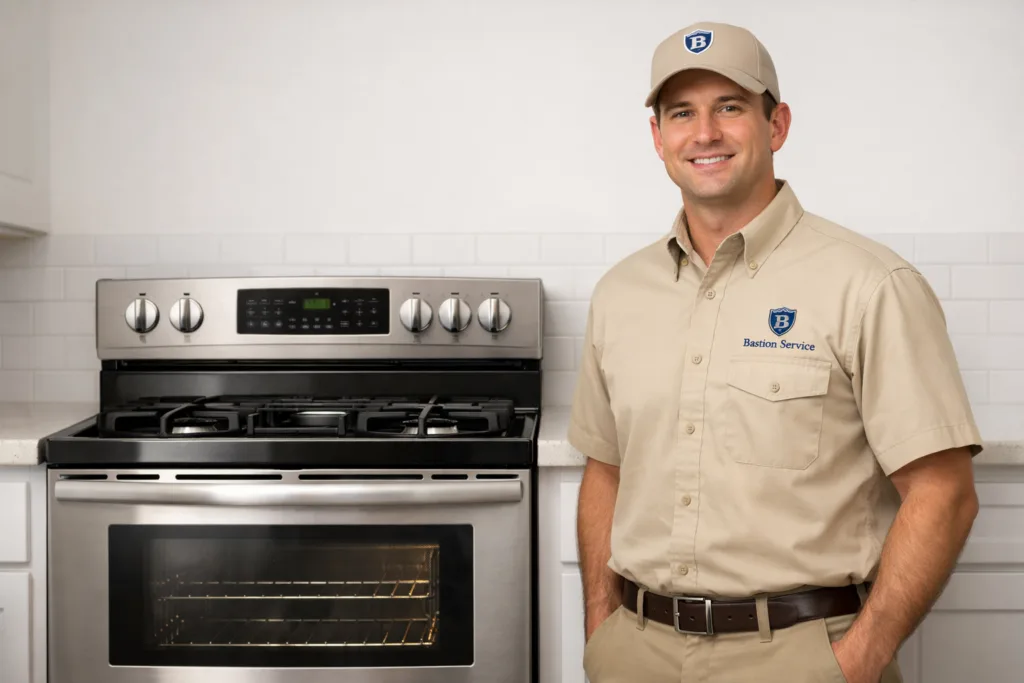
Cooking problems usually show up before an oven fails completely. A Frigidaire oven may begin taking too long to preheat, bake unevenly from rack to rack, or miss the selected temperature by enough to affect everyday meals. Looking closely at the symptom pattern helps narrow the issue faster and makes it easier to judge whether repair is the sensible next step.
Common Frigidaire oven problems in Beverly Hills homes
Frigidaire ovens in residential kitchens can develop both obvious and subtle faults. Some stop heating altogether, while others still run but no longer cook predictably. In Beverly Hills homes, the most common complaints tend to involve heat production, temperature control, door-lock behavior, and electronic response.
An oven that appears completely dead can be related to incoming power, a failed control, wiring damage, or a safety-related interruption. If the display is on but bake or broil will not start, the problem is often further inside the heating system. Electric models may have a failed bake element, weakened broil element, damaged connection, or relay problem. Gas models often point toward an igniter that glows but no longer draws enough current to open the gas valve reliably.
There are also cases where the oven still works, but performance keeps slipping. Recipes need extra time, cookies brown unevenly, casseroles stay cold in the middle, or the oven overshoots the set temperature and burns food around the edges. Those symptoms usually suggest a sensor, control, element, igniter, or airflow-related issue rather than a simple user-setting problem.
What specific symptoms can mean
Oven not heating
If the oven will not heat in bake mode, the failure may be different from one that affects broil mode. That distinction matters. When bake fails but broil still works, diagnosis often centers on the bake circuit, element, or related control output. When both functions fail, the cause may involve power supply, the electronic control, wiring, or a broader interruption.
For gas Frigidaire ovens, a weak igniter is one of the most common causes of no-heat or delayed-heat complaints. Homeowners may hear clicking, notice a glow without ignition, or find that the oven starts only sometimes. That kind of intermittent behavior often gets worse over time.
Slow preheating
Slow preheat is easy to live with for a while, but it usually means something is no longer operating at full strength. Electric ovens may have an element that is partially failing even if it still glows. Gas ovens may have an igniter that is too weak to ignite efficiently. A drifting temperature sensor or control problem can also make the oven appear slower than it really is because the temperature reading is inaccurate.
If preheat time has gradually stretched from normal to frustrating, it is worth having checked before the oven stops reaching cooking temperature altogether.
Uneven baking and temperature swings
Uneven results are often a sign that the oven is cycling heat incorrectly. Food may cook faster on the top rack, brown only on one side, or require frequent pan rotation when that was not necessary before. In other cases, the oven runs too hot for one cycle and too cool for the next.
Possible causes include:
- Temperature sensor readings that are out of range
- Heating elements that are no longer producing consistent output
- Control-board faults affecting cycling patterns
- Calibration settings that need review after the underlying fault is addressed
- Door seal or closure issues allowing heat loss
When the problem is temperature instability rather than total heat loss, good symptom notes can be very helpful. Examples include whether the oven runs hot only during preheat, whether broil seems stronger than bake, or whether the issue is worse during longer cooking cycles.
Control panel, error code, and start-up issues
If the display flashes, buttons respond intermittently, settings reset on their own, or the oven beeps without completing a cycle, the issue may involve the touch interface, control board, or communication between components. Some electronic faults are constant, while others appear only after the oven has warmed up.
Error codes can be useful, but they do not always point to a single failed part. A code may indicate an overheat condition, sensor circuit problem, door-lock fault, or control communication issue. The code is a clue, not always a final diagnosis.
Door lock and self-clean problems
Frigidaire oven door-lock complaints often appear around self-clean use, but not always. The door may remain locked after the cycle ends, refuse to lock when self-clean is selected, or display a lock-related fault even during normal cooking. Problems in this area can involve the latch motor, switch, control logic, or alignment within the lock assembly.
Forcing the door or repeatedly cycling power in hopes of releasing a stuck lock can create additional stress on the mechanism. If the oven is locked shut or will not return to normal operation after a clean cycle, a proper inspection is usually the safest approach.
Why diagnosis matters before replacing parts
Several different failures can create the same outward symptom. An oven that will not heat might need an igniter, but it could also have a sensor problem, control issue, wiring failure, or power-supply fault. Replacing the most likely part without testing can lead to extra cost and no real fix.
This matters even more when the complaint is inconsistent cooking rather than total failure. Temperature problems can come from more than one source, and two small faults can overlap enough to make the oven seem unpredictable. A good service visit should sort out what is actually failing, what is still functioning properly, and whether the problem appears isolated or part of broader wear.
Signs the oven should not keep being used
Some problems are inconvenient. Others can become unsafe if ignored. Stop using the oven and arrange service if you notice any of the following:
- Burning smells that do not clear quickly after normal use
- Sparking or visible arcing
- Repeated breaker trips
- The oven overheating far beyond the set temperature
- The appliance shutting off mid-cycle with signs of electrical stress
- A persistent gas odor on a gas model
With gas models, any strong or ongoing gas smell should be treated as a safety issue first. Avoid continued operation until the source is identified and the appliance is considered safe to use again.
Repair versus replacement for a Frigidaire oven
Many Frigidaire oven problems are still worthwhile to repair when the fault is limited to one serviceable component. That often includes items such as an igniter, heating element, sensor, latch assembly, or certain control-related parts. If the oven has otherwise been performing well and the cabinet, door, and interior are in solid condition, repair is often the more reasonable path.
Replacement becomes a stronger consideration when there are multiple active failures, recurring electrical problems, severe wiring damage, major control failure combined with other wear, or a history of repeat repairs without lasting improvement. The decision usually comes down to the age and condition of the oven, the scope of the failure, and how dependable the unit has been in recent months.
How to describe the problem before service
Homeowners can make troubleshooting easier by noting a few practical details before the visit. Helpful observations include:
- Whether bake, broil, or both are affected
- How long preheat currently takes compared with normal
- Whether the oven runs hot, cold, or fluctuates
- Any error code shown on the display
- Whether the issue started suddenly or gradually
- Whether the problem began after self-clean, a power interruption, or a breaker trip
Those details can help separate a heating problem from a sensing problem or an electronic control issue, especially when the oven still works part of the time.
What a service visit should clarify
A productive oven repair appointment should identify the failed system, explain whether the appliance is safe to use, and outline the repair path in straightforward terms. For a household in Beverly Hills, that means understanding not just what part has failed, but whether the oven is likely to return to stable everyday cooking after the repair is completed.
When the symptom is matched to the actual fault, homeowners can make a better decision about timing, cost, and whether restoring the oven makes sense. That is especially useful for ovens that have not stopped working entirely but have become unreliable enough to affect daily use.