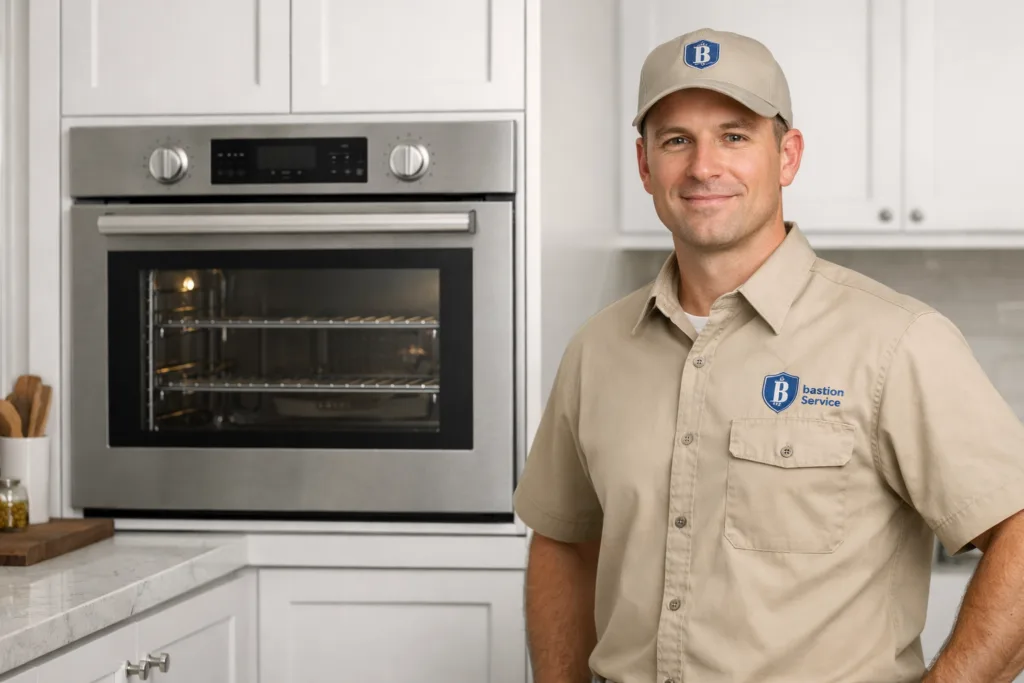
Oven problems usually become obvious in the middle of normal cooking. A casserole takes far too long, cookies brown unevenly, broil stops working, or the control panel responds inconsistently. On a Blomberg oven, those symptoms can come from several different components, so the most efficient repair path starts by matching the failure pattern to the likely cause instead of swapping parts at random.
Common Blomberg oven problems seen in Beverly Hills homes
Most residential oven calls fall into a few recognizable categories. The way the problem shows up often says a lot about where to look first, especially when the issue has been getting gradually worse rather than failing all at once.
Not heating or taking too long to preheat
If the oven powers on but does not build heat normally, likely causes include a weak bake element, a failing igniter on gas models, a sensor reading incorrectly, or a control issue that is not sending power at the right time. Slow preheat is easy to ignore at first, but it often signals a component that is degrading and may stop working completely.
Signs this problem is developing include:
- Preheat times getting longer from week to week
- Food staying pale or undercooked at normal settings
- The oven appearing hot without reaching the selected temperature
- Broil working while bake does not, or the reverse
Uneven baking and temperature swings
When one rack cooks faster than another, the back of the oven runs hotter, or food burns before the center is done, temperature regulation is often the real issue. That can involve the sensor, control board, heating circuit, or airflow inside the cavity. In day-to-day use, this usually shows up as recipes that suddenly stop turning out the way they used to.
Temperature inconsistency can also look like overcorrection. The oven may overshoot the set point, cool off too much, then heat aggressively again. That cycling pattern leads to unstable baking results and makes timing unreliable.
Control panel or display problems
A blank display, partial response from the keypad, random beeping, or settings that will not hold can point to a user interface fault, wiring problem, or electronic control failure. Sometimes the oven itself is still capable of heating, but the controls cannot start or manage a cycle correctly. In other cases, the display works while heating functions do not, which usually means the fault is deeper than the touchpad alone.
Door, latch, or shutdown issues
If the door does not close securely, heat can escape and cooking performance drops quickly. A failing latch or alignment problem may also affect self-clean functions or trigger lock-related errors. Sudden shutdowns during baking can be tied to overheating protection, loose connections, or controls that are no longer handling the cycle correctly.
What specific symptoms often mean
Homeowners can save time by paying attention to the exact behavior of the oven, not just the general complaint. Small details often separate one repair path from another.
The oven is on, but food is still undercooked
This usually suggests the oven is heating weakly or reading temperature incorrectly. The cavity may feel warm enough to seem functional, but not hot enough to cook properly. That difference matters because a unit with partial heat often points to a single failed component rather than a total system failure.
The oven burns the bottom of food
Bottom burning often means the bake system is not cycling properly or heat is being concentrated unevenly. If this starts happening with recipes that previously baked well, it is a strong sign that the oven is no longer regulating temperature the way it should.
The oven shuts off before cooking is finished
Mid-cycle shutdowns should not be dismissed as a one-time glitch. Repeated interruptions can indicate overheating, a control fault, or an unstable electrical connection. If the oven must be restarted repeatedly, continued use may increase the chance of a larger failure.
The oven will not start at all
When there is no heat and little or no response from the controls, the issue may involve incoming power, the control assembly, a safety circuit, or an internal wiring problem. A completely dead oven needs a different diagnostic approach than one that turns on but fails to cook correctly.
When to stop using the oven
Some symptoms are frustrating but not immediately hazardous. Others mean it is better to stop using the appliance until it has been checked. You should avoid regular use if the oven is:
- Overheating or running far hotter than the set temperature
- Tripping the breaker
- Sparking or showing signs of electrical damage
- Failing to ignite properly on a gas model
- Shutting off unpredictably during operation
- Showing repeated error codes tied to heat or control faults
If there is a noticeable gas odor around a gas oven, stop using it immediately and address the safety concern first before arranging appliance service.
Repair or replace: how homeowners usually decide
Many Blomberg oven repairs are worthwhile when the problem is isolated to a sensor, igniter, heating element, latch, or a single control-related issue. Repair becomes less attractive when the oven has multiple major failures, long-term reliability concerns, or a repair cost that does not match the condition of the appliance.
A useful decision usually comes down to a few factors:
- Whether the failure is limited or part of a larger pattern
- The overall condition of the oven cavity, door, racks, and controls
- How often the unit has needed service recently
- Whether the repair is likely to restore normal daily cooking
For many households in Beverly Hills, the real question is not just whether the oven can be repaired, but whether the repair returns consistent, trustworthy performance for everyday meals.
What to have ready before scheduling service
A few details can make the appointment more productive. If available, note the model number and write down the exact symptom pattern. It helps to know whether the problem affects bake, broil, preheat, the display, or only certain cycles. If an error code appears, record it before resetting power. If the issue is intermittent, mention when it happens most often, such as during preheat, after the oven has been running for twenty minutes, or only at higher temperatures.
That kind of information often narrows the likely cause quickly and reduces guesswork.
A practical service visit should answer the important questions
Good oven service should identify what failed, explain whether the appliance should be used before repair, and clarify whether the recommended fix makes sense for the condition of the unit. For a Blomberg oven in Beverly Hills, that matters because the difference between a straightforward component replacement and a larger electronic problem is significant in both cost and downtime.
When the symptom is handled correctly from the start, homeowners are in a much better position to decide whether to move forward with repair and what to expect from the appliance afterward.