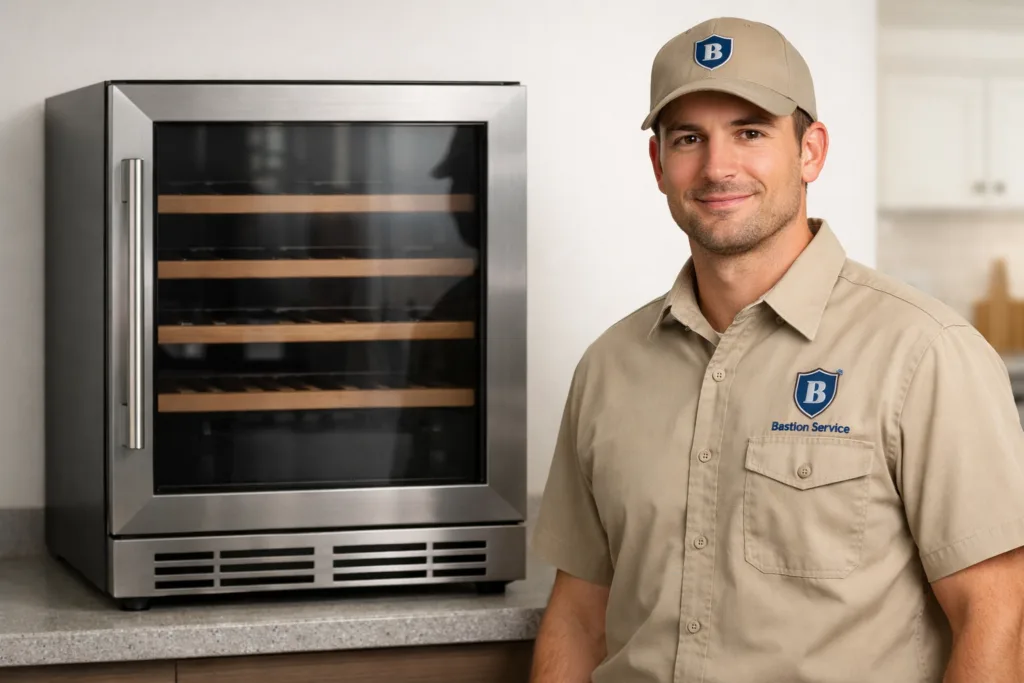
Wine coolers fail in ways that can look similar at first, but the repair path depends on the exact pattern. A cabinet that runs warm all day is different from one that cools overnight and drifts by afternoon. A clicking sound is different from fan scraping, and light condensation is different from active puddling. Looking closely at what changed, when it changed, and how the cooler behaves between cycles is often the fastest way to narrow down the issue.
Common EdgeStar Wine Cooler Problems in Sawtelle Homes
Many EdgeStar wine cooler service calls come down to five symptom groups: not cooling enough, overcooling, constant running, unusual noise, or moisture inside the cabinet. Each symptom can point to several possible causes, which is why replacing parts based on guesswork often leads to repeat problems.
If the cooler is too warm, likely causes can include restricted airflow, dusty condenser coils, a weak evaporator fan, a worn door gasket, sensor or thermostat trouble, or a more serious cooling-system fault. If bottles are getting too cold, the controls may not be regulating temperature correctly. When the unit runs almost nonstop, it may be struggling to remove heat, dealing with air leakage around the door, or receiving inaccurate temperature feedback from a sensor.
Noise is another important clue. Rattling can come from vibration against surrounding surfaces. Buzzing may point to a motor or compressor-related issue. Clicking can be electrical or control related, while scraping often suggests a fan blade hitting ice or a loose housing. Water or condensation usually means warm air is entering the cabinet, drainage is restricted, or temperature stability has already been compromised.
What Specific Symptoms Often Mean
Running Warm
An EdgeStar wine cooler that no longer holds the set temperature may still feel somewhat cool inside, which can delay action. In many cases, homeowners first notice that bottles are not as chilled as expected or that temperature changes from shelf to shelf. That can happen when airflow is blocked, the fan is underperforming, the coils cannot release heat efficiently, or the controls are not reading accurately.
If the cooler has ventilation space around it, the door closes evenly, and the problem continues, the cause is more likely internal than environmental. A unit that stays warm for more than a short period should be checked before repeated temperature swings affect stored wine.
Too Cold or Freezing Bottles
Overcooling is often treated as less urgent than warming, but it still signals a control problem. A faulty thermostat, sensor, or control board can keep the system cooling longer than it should. This may show up as bottles near the back wall becoming excessively cold, frost forming where it normally does not, or the display not matching actual cabinet temperature.
Because wine coolers are designed for steady storage rather than extreme cold, freezing symptoms should not be ignored. Continued operation in that condition can lead to more strain on internal components.
Constant Running
When a wine cooler rarely shuts off, it is usually trying to reach a temperature it cannot maintain. Common reasons include dirty coils, door seal leaks, high heat around the cabinet, poor internal airflow, or declining cooling performance. Constant operation tends to increase wear over time and can make a smaller issue more expensive if left unresolved.
Some continuous running complaints begin after the cooler has been moved, loaded more heavily than usual, or placed too close to walls or cabinetry. If those conditions are not the cause, the unit should be evaluated for a deeper mechanical or control issue.
Frost or Ice Buildup
Frost inside an EdgeStar wine cooler often points to warm air entering where it should not, or to airflow problems that prevent even cooling. A gasket that no longer seals flat can let moisture enter again and again. A fan issue can trap cold air in one area and create ice where circulation should be smooth.
Homeowners may notice the frost first, or they may notice the side effects: reduced space, louder fan noise, inconsistent temperature, or a door that seems harder to close properly. Ice buildup is worth addressing early because it can interfere with normal air movement and place added stress on fan components.
Interior Water or Condensation
Moisture inside the cabinet is not always a drainage problem. It can also be the result of unstable temperatures, frequent warm-air intrusion, or a door that is not sealing completely. Light condensation on some surfaces may seem minor at first, but recurring puddles, damp labels, or water collecting beneath bottles usually mean the cooler is no longer maintaining the environment it should.
If the moisture returns after wiping the cabinet dry, there is likely an underlying cause that will not correct itself without service.
Fan Noise, Clicking, or Vibrations
Not every new sound means a major failure, but sound changes are useful diagnostic clues. Fan scraping may happen when ice develops near the fan path or when a blade loosens. Repeated clicking can point to a relay, start issue, or control fault. A low rattle may be as simple as a panel vibration, but it can also signal a motor beginning to wear.
The most helpful detail is whether the sound happens constantly, only during startup, only when cooling begins, or only after the unit has been running for a while. Those patterns help distinguish a minor mechanical issue from a more significant repair need.
Simple Checks Before Scheduling Service
Before assuming a major failure, a few basic checks can help rule out obvious causes:
- Confirm the temperature setting was not changed accidentally.
- Make sure bottles or shelves are not blocking internal vents.
- Check that the door closes fully and the gasket sits flat all around.
- Look for visible dust buildup around condenser areas if accessible.
- Notice whether the unit is packed tightly enough to restrict airflow.
- Pay attention to whether the problem began after a move, cleaning, or power interruption.
If these checks do not change the behavior, the problem is more likely tied to controls, fans, sensors, drainage, or the cooling system itself.
Why Symptom-Based Diagnosis Matters
Several different failures can produce the same headline complaint. “Not cooling” might be caused by a fan issue, sensor problem, condenser restriction, poor door sealing, or a sealed-system fault. “Leaking water” might be drainage related, but it can also be secondary to unstable cooling or repeated condensation. Without testing the unit’s actual behavior, it is easy to blame the wrong component.
That is why a good visit focuses on how the cooler cycles, whether the fans are running properly, how the controls respond, whether the cabinet seals evenly, and whether the temperature problem is consistent or intermittent. For homeowners in Sawtelle, that approach helps avoid spending money on parts that do not solve the root issue.
When to Schedule EdgeStar Wine Cooler Repair in Sawtelle
Service makes sense when the cooler can no longer maintain stable storage conditions, develops recurring frost, starts making new mechanical sounds, leaks repeatedly, or runs far more than normal. It is also worth scheduling service if the display behaves erratically, if the cabinet feels much warmer than the setting suggests, or if the unit seems to recover only briefly after being unplugged and restarted.
Waiting may not always cause immediate failure, but repeated temperature swings, nonstop cycling, and ongoing moisture problems usually get worse rather than better. If the wine cooler is used regularly in your household, early attention often prevents a smaller issue from becoming a larger one.
Repair or Replace?
The answer depends on the age of the unit, its overall condition, and what actually failed. Repairs are often reasonable when the problem involves accessible parts such as fans, controls, thermostats, sensors, gaskets, or drainage components. Those issues can often be addressed without replacing the entire cooler if the cabinet and cooling performance are otherwise sound.
Replacement becomes more likely when the cooler has major cooling-system trouble, multiple worn components at the same time, or a history of recurring temperature problems. If the cost of restoring reliable operation approaches the value of the appliance, replacement may be the better long-term choice.
A proper assessment should answer three practical questions: what failed, whether continued use risks more damage, and whether the repair is likely to restore stable operation rather than only improve the symptom temporarily.
What Homeowners in Sawtelle Should Pay Attention to
If you are deciding whether to call now or wait, the most useful details to note are the actual cabinet temperature, whether the problem is constant or intermittent, what sounds the unit makes, and whether moisture or frost keeps returning. Even small changes in behavior can help pinpoint the difference between an airflow issue, a control problem, and a more serious cooling fault.
For an EdgeStar wine cooler, the goal is not simply getting the unit to turn back on or feel cool again. The goal is restoring steady, controlled storage conditions so the appliance works the way it is supposed to in daily use.