
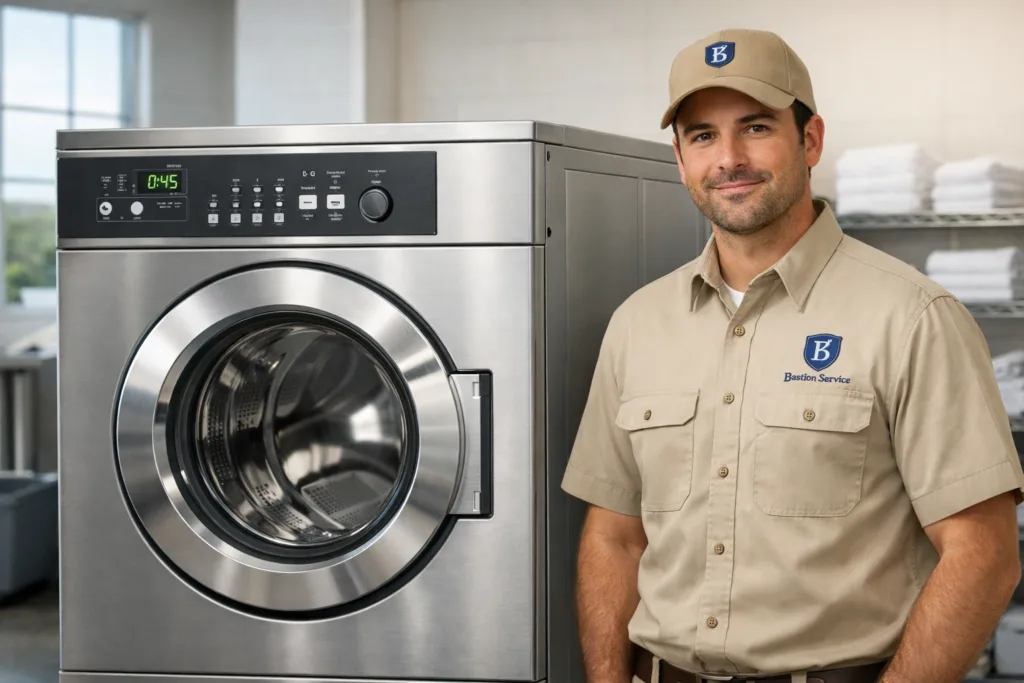




Commercial laundry interruptions affect more than one machine. When a washer falls behind, staff often have to re-sort loads, extend turnaround windows, and manage wet items that cannot move to the next step on schedule. The fastest way to reduce disruption is to match the symptom to the likely failure area instead of treating every no-start, leak, or drain complaint as the same problem.
Related commercial equipment paths in Santa Monica include Speed Queen Washer Repair in Santa Monica and Wascomat Washer Repair in Santa Monica.
Common washer problems in commercial settings
Fill issues are one of the most common service calls. A washer that fills slowly, overfills, or fails to reach the right water level may have a restricted inlet, a faulty valve, pressure-sensing trouble, or a control problem. In a business environment, even a partial fill problem matters because it can affect wash quality, chemical dilution, and cycle timing across the day.
Drain complaints are just as disruptive. When water stays in the drum, the machine stops before spin, or loads come out saturated, the cause may be a blocked drain path, a failing pump, a sensor fault, or an interruption in the control sequence. If loads are consistently finishing too wet and the bottleneck continues after extraction, Commercial Dryer Repair in Santa Monica may be the better service path for the second half of the laundry workflow.
Leaks require careful observation because the water source matters. Water at the front of the machine may suggest a door boot or seal issue, while water underneath or behind the cabinet can point to hoses, pump components, tub problems, or connection failures. In commercial use, even a small recurring leak can create slip risk, damage surrounding surfaces, and lead to corrosion or electrical concerns if left unresolved.
Symptoms that help narrow the cause
A washer that will not start at all may have a power supply issue, door or lid lock failure, user interface problem, or control fault. If it starts but stops mid-cycle, technicians often look at lock assemblies, drain performance, water level sensing, or boards that are losing the proper sequence. These symptoms can look similar from the outside, but the repair path can be very different once testing begins.
Spin problems usually show up as repeated off-balance stops, loud movement, poor extraction, or loads that remain unusually heavy after the cycle. Possible causes include worn suspension components, drive system wear, basket or bearing issues, flooring instability, or loading patterns that repeatedly exceed what the machine can correct on its own. In commercial environments, poor extraction also slows downstream drying and cuts into throughput.
Unusual noise is another important clue. Grinding, scraping, knocking, or humming sounds can signal mechanical wear, foreign objects, pump problems, or motor-related issues. The point in the cycle when the sound occurs often matters as much as the sound itself, whether it happens during fill, wash action, drain, or high-speed spin.
Why diagnosis matters for business uptime
Replacing parts based only on a visible symptom often leads to repeat downtime. A machine that does not drain may appear to need only a pump, yet the actual fault may be in sensing, controls, or an intermittent lock problem that prevents the cycle from advancing. A structured diagnosis helps identify the failed component, checks for secondary damage, and keeps businesses from spending money on the wrong repair.
This is especially important for operations running multiple loads per day. One underperforming washer can shift work to other units, increase wear across the room, and leave staff chasing delays instead of maintaining a predictable process. In Santa Monica, that can affect daily scheduling, labor planning, and customer-facing timelines if laundry supports core operations.
When continued use can make the repair worse
Some machines should be taken out of rotation quickly. Major leaks, repeated drain failures, strong burning odors, violent vibration, or a drum that will not reach proper spin speed can all lead to larger failures if the washer is pushed through more cycles. What begins as a serviceable component problem can become damage to adjacent parts when the machine continues operating under strain.
Intermittent failures are also worth addressing early. A washer that only occasionally stops mid-cycle or unlocks late may still be processing some loads, but those partial failures tend to become more frequent under commercial demand. Early service is often less disruptive than waiting for a full outage during a busy period.
Repair versus replacement decisions
Not every commercial washer issue points to replacement. If the machine still matches the site’s capacity needs and the failure is limited to a repairable component, repair is often the practical choice. Replacement becomes more likely when breakdowns are recurring, major assemblies are failing, parts support is poor, or the washer no longer fits the workload expected of it.
A useful decision usually considers the age of the unit, service history, severity of the current fault, and the business cost of another interruption. For many operators, the best next step is not guessing which option is cheaper in theory, but confirming the actual condition of the machine and whether the current problem is isolated or part of broader wear.
What to note before service
It helps to record when the symptom appears, whether every load is affected, whether the machine shows error codes, and whether the issue began suddenly or worsened over time. Staff should also note if the problem is tied to fill, agitation, drain, spin, leaks, or specific cycle selections. That kind of detail makes troubleshooting more efficient and supports a faster, more accurate repair recommendation.


