
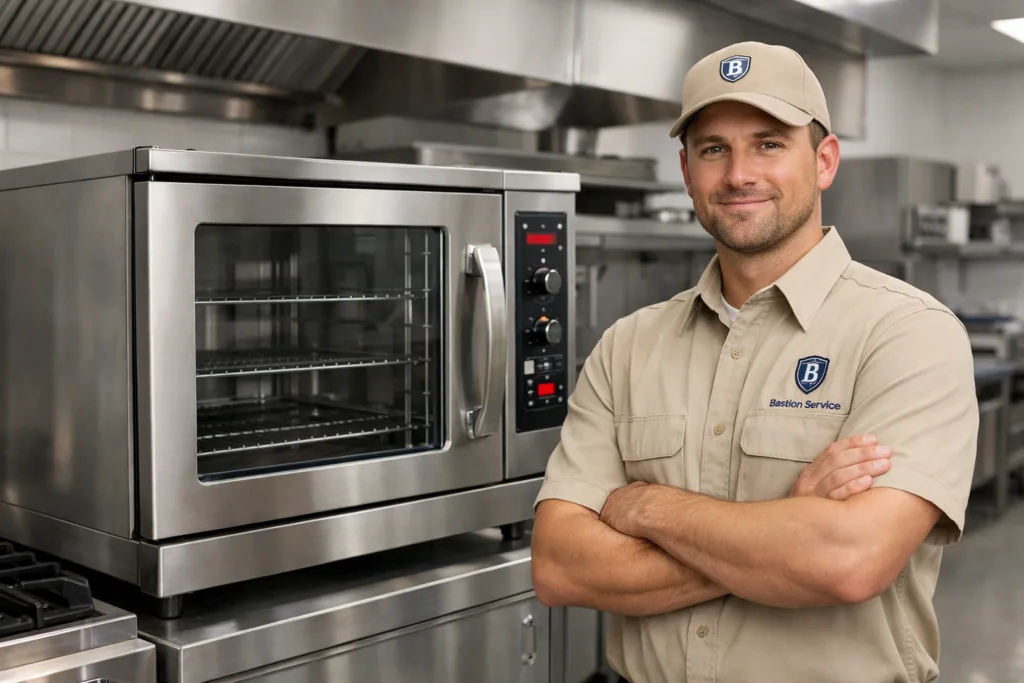







Commercial oven problems can disrupt prep schedules, slow ticket times, and make food quality harder to control. When heat output changes, preheat drags, or batches stop cooking evenly, the most useful next step is identifying whether the failure involves ignition, heating components, temperature sensing, airflow, controls, or incoming power.
Related commercial equipment paths in Palms include Blodgett Oven Repair in Palms and Southbend Oven Repair in Palms.
Common oven symptoms in busy kitchens
Not every oven failure looks the same in daily operation. Some units stop heating entirely, while others still produce heat but fail to hold the correct temperature. That difference matters because a complete no-heat condition may point to an igniter, element, safety cutoff, relay, contactor, or supply issue, while temperature drift often suggests a sensor, calibration, circulation, or control problem.
Uneven baking is another frequent complaint. Burned corners, pale centers, inconsistent browning, and rack-to-rack variation can come from weak convection airflow, worn door gaskets, damaged interior components, or controls that are no longer regulating heat accurately. In a commercial setting, those symptoms usually show up first as waste, re-fires, and slower output rather than a total shutdown.
Slow preheat can be just as disruptive as complete failure. If the oven eventually reaches set temperature but takes much longer than normal, the issue may involve a weak igniter, deteriorating element, partial electrical fault, sensor inaccuracy, or heat loss through seals and doors. When staff begin compensating by starting equipment earlier or extending cook times, the oven is already affecting labor and consistency.
Warning signs that should not be ignored
Some symptoms suggest the problem is progressing beyond routine wear. Repeated shutdowns, breaker trips, unusual clicking or buzzing, flashing control errors, or a unit that needs multiple restart attempts should be addressed before the oven stays in regular rotation. Continued use under those conditions can increase stress on controls, wiring, and adjacent components.
If the symptom involves burner heat and oil temperature recovery instead of enclosed baking performance, Commercial Fryer Repair in Palms may be the better service path. That distinction can help kitchens avoid misdirected service calls when multiple cooking stations are underperforming at the same time.
What a proper diagnosis should determine
An oven symptom is not the same as an oven cause. A no-heat complaint might involve the igniter, valve circuit, element output, thermostat signal, control board, thermal protection, or incoming voltage. A useful diagnosis separates those possibilities rather than replacing parts based only on the first visible failure.
Temperature complaints also need more than a quick check of the display. A technician should consider actual cavity temperature, sensor response, calibration accuracy, heat recovery, fan operation where applicable, and door seal condition. In many commercial kitchens, the complaint is not that the oven never heats, but that it no longer heats predictably under real production load.
For operators in Palms, it also helps to determine whether the issue is isolated to one oven or tied to a broader cooking-line problem. When equipment shares electrical loads, ventilation conditions, or heavy continuous use, related performance issues can appear across more than one station even though each appliance ultimately needs its own diagnosis.
When service should be scheduled
Service should be scheduled promptly when the oven cannot maintain set temperature, cooks unevenly across racks, struggles to ignite, shuts off mid-cycle, or shows visible wear around controls, hinges, seals, wiring, or interior panels. Waiting often increases the cost of downtime before it saves anything on repair.
Operators should also act quickly when the oven still seems usable but results are becoming inconsistent. Commercial kitchens often tolerate gradual decline for too long because the unit technically still runs. In practice, though, extended cook times, staff workarounds, and lost batch consistency are early signs that a repair issue is already affecting performance.
If there is a strong or persistent gas odor, stop using the appliance and follow appropriate safety procedures immediately. Emergency utility or safety response comes before appliance service. If there is repeated clicking without a gas smell, ignition components should still be evaluated before normal operation continues.
Repair or replacement decisions
Repair is often the practical choice when the failure is limited to serviceable parts such as igniters, heating elements, sensors, switches, relays, contactors, fans, thermostats, door hardware, or control-related components that can be tested and replaced individually. In those cases, returning the oven to stable operation may be more efficient than replacing the entire unit.
Replacement becomes more likely when the oven has severe structural deterioration, recurring control failures, major insulation or cavity damage, hard-to-source parts, or a pattern of repeated breakdowns that continues to interrupt daily production. The right decision depends on more than the current symptom; it depends on whether the unit can return to dependable use without becoming an ongoing disruption.
Why symptom patterns matter in commercial settings
Commercial ovens are rarely evaluated in a vacuum. The real impact shows up in missed timing, reduced throughput, inconsistent finished product, and extra staff attention during peak hours. A unit that runs slightly cold, overshoots temperature, or recovers too slowly between cycles may still power on normally while quietly reducing kitchen efficiency.
Looking closely at symptom patterns helps narrow the likely fault. No heat, delayed ignition, hot spots, inaccurate display readings, door heat loss, and intermittent shutdowns each point toward different systems. That is why the most effective service approach is based on testing and confirmation rather than assumptions, especially for businesses in Palms that need cooking equipment to return to predictable operation quickly.


