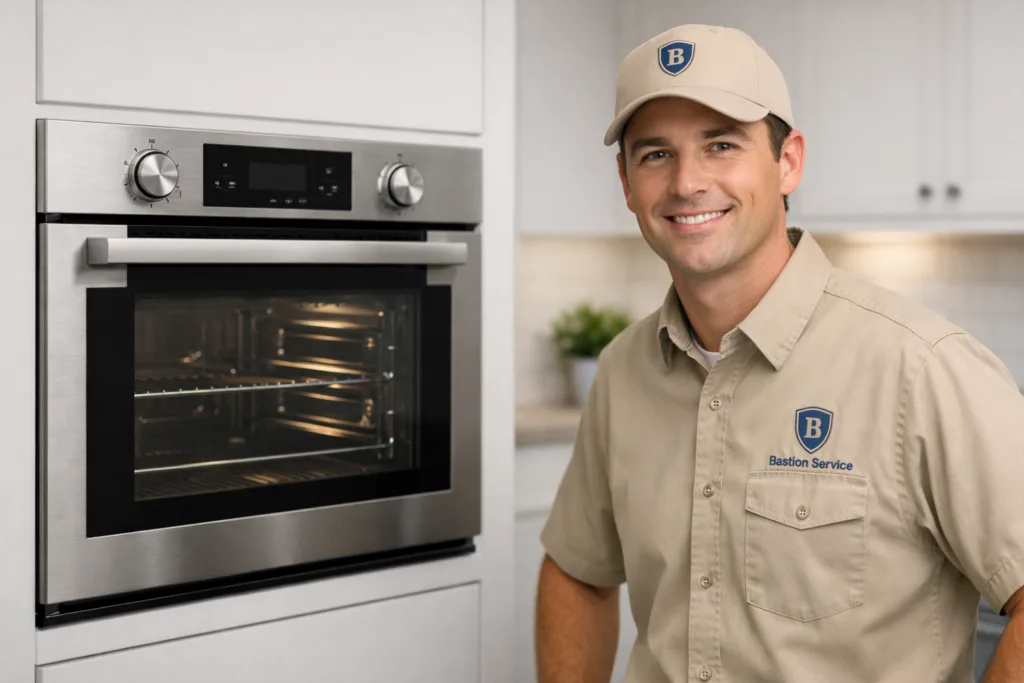
Oven problems rarely stay minor for long. A Blomberg oven that starts taking too long to preheat, browns unevenly, or shuts off during cooking can disrupt everyday meals and make it hard to trust results from one use to the next. The underlying cause may be a heating component, temperature-sensing issue, control fault, door-related problem, or an electrical supply issue inside the unit.
Common Blomberg oven problems homeowners notice first
Most oven failures begin with a pattern rather than a complete breakdown. Paying attention to that pattern helps narrow down what system may be failing and whether continued use could make the repair more involved.
Not heating at all
If the display turns on but the oven cavity stays cold, the fault may involve the bake element, broil element, temperature sensor, control board, relay, or wiring. On some models, the oven can appear to start normally while one critical part never energizes. That is why a unit that looks operational can still fail to produce usable heat.
Slow preheat
When preheat times gradually get longer, homeowners often adapt for a while by starting dinner earlier or adding extra cook time. In many cases, slow preheat points to weak heating output, an element that is only partially functioning, inaccurate temperature feedback, or a control issue that is not cycling heat correctly.
Uneven baking or hot spots
If one side of a tray browns faster than the other, or recipes that used to work suddenly become inconsistent, the oven may be struggling to maintain stable temperature. Convection fan issues, sensor drift, weak elements, and calibration-related faults can all contribute to uneven results. These problems are especially frustrating because the oven still works, just not reliably.
Temperature swings during cooking
An oven that runs too hot, too cool, or fluctuates widely during a cycle can affect everything from roasting to baking. Temperature instability may come from a failing sensor, control board regulation problem, relay issue, or intermittent heating component. When the temperature swings are large enough, food quality drops quickly even if the oven never fully stops.
Control and display issues
Some Blomberg ovens develop problems where the keypad responds inconsistently, the display shows errors, the oven will not begin a cycle, or settings change unpredictably. These symptoms can point to the user interface, electronic control, touch panel, or connections between components. A control issue can mimic a heating problem, so proper testing matters before replacing parts.
Symptoms that often point to specific oven systems
While different faults can produce similar results, certain symptom groups tend to line up with specific parts of the oven.
- Oven will not heat but the panel works: often related to heating elements, relays, sensor faults, or internal wiring.
- Food cooks unevenly: commonly associated with weak heat output, poor temperature regulation, or convection-related issues.
- Oven overheats: may involve a temperature sensor problem or a control that is not cycling heat correctly.
- Door will not close properly: can cause heat loss, longer cook times, and strain on heating components.
- Self-clean problems or locked door issues: often tied to latch assemblies, switches, or control faults.
- Breaker trips during use: may signal a shorted element, damaged wiring, or another electrical fault that should not be ignored.
Door, latch, and self-clean issues
Not every oven problem starts with temperature. A door that does not seal well can let heat escape and create the impression that the oven is weak or slow. If the door is misaligned, the gasket is worn, or the latch system is not operating correctly, cooking performance can drop even when the heating system is still capable of reaching target temperature.
Self-clean cycles can also expose latent problems. Homeowners sometimes notice a Blomberg oven that becomes stuck locked, stops responding, or begins showing errors after a self-clean cycle. High-heat cleaning can stress door latch components, sensors, controls, and wiring connections, especially if another part was already weakening.
Electrical warning signs to take seriously
Some symptoms are more than convenience issues. If the oven gives off a sharp burning smell, sparks, shuts off abruptly, or repeatedly trips the breaker, it is best to stop using it until the cause is checked. Those signs can indicate a short, failing element, damaged terminal, or overheated wiring. Continued use can increase damage and create a safety concern.
A mild odor from residue or recent spill burnoff is different from an electrical smell. The difference is usually noticeable: food residue smells temporary and localized, while electrical burning tends to smell harsher and often returns quickly when the oven heats again.
When service makes sense
Scheduling service is usually worthwhile when the oven no longer reaches temperature, cooking results are inconsistent, preheat has become noticeably slower, the controls are unreliable, or the appliance stops mid-cycle. These are the kinds of problems that often worsen with continued use. A failing element can damage its terminals, an overheating condition can affect nearby components, and repeated breaker trips can point to faults that should be addressed promptly.
In busy households in Manhattan Beach, even a partially working oven can become a daily frustration. If you are adjusting recipes, rotating pans constantly, or second-guessing every baking time, the problem is already affecting normal use enough to justify professional evaluation.
Repair versus replacement
Whether a repair is worthwhile depends on the failed part, the overall condition of the oven, and how cleanly the repair resolves the issue. Many common problems, including heating element failure, sensor issues, door latch faults, and some control-related failures, can be sensible to repair if the rest of the unit is in good shape.
Replacement becomes more likely when there are multiple major failures at once, repeated electronic issues, extensive internal wear, or repair costs that approach the value of replacing the appliance. Age alone does not decide the question. A well-kept oven with one defined fault can still be a good repair candidate, while a newer unit with repeated major control problems may deserve a closer cost comparison.
What to watch for before the oven fails completely
Many homeowners in Manhattan Beach notice warning signs weeks before a full breakdown. The most useful clues include:
- Preheat taking longer than it used to
- Food finishing too early or too late at the same setting
- One rack position cooking differently than before
- The oven clicking on and off abnormally
- Error messages or unresponsive controls
- A door that feels loose, misaligned, or difficult to latch
These symptoms are worth addressing early because they often begin as isolated component failures. Catching the problem before a complete shutdown can reduce inconvenience and may prevent added damage to surrounding parts.
What a diagnosis should accomplish
A useful service visit should determine which system has failed, whether the problem is isolated or part of a larger pattern, and whether repair is a sound investment. For Blomberg oven repair in Manhattan Beach, that means looking beyond the surface symptom and identifying why the oven is not heating, regulating temperature, or operating normally. Once the exact cause is known, it becomes much easier to decide on repair timing and next steps for the household.