
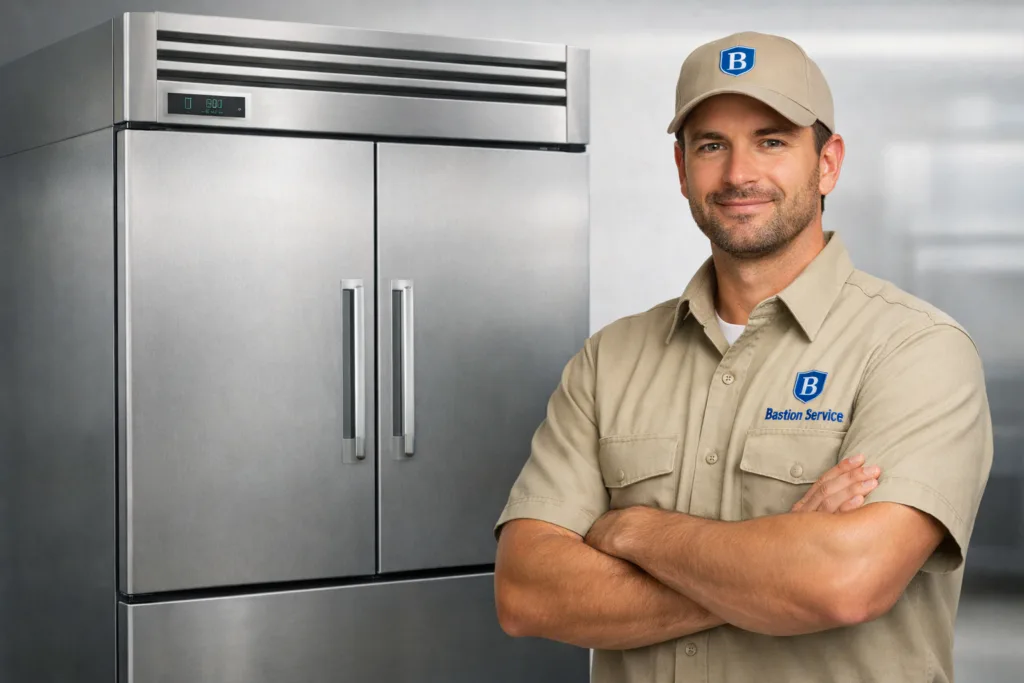




When a Beverage-Air refrigerator starts running warm, icing over, leaking, or short cycling in a West Hollywood business, the best next step is service that identifies the actual failure before more downtime follows. Similar symptoms can come from very different causes, including airflow restrictions, fan problems, bad door seals, control faults, drain issues, or refrigeration-system trouble. Bastion Service handles Beverage-Air refrigerator repair for businesses in West Hollywood with attention to temperature protection, workflow impact, and repair scheduling based on the unit’s real condition.
Related commercial service paths in West Hollywood include Beverage-Air Repair in West Hollywood, Commercial Fridge Repair in West Hollywood, and Beverage-Air Freezer Repair in West Hollywood.
What Beverage-Air refrigerator problems usually mean in day-to-day operation
A refrigerator does not have to stop cooling completely to create a serious business problem. Many units still appear to run while drifting out of range, recovering too slowly after door openings, or developing heavy frost that blocks airflow. In kitchens, prep areas, service stations, and storage rooms, those changes can affect product holding, staff routines, and confidence in the equipment.
Common warning signs include:
- Cabinet temperatures that rise above setpoint or fluctuate through the day
- Fans that sound louder than usual or seem to run continuously
- Ice buildup on interior panels, around the evaporator area, or near the door opening
- Water under the unit or persistent interior condensation
- Doors that do not close cleanly or need to be pushed shut
- Clicking, buzzing, rattling, or signs of compressor strain
These symptoms often start small, but they usually point to a condition that will keep worsening until the underlying cause is corrected.
Why your Beverage-Air refrigerator may not be holding temperature
Temperature complaints are one of the most common reasons businesses schedule refrigerator service. If the cabinet is warm, inconsistent, or slow to recover, the issue may be related to airflow, controls, heat exchange, or door sealing rather than a single obvious failed part.
Airflow problems inside the cabinet
If the evaporator fan is weak, obstructed, or not running correctly, cold air will not circulate as intended. That can create warm zones, product temperature variation, and icing around the coil area. In some cases, staff may notice that one section of the cabinet feels colder than another, or that the refrigerator struggles most during normal business hours.
Dirty coils or poor heat removal
When condenser coils are dirty or the condenser fan is not moving heat away effectively, the refrigeration system has to work harder to maintain temperature. The unit may run for long periods, sound strained, and still fail to hold the target range. This is especially important when a refrigerator has been gradually losing performance rather than failing all at once.
Door gasket and closure issues
A torn gasket, sagging door, worn hinge, or frame alignment problem allows warm air to enter the cabinet. That can lead to temperature swings, moisture buildup, frost, and excessive run time. If staff notice that the door pops open, does not seal evenly, or leaves condensation around the frame, the sealing problem may be central to the cooling complaint.
Sensor or control faults
Some Beverage-Air refrigerators show a set temperature that does not match actual cabinet conditions. A sensor reading incorrectly, a thermostat issue, or a control problem can cause erratic cycling and poor temperature stability. This can look like a cooling failure even when the refrigeration system itself is still operating.
Refrigeration-system defects
Low cooling capacity, slow pull-down, and chronic warm operation can also come from compressor or sealed-system problems. These issues typically need careful testing because they can resemble airflow or control failures at first. If the unit has weak cooling along with nonstop running or poor recovery, deeper system diagnosis may be needed.
Frost buildup, ice accumulation, and what they often indicate
Frost is not just a cosmetic issue. On a Beverage-Air refrigerator, recurring ice can block airflow, reduce usable storage space, and force the system to work harder than it should. If frost keeps coming back after being cleared, the cause has not been solved.
Common reasons include:
- Door seals leaking warm, humid air into the cabinet
- Defrost component problems
- Evaporator fan issues
- Airflow restrictions caused by product loading or internal blockage
- Control faults that affect normal cycling
Heavy ice on the evaporator section often leads to a second symptom: the refrigerator starts warm even though it still sounds like it is running. At that stage, scheduling repair sooner is usually the better move, since continued operation can add stress to the compressor and other components.
Water leaks and condensation should not be ignored
Water under a refrigerator can create more than a cooling concern. In a business setting, it can become a floor safety issue, a sanitation issue, and a sign that moisture is moving where it should not. Interior sweating or pooled water may point to a blocked drain, drainage component problem, cabinet leveling issue, or repeated warm-air infiltration through a bad seal.
Condensation around the door area can also signal that the refrigerator is struggling with closure or insulation-related moisture entry. If staff are wiping up water often or noticing dampness return quickly, service is usually more effective than repeated cleanup and temporary workarounds.
Unusual noise, clicking, buzzing, or nonstop running
A Beverage-Air refrigerator that suddenly sounds different is often giving an early warning. Buzzing may point to a starting or relay issue. Rattling can come from loose panels or vibration around the fan or compressor area. Grinding or fan interference sounds can indicate a motor or blade problem. A unit that runs almost constantly may be compensating for poor coil performance, air leaks, or reduced cooling capacity.
Noise matters because it often shows up before total failure. If the sound change is paired with warm temperatures, frost, or longer run times, the unit should be checked before it progresses into a no-cool condition.
Door and cabinet wear can drive repeat cooling complaints
Many recurring refrigerator problems start at the door. Gaskets flatten over time, hinges wear, and alignment shifts with daily use. The result is a cabinet that loses cold air every cycle, pulls in moisture, and forces the system to run longer to compensate.
Signs that door-related service may be needed include:
- The door does not close on its own
- Staff have to push hard to get a full seal
- Condensation forms around the frame
- Frost appears near the opening
- The gasket is torn, loose, brittle, or uneven
These issues may seem minor at first, but they often sit behind repeated temperature instability and excessive wear on the refrigeration system.
When to schedule service instead of waiting
It is time to schedule repair when the refrigerator is no longer maintaining consistent temperature, when frost or leaks keep returning, when alarms or displayed temperatures do not match actual cabinet conditions, or when the unit shows clear signs of strain. Businesses in West Hollywood often benefit from earlier service because a partial cooling problem can still disrupt inventory handling and staff workflow long before the unit fully fails.
Waiting tends to increase the repair risk. A fan issue can lead to ice buildup. A gasket problem can create compressor overrun. A drain problem can turn into repeated water on the floor. Once staff are adjusting routines around the refrigerator, moving product more often, or checking temperatures manually, the problem is already affecting operations enough to justify service.
Situations where continued use may cause more damage
Some units should not be pushed through normal operation while symptoms are worsening. Continued use is risky when the cabinet is clearly warm, the evaporator area is heavily iced, the refrigerator is leaking significantly, or the compressor sounds strained. Repeated resets, forcing doors shut, or manually clearing ice without fixing the root cause can also make later repair more complicated.
If product protection is uncertain or the refrigerator cannot recover to a stable range, limiting use and arranging diagnosis is often the safer option.
Repair or replacement: how businesses usually weigh the decision
Not every underperforming Beverage-Air refrigerator needs to be replaced. Many problems are repairable when the cabinet itself is in good condition and the failure involves fans, controls, gaskets, drains, relays, sensors, or other serviceable components. In those cases, repair can restore reliable operation without the disruption of changing out equipment.
Replacement becomes a more serious consideration when the refrigerator has major system failure, heavy cabinet wear, repeated breakdown history, or costs that no longer make sense relative to remaining service life. The most useful decision point is not simply whether the unit can be fixed, but whether the repair is likely to restore stable operation in a way that supports the business.
What to expect from a service visit
A productive visit should connect the symptom to the failed part or system, not just treat the most visible effect. That usually means checking actual temperature behavior, door sealing, airflow, fan operation, coil condition, drainage, controls, and other likely causes tied to the complaint. Once the source of the problem is identified, the next step is deciding whether immediate repair, staged repair, or equipment replacement planning makes the most sense.
For businesses in West Hollywood, the goal is straightforward: get the Beverage-Air refrigerator evaluated quickly, understand what is causing the performance issue, and move forward with the repair decision that best limits downtime and protects daily operations.


