
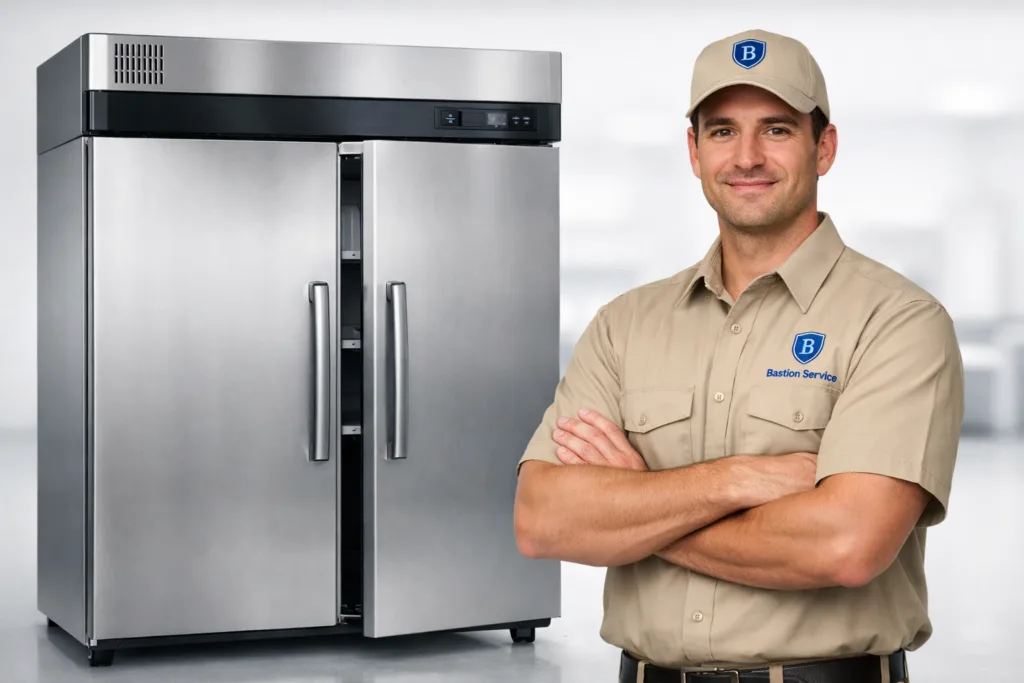




Refrigerator problems in a business setting rarely stay small for long. A Beverage-Air unit that starts running warm, icing up, leaking, or making new noises can disrupt storage routines, prep timing, and product protection the same day. The most useful next step is service that matches the actual symptom pattern, isolates the fault, and helps you decide whether the unit should keep operating, be repaired promptly, or be taken out of use until corrected. Bastion Service provides Beverage-Air refrigerator service in Pico-Robertson with that decision-making process in mind.
Related commercial service paths in Pico-Robertson include Beverage-Air Repair in Pico-Robertson, Commercial Fridge Repair in Pico-Robertson, and Beverage-Air Freezer Repair in Pico-Robertson.
Why a Beverage-Air refrigerator stops performing normally
One symptom can come from several different causes. A warm cabinet does not always mean the same repair as another warm cabinet, and frost buildup does not always point to a single failed part. On Beverage-Air refrigerators, performance issues often involve some combination of airflow restriction, dirty condenser coils, fan motor problems, control or sensor faults, door gasket wear, drainage issues, defrost failure, or sealed-system loss.
That is why symptom-based diagnosis matters. If the wrong part is replaced first, the refrigerator may appear better for a short time while the underlying issue continues to stress the system. For businesses in Pico-Robertson, that can mean repeat downtime, inventory risk, and more disruption than the original problem caused.
Common symptoms and what they often indicate
Not holding temperature
If the cabinet temperature drifts above its normal range, the cause may be restricted condenser airflow, weak evaporator airflow, a faulty temperature control, sensor inaccuracy, refrigerant loss, or poor door sealing. In some cases, the refrigerator still runs constantly but cannot pull down to the set temperature. In others, the unit cycles but never stabilizes.
This symptom should be taken seriously because temperature inconsistency can affect stored product well before the refrigerator stops cooling completely.
Frost or ice buildup inside
Ice on the evaporator cover, back wall, ceiling area, or around the door opening usually points to either moisture entering the cabinet or the unit failing to clear frost during its normal cycle. Worn gaskets, doors not closing properly, fan issues, and defrost component failures are all common reasons.
As frost builds, airflow drops. Once airflow drops, cooling becomes less even and the refrigerator may run longer while doing a worse job of maintaining temperature.
Water leaks
Water on the floor or inside the cabinet can come from a clogged drain, frozen drain line, condensation problem, or ice melt caused by another cooling issue. Leaks are not just housekeeping problems. In kitchens, storage rooms, and service areas, they can create slip hazards and signal a larger refrigeration fault that is already affecting performance.
Running constantly or short cycling
A Beverage-Air refrigerator that rarely shuts off is often compensating for heat load, airflow problems, dirty coils, control issues, or declining refrigeration efficiency. A unit that starts and stops too often may have a thermostat or sensor problem, electrical issue, or compressor-related stress.
Either pattern usually means the equipment is working harder than it should, which can shorten component life if the condition is ignored.
Noisy operation or vibration
Changes in sound matter, especially when they appear alongside weak cooling or frost. Rattling can come from loose panels or mounting points. Grinding or scraping may involve fan blades or motor wear. Buzzing and strain noises can point to compressor or electrical issues. A refrigerator does not need to be completely down to justify service if the operating sound has clearly changed.
Why is my Beverage-Air refrigerator not holding temperature?
This is one of the most common service calls because the symptom has several possible causes. The refrigerator may have poor condenser airflow from coil buildup, evaporator airflow loss from ice or fan trouble, inaccurate sensing, failing controls, a door that is not sealing, or a refrigeration system that is no longer moving heat efficiently.
Temperature loss is also not always uniform. Staff may notice one shelf zone warming faster than another, slow recovery after door openings, or a cabinet that seems acceptable in the morning and warm later in the day. Those details help narrow the diagnosis and often make the difference between a quick correction and a recurring issue.
- Warm product near the door can suggest sealing or frequent-opening problems.
- Uniform warming throughout the cabinet may point more toward airflow, controls, or refrigeration performance.
- Heavy frost combined with warm temperatures often indicates an airflow or defrost-related problem.
- Long run times with weak cooling can signal coil loading, fan failure, or sealed-system decline.
Signs the problem is getting worse
Some refrigerator issues stay stable for a short period, but many become more expensive once the unit continues operating under stress. Warning signs that usually mean the fault is progressing include:
- Temperatures recovering more slowly than usual
- Frost returning soon after being cleared
- Condensation increasing around the doors or cabinet
- New fan noise or intermittent airflow
- The compressor area feeling unusually hot
- Repeated resets, alarms, or restart trouble
- Different sections of the cabinet cooling unevenly
When these patterns appear together, the refrigerator is often doing extra work to compensate for a fault that will not resolve on its own.
When to schedule repair instead of waiting
Prompt service makes sense when the refrigerator is no longer maintaining safe and consistent storage conditions, when water leakage keeps returning, when frost buildup is affecting usable space or airflow, or when the unit is clearly laboring harder than normal. Waiting tends to increase the chance of product loss and may expand the repair from one failed component to several stressed components.
Businesses in Pico-Robertson should also schedule service when the symptom is intermittent. A refrigerator that sometimes cools properly and sometimes does not can be harder on the system than a unit that fails in a more obvious way, because staff may continue relying on it while the underlying fault worsens.
What technicians typically check on a service visit
A proper refrigerator diagnosis is more than confirming that the cabinet feels warm. Service typically focuses on operating conditions, temperature behavior, airflow, frost pattern, fan operation, control response, drain condition, door sealing, and condenser cleanliness. If needed, electrical and refrigeration performance are checked to determine whether the issue is a serviceable component problem or a larger system concern.
This approach helps answer practical questions that matter to a business:
- Is the refrigerator safe to keep using for now?
- Is the fault isolated or part of a broader reliability problem?
- Is the repair likely to restore normal performance?
- Are there conditions that could cause the same failure to return?
Repair or replace?
Many Beverage-Air refrigerator problems are repairable, especially when the issue involves fans, controls, sensors, gaskets, drains, switches, or other accessible components and the cabinet itself remains in solid condition. Repair is often the better choice when the equipment has otherwise been reliable and the current fault is clearly defined.
Replacement becomes a more realistic discussion when cooling problems keep returning, repair history is stacking up, the cabinet condition is declining, or the refrigeration system is facing major cost with no strong expectation of long-term stability. The right decision depends on the severity of the current issue, the age and condition of the unit, and how much downtime your operation can absorb.
How to prepare for refrigerator service
Before the visit, it helps to note the exact behavior of the unit rather than just the end result. Useful details include when the temperature started drifting, whether the cabinet is warm all the time or only during part of the day, where frost appears, whether water is inside or outside the cabinet, and whether new noises happen at startup or during operation.
Staff can also help by avoiding repeated resets and by not forcing doors closed if alignment or gasket problems are visible. Those temporary workarounds can make diagnosis less clear or cause additional wear.
Service focused on uptime and the next step
For a Beverage-Air refrigerator in Pico-Robertson, the goal is not simply to get the unit running again for a few hours. The real value of service is understanding why the problem started, what repair will address it, and whether the refrigerator can return to normal use without creating another interruption. If your unit is running warm, building frost, leaking, short cycling, or showing signs of airflow trouble, scheduling service is the most practical way to reduce downtime and make a sound repair decision.


