
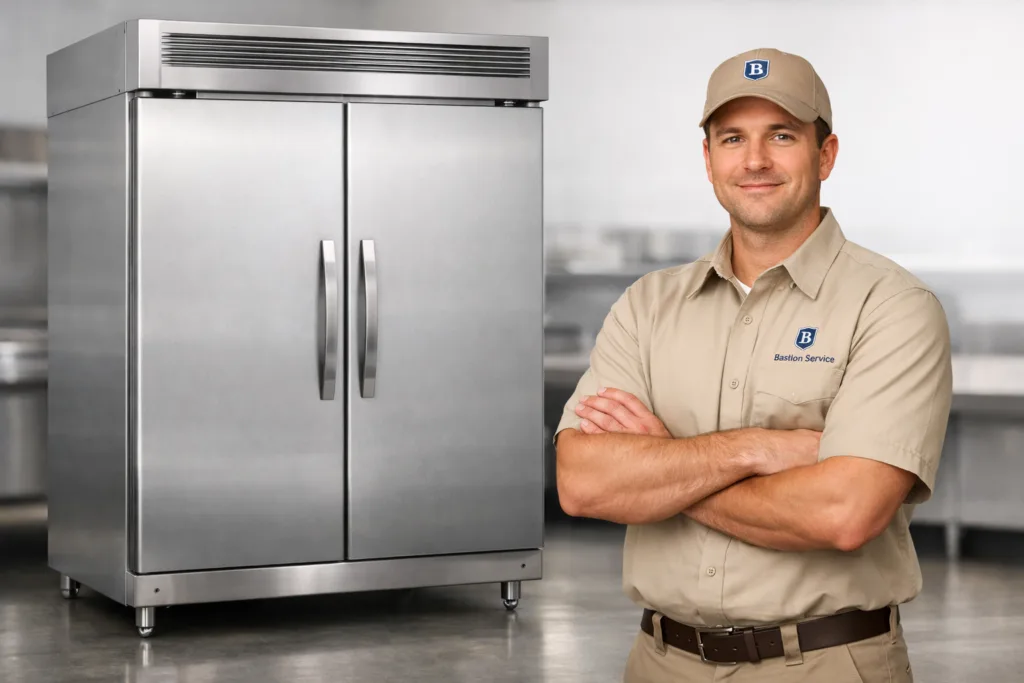







A Beverage-Air freezer that starts running warm, building frost, leaking, or making new noise can disrupt storage plans fast. For businesses in West Los Angeles, the most useful next step is service that matches the actual symptom pattern, because the same freezer can show similar warning signs for very different reasons. Bastion Service handles Beverage-Air freezer repair by focusing first on what the unit is doing now, how it has changed, and whether the problem points to airflow restriction, a control fault, a defrost issue, a door seal problem, or a deeper cooling failure.
Related commercial service paths in West Los Angeles include Beverage-Air Repair in West Los Angeles, Commercial Freezer Repair in West Los Angeles, and Beverage-Air Fridge Repair in West Los Angeles.
That service-oriented approach matters when downtime affects inventory, prep schedules, staff workflow, or opening hours. A freezer that is still partially cooling may not be safe to rely on, and a unit that looks like it needs major work may turn out to have a more limited fault. The goal of a repair visit is to determine urgency, protect product, and help the business decide whether the unit should stay in use, be monitored closely, or be taken out of operation until repairs are completed.
Why a Beverage-Air freezer stops staying cold enough
If a freezer is not holding temperature, there is rarely just one possible cause. In many cases, the cabinet temperature rises because cold air is not moving properly through the evaporator section, heat is not leaving the condenser area efficiently, or the controls are no longer reading cabinet conditions correctly. Low refrigerant, fan failure, heavy frost buildup, damaged gaskets, or compressor stress can all produce similar results.
Staff often notice this problem first when product softens, recovery after door openings slows down, or certain shelves feel warmer than others. Those details help narrow the repair path. Uneven cooling may point more toward airflow or evaporator issues, while an overall steady warming pattern can suggest broader refrigeration or control problems.
Symptoms that usually need prompt service
- Cabinet temperature drifting above the normal range
- Long run times with little improvement in product temperature
- Soft product near the door, top shelves, or high-use sections
- Frequent temperature alarms or unexplained resets
- Noticeably slow recovery after normal door openings
Frost buildup and ice patterns that signal a repair issue
Frost is one of the most common warning signs on a Beverage-Air freezer. A light coating in predictable places is different from heavy ice on the evaporator cover, frost around the door frame, or packed ice that restricts airflow. When frost builds up beyond normal levels, the freezer often has to run longer while cooling performance gets worse.
In West Los Angeles, businesses often call for service after seeing one of three patterns: frost near the door opening, frost concentrated behind the interior panel, or thick ice paired with warming temperatures. Each pattern suggests something different. Door-area frost often points to gasket wear, misalignment, or warm-air infiltration. Ice around the evaporator section can indicate a defrost problem or fan-related airflow issue. When frost appears in multiple areas at once, the unit may be struggling with both sealing and temperature control.
Common causes of heavy frost
- Door gaskets that no longer seal tightly
- Doors not closing fully or staying slightly ajar
- Defrost heaters, controls, or sensors not operating properly
- Evaporator fan problems that reduce air movement
- Frequent warm-air entry during busy operating periods
What unusual noise can mean on a Beverage-Air freezer
Not every noise means a major failure, but a change in sound usually means something has changed mechanically. Buzzing, rattling, clicking, scraping, or louder compressor operation can all point to a developing issue. A fan blade may be hitting ice, a motor may be wearing out, hardware may have loosened, or the compressor may be working under higher load because the freezer is no longer cooling efficiently.
Noise becomes more significant when it appears together with warming temperatures, long run cycles, or visible frost. A loud freezer that is also losing temperature should not be treated as a minor annoyance. In that situation, the sound is often one part of a larger failure pattern.
Water leaks, interior moisture, and floor safety concerns
Water around a freezer is easy to dismiss at first, especially if the cabinet still seems cold. But pooled water, interior dripping, or repeated ice melt can indicate blocked drainage, a defrost issue, air leakage at the door, or unstable cabinet temperature. In business settings, that creates more than a cleanup problem. It can affect sanitation, increase slip risk, and signal that the freezer is no longer managing moisture the way it should.
If a Beverage-Air freezer is leaving water on the floor in West Los Angeles, it is worth checking whether the leak appears after defrost cycles, during heavy use, or together with frost near the door. Those timing details can help determine whether the source is drainage, sealing, or a broader cooling problem.
Why short cycling or nonstop running should not be ignored
A freezer that turns on and off too often or one that seems to run without stopping is telling you that the refrigeration process is under stress. Short cycling may be tied to controls, sensors, electrical issues, or overheating conditions. Constant operation may indicate dirty condenser conditions, airflow restrictions, refrigerant loss, a weakened compressor, or ice buildup that is choking the evaporator section.
Either pattern can increase wear and make future repairs more expensive. Even when product is still frozen, the freezer may be operating with less margin than normal. That matters for kitchens, hotels, markets, and other businesses in West Los Angeles that depend on steady temperature performance throughout the day.
Why diagnosis should come before parts replacement
With Beverage-Air freezer problems, visible symptoms can overlap. A warm cabinet might be caused by a failed fan motor, a sensor issue, a control board fault, a bad gasket, or a sealed-system problem. Replacing one part based only on the most obvious symptom can waste time and leave the actual cause untouched.
A proper service visit should clarify what the freezer is doing under operating conditions, which components are responding correctly, and whether the issue is isolated or part of a larger decline. That is especially important when a business is deciding whether to move product, adjust staffing, or approve a repair quickly to reduce downtime.
A useful diagnosis typically helps answer
- Is the freezer safe to keep using right now?
- Is the problem mainly airflow, controls, defrost, or cooling performance?
- Has one failure triggered a chain of other symptoms?
- Is the repair likely to restore stable operation?
- Should replacement planning be considered instead?
When to schedule service instead of waiting
It is smart to schedule repair as soon as the freezer shows a new pattern that affects temperature, frost, door sealing, or sound. Waiting often turns a manageable issue into a more disruptive one. A door gasket problem can lead to frost and fan strain. A defrost problem can become an airflow problem. A cooling issue can place extra load on the compressor until the unit stops protecting product reliably.
Service is especially important when staff notice repeated alarms, inconsistent product condition, breaker trips, persistent moisture, or a cabinet that seems colder in one area and warmer in another. Those are all signs that the unit needs more than observation.
Repair or replacement: how businesses usually decide
Many Beverage-Air freezer problems are repairable when the issue is limited to gaskets, fan motors, controls, sensors, defrost components, or other serviceable parts. Repair also tends to make sense when the cabinet is structurally sound and the freezer has otherwise been stable.
Replacement becomes a more serious discussion when the freezer has repeated breakdowns, ongoing temperature instability after prior work, or signs of broader system decline involving major cooling components. The right decision depends on the severity of the fault, the age and condition of the equipment, and how much risk the business can tolerate from future downtime.
For businesses in West Los Angeles, the best next step is usually a service call that identifies the actual failure point and the urgency behind it. Once that is clear, it becomes much easier to decide whether to repair now, temporarily remove the unit from use, or start planning for replacement before a full no-cool failure affects operations.


