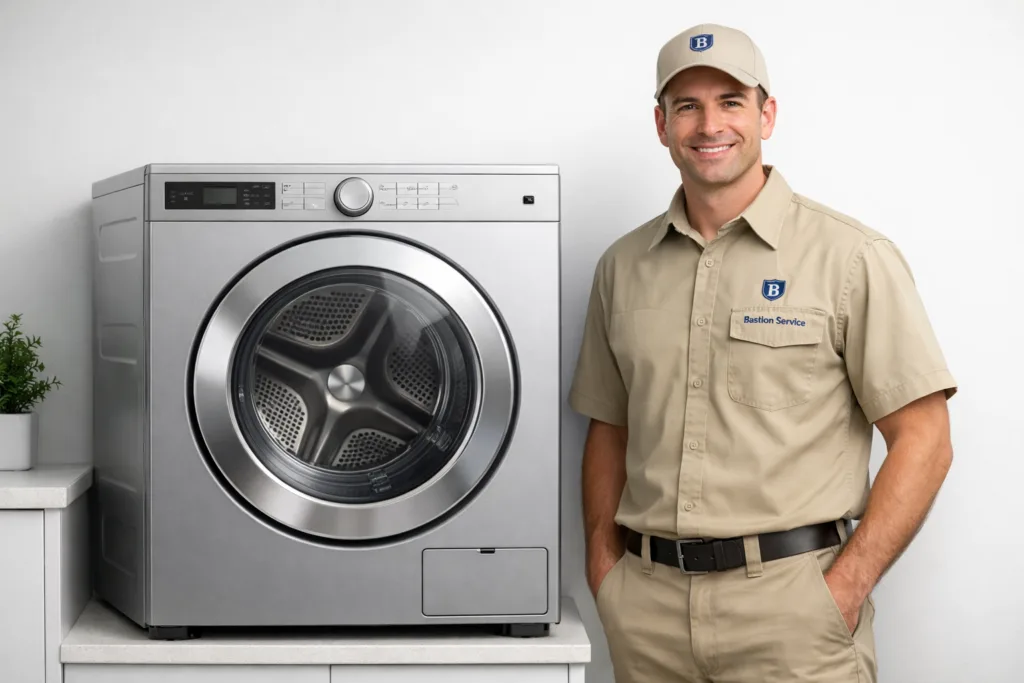
Dryer problems rarely stay small for long. A load that comes out damp, a cycle that takes twice as long, or a machine that suddenly stops starting can quickly disrupt the routine in a Santa Monica household. With Asko dryers, the same outward symptom can come from different underlying faults, so the best next step is to match the repair plan to how the dryer is actually behaving.
What the symptom usually tells you
Asko dryers use coordinated heating, airflow, sensing, and control systems. When one part of that system falls out of range, the dryer may still run, but performance changes in noticeable ways. Looking at the exact symptom pattern often helps separate a venting issue from a heating failure, a sensor problem, or a mechanical fault.
Dryer runs but clothes do not dry well
If the drum turns normally but laundry stays damp, the issue may involve restricted airflow, weak heat, a moisture sensing problem, or a component that is causing the cycle to end before the load is actually dry. Heavier items may seem especially affected because they need steady heat and proper air movement to finish correctly.
In many homes, this starts as “the dryer is a little slower than usual” before turning into multiple cycles for every load. That is a sign the machine is straining rather than operating efficiently.
No heat or noticeably low heat
An Asko dryer that tumbles without producing heat may have a failed heating part, thermostat, thermal safety component, relay issue, or control problem. Low heat can be trickier because the dryer may feel warm enough to seem functional while still failing to dry clothes in a reasonable time.
This is also the kind of symptom that can be confused with poor venting. Proper testing matters because replacing a heating part will not solve an airflow restriction, and cleaning airflow alone will not fix a broken heating circuit.
Dryer stops early or cycles feel erratic
When a dryer starts normally and then shuts off too soon, the cause may involve overheating protection, moisture sensor feedback, a door switch issue, or an electronic control fault. Some units also behave inconsistently from load to load, which can make the problem seem random even when a specific part is failing.
If towels stay damp but lighter loads seem fine, or if the dryer sometimes completes a cycle and sometimes does not, it usually points to a system that is reading conditions incorrectly or protecting itself from a developing fault.
Noise, vibration, or new odors
Thumping, scraping, squealing, or rattling often comes from worn drum support parts, belt issues, idler wear, blower problems, or objects caught where they should not be. A burning smell deserves extra caution. It can indicate overheating, lint accumulation inside the cabinet, belt friction, or a motor working under strain.
New sounds and smells are usually warning signs, not minor quirks. If the dryer suddenly sounds rougher than usual, it is wise to stop using it until the cause is identified.
Signs the problem is getting worse
Some dryer issues begin subtly and then accelerate. Homeowners in Santa Monica often notice one or more of these changes before a full breakdown:
- Dry times keep increasing from one week to the next
- The outside of the dryer feels hotter than normal
- The laundry room becomes unusually warm or humid during use
- The dryer needs to be restarted to finish a load
- The unit hums, clicks, or pauses without completing the cycle
- There is a sharp mechanical noise during tumbling
- The dryer trips power or shuts down mid-cycle
When these symptoms show up together, continued use can create more wear on heating components, motors, controls, and safety devices.
Why airflow problems should not be overlooked
Airflow is one of the most common reasons a dryer underperforms, and it can mimic several other failures. When hot, moist air cannot move out of the system properly, clothes take longer to dry, temperatures can rise unevenly, and safety parts may start cycling the machine off to prevent overheating.
That matters because poor airflow does more than extend dry time. It can make a healthy heating system seem weak, contribute to overheating smells, and shorten the life of internal components. On an Asko dryer, restricted airflow may also cause cycles to behave unpredictably because temperature and moisture readings no longer match normal operating conditions.
When service makes more sense than trying another load
It is usually time to schedule service when the dryer is no longer performing consistently or shows any sign of heat, electrical, or mechanical stress. That includes situations where the unit:
- Runs but never gets clothes fully dry
- Starts and then stops before the cycle is complete
- Will not start at all
- Makes grinding, squealing, or scraping sounds
- Produces a burning odor
- Heats unevenly or not at all
Intermittent problems are also worth taking seriously. A dryer that works normally one day and fails the next often has a weakening component rather than a one-time glitch.
Repair or replace?
The decision usually depends on the dryer’s age, overall condition, repair scope, and whether the current problem is isolated or part of a larger pattern. If the appliance has been reliable and the failure is limited to one repairable system, fixing it is often the better choice. If there are signs of multiple problems involving heat, controls, and drum movement at the same time, replacement may be the more sensible long-term option.
For a premium unit like an Asko dryer, that decision should be based on actual test results rather than assumptions. The goal is to understand whether the machine needs a targeted repair or whether wear has spread far enough that investing more in it no longer makes sense.
What homeowners should expect from a service visit
A useful service appointment should answer a few straightforward questions: what failed, whether any related parts have been affected, whether the dryer is safe to keep using, and whether the repair is worthwhile. On an Asko dryer, that often means evaluating heat production, airflow, sensor response, drum movement, and control behavior together instead of treating each symptom as a separate issue.
That kind of complete check is especially important when the complaint sounds simple but the cause may not be. “Not drying,” “stops early,” or “makes noise” can each point to several very different repairs.
Common household situations in Santa Monica
In daily use, dryer problems often show up in practical ways before anyone thinks of a specific failed part. Bedding may still feel cool and damp after a full cycle. Workout clothes may come out warm but not dry. Family laundry may begin piling up because every load needs extra time. These are the moments when symptom-based diagnosis is most helpful, because the pattern usually reveals whether the problem is tied to heat, moisture sensing, airflow, or drum operation.
For households trying to decide what to do next, the most helpful path is one that identifies the actual fault and explains the repair options clearly, including whether the dryer is a good candidate for restoration or nearing the point where replacement should be considered.