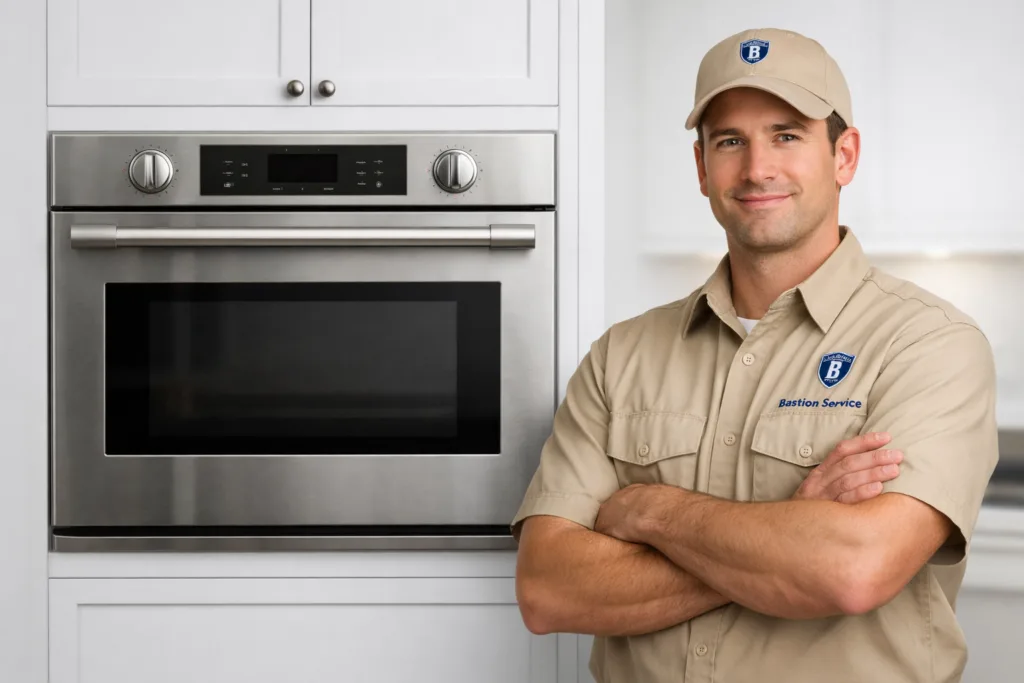
When a wall oven starts missing temperatures, taking too long to preheat, or stopping mid-cycle, the symptom itself usually points the repair in a specific direction. With Wolf models, small changes in performance can affect baking accuracy, roasting times, and everyday cooking consistency, so it helps to look at how the oven behaves in each mode rather than assuming every heating problem has the same cause.
How Wolf wall oven problems usually show up
Most oven failures are not completely random. A unit that never heats at all raises different concerns than one that heats slowly, overshoots temperature, or cooks unevenly from rack to rack. In Beverly Hills homes, homeowners often notice the problem first through cooking results: longer preheat times, baked goods that finish unevenly, food that needs repeated time adjustments, or an oven that seems normal one day and unreliable the next.
A symptom-based inspection typically starts with a few basic questions:
- Does the issue affect bake, broil, convection, or every cooking mode?
- Is the oven failing consistently or only once it has been running for a while?
- Did the problem begin suddenly, or has performance gradually declined?
- Is there an error code, unusual clicking, or a display problem at the same time?
Those details help separate a heating issue from a sensor, control, airflow, or door-related problem.
Common symptoms and what they may indicate
Not heating at all
If the control responds but the oven does not produce heat, the fault may involve a heating circuit, temperature sensing component, relay, control board, or power-related issue. On some units, bake may fail while broil still works, or the reverse. That distinction matters because it can narrow the problem to a specific part of the system instead of the entire oven.
Slow preheat
Slow preheat often gets blamed on normal aging, but it can point to a weakening element, inaccurate sensor feedback, control trouble, or a problem in a convection-assisted heating pattern. If preheating now takes much longer than it used to, the oven may still be producing heat but not at the rate required to reach the selected temperature properly.
Uneven baking
When cookies brown faster on one side, casseroles need rotation every time, or the top finishes long before the center, the issue may involve temperature calibration, convection performance, heat distribution, or a door seal problem. Uneven baking does not always mean the oven is far off temperature overall; sometimes it means the heat is not circulating or retaining the way it should.
Temperature swings during cooking
All ovens cycle on and off, but wide swings that affect results can signal sensor drift, control instability, or a heating component that is not responding correctly. This is especially noticeable during longer baking or roasting cycles where steady heat matters more than a quick burst of heat at startup.
Display or control issues
An unresponsive panel, flashing display, partial readout, or recurring error code can be more than an inconvenience. On a Wolf wall oven, control and communication faults may affect temperature regulation, cooking mode selection, timing functions, or the oven’s ability to complete a cycle without interruption.
Door not closing or sealing properly
If the door sits unevenly, does not close with normal tension, or allows noticeable heat to escape, the oven may struggle to maintain temperature. Hinges, latch parts, alignment issues, and worn sealing surfaces can all reduce cooking efficiency. In some cases, a door problem creates symptoms that look like a heating failure even though the heat source is working.
Shutting off during use
An oven that starts normally and then powers down may be dealing with overheating protection, electrical interruptions, sensor errors, or control failure. Intermittent shutdowns are frustrating because they can seem unpredictable, but the timing of the shutdown often provides useful clues. If it happens during preheat, after the oven reaches temperature, or only during longer cooking cycles, that pattern can help isolate the cause.
Why cooking mode matters during diagnosis
Wolf wall ovens can behave differently in bake, broil, and convection settings, and those differences are useful during troubleshooting. If broil works but bake does not, or convection performance is inconsistent while standard baking seems close to normal, the repair path becomes more focused. It is also worth noting whether the problem appeared after a self-clean cycle, because high-heat cycles sometimes expose weakened components that were already close to failure.
Useful observations include:
- Whether the oven reaches temperature eventually or never gets there
- Whether the issue happens with every recipe or only certain temperature ranges
- Whether the display stays active when heating stops
- Whether the cooling fan, lights, and controls behave normally during the problem
When the issue is more than calibration
Some homeowners assume a temperature problem can always be solved by adjusting settings, but repeated underheating, overbrowning, or long preheat times often go beyond simple calibration. If a Wolf wall oven in Beverly Hills has become consistently unreliable, especially across multiple recipes, it usually makes more sense to inspect the underlying system than to keep compensating with guesswork.
That is particularly true when symptoms are paired with error messages, interrupted cycles, or changes in door performance. A calibration adjustment may fine-tune a healthy oven, but it will not correct a failing sensor, a weak heating component, or an unstable control issue.
Signs you should stop using the oven until it is checked
Some problems are mainly inconvenient, while others are worth addressing before the next cooking cycle. It is smart to pause use if you notice:
- Burning odors from the control area
- Repeated shutdowns during normal operation
- A door that will not close securely
- Error codes that keep returning after reset attempts
- Visible interior damage, arcing, or scorching
- Controls that stop responding while the oven is on
Continued operation under those conditions can make the eventual repair more involved and may affect additional components.
Repair versus replacement
Many Wolf wall oven issues are repairable when the fault is isolated to a sensor, heating circuit component, latch assembly, hinge, fan-related part, or control-related part. Replacement becomes a more serious conversation when there are multiple major failures, repeated electronic issues, or a broader condition problem that affects confidence in long-term reliability.
The most useful way to make that decision is to look at the exact failed system, the overall condition of the oven, and whether normal performance can be restored without stacking one major repair on top of another. A diagnosis based on the actual symptom pattern gives a clearer answer than replacing parts by trial and error.
What to note before service
If service is needed, a few details can make the visit more productive. Try to have the model information available and note the following if possible:
- The exact error code shown, if any
- Which cooking modes are affected
- The approximate temperature where the problem becomes noticeable
- Whether the issue started after a power interruption or self-clean cycle
- Whether the problem is constant or intermittent
Even simple notes such as “stops heating after reaching 350” or “broil works but bake does not” can help move the inspection in the right direction faster.
Keeping a frequently used kitchen appliance reliable
A wall oven is often one of the most heavily used cooking appliances in the home, especially for households that bake often, cook family meals, or entertain regularly in Beverly Hills. When it begins to miss temperatures or behave unpredictably, the best next step is usually to identify the failed system and determine whether repair will return the oven to stable, accurate operation. That keeps the decision grounded in the actual condition of the appliance rather than in assumptions based on one symptom alone.