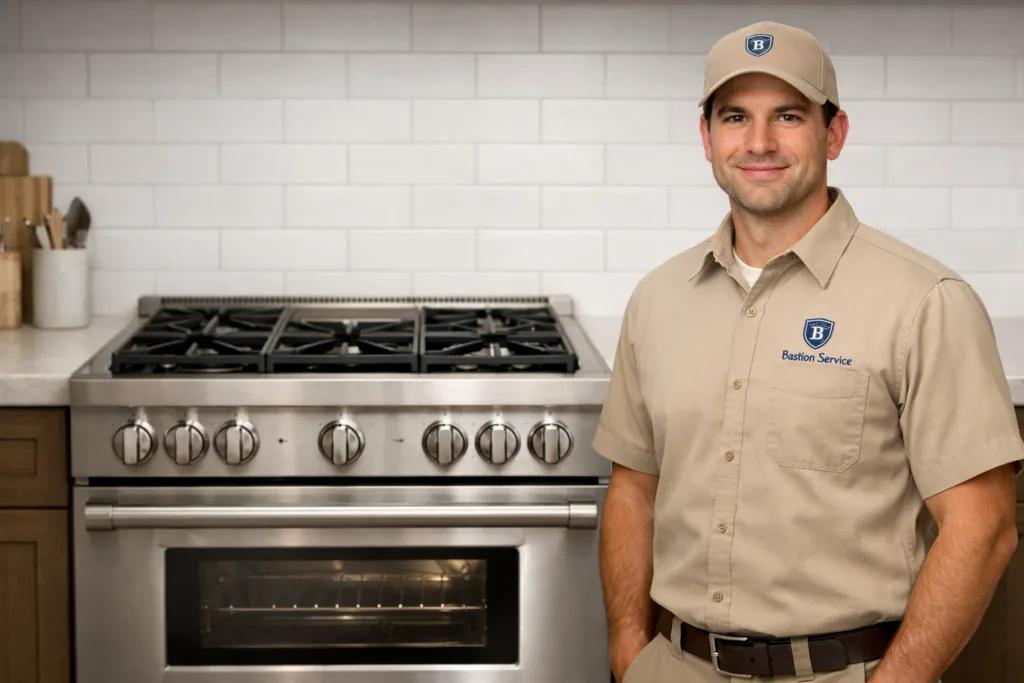
Burner and oven problems on a Wolf range usually follow a pattern, and that pattern matters. A burner that clicks without lighting points to a different repair path than an oven that preheats slowly, runs hot, or shuts off unexpectedly. Looking closely at what the range is doing during normal cooking is often the fastest way to narrow down the likely cause and avoid replacing parts that are not actually failing.
Common Wolf range symptoms homeowners notice in Brentwood
Most service calls start with one or two recurring issues rather than a complete appliance shutdown. Paying attention to when the problem happens, whether it affects one burner or the whole range, and whether the issue is constant or intermittent can make the next step much more straightforward.
Surface burners click but do not ignite
If the igniter clicks repeatedly and the burner does not light, the issue may be related to burner cap alignment, moisture around ignition components, a dirty burner assembly, or a failing igniter circuit. In some cases, the flame lights after several clicks. In others, the burner never ignites at all. Either way, repeated failed ignition should not be ignored, especially if cooking has become inconsistent from one day to the next.
When only one burner is affected, the fault is often more localized. When multiple burners show similar ignition trouble, it can point to a broader electrical or ignition-related issue within the range.
Burners light, but the flame looks weak or uneven
A weak, unstable, or uneven flame can make everyday cooking frustrating. Pots take longer to heat, simmer settings become unreliable, and temperature control on the cooktop becomes harder to manage. This type of symptom can be tied to clogged burner ports, burner assembly issues, or gas flow problems affecting performance at that burner.
If the flame appearance has changed noticeably, it is worth having the range evaluated before the issue begins affecting additional components or daily meal prep.
Oven takes too long to preheat
Slow preheating is one of the most common signs that something is no longer working as it should. Homeowners may first notice that baking times drift longer, recipes need extra minutes, or the oven seems to struggle reaching the selected temperature. On a gas range, that can indicate ignition weakness or a problem with heat generation. It can also involve temperature sensing or control response.
Because several different faults can create the same symptom, testing matters more than guessing based on preheat time alone.
Oven temperature is inconsistent
When a range oven runs too hot, too cool, or swings during a cooking cycle, the results usually show up quickly: undercooked centers, overbrowned tops, scorched bottoms, or uneven baking from front to back. In some homes, this starts as an occasional issue and gradually becomes the new normal.
Temperature inconsistency can come from sensor problems, ignition issues, control faults, or wear in heating-related components. It may also feel similar to a calibration problem even when the real cause is a part that is beginning to fail.
Broil or bake functions stop working properly
If bake works but broil does not, or broil works while bake struggles, that difference is useful. It helps isolate whether the problem is limited to one function or tied to a shared control or ignition issue. Some homeowners notice the oven starts a cycle but never fully heats. Others find that one mode works only intermittently.
Function-specific failures are often more repairable than they first appear, but they still need proper diagnosis to confirm which component is responsible.
Control panel problems or erratic display behavior
A Wolf range may still partially operate even when the controls are beginning to fail. You might see settings that do not respond, a display that behaves unpredictably, fault codes, or commands that do not match what the range actually does. These issues can interfere with oven operation even if the cooktop seems mostly normal.
Electronic faults should be taken seriously because they can affect temperature regulation, cycle timing, and overall reliability.
What different symptom patterns can mean
It helps to think about range problems in groups instead of as isolated annoyances. The same appliance can show several related symptoms at once, and those combinations often tell a more complete story.
- Clicking plus delayed ignition: often suggests an ignition-side problem at the burner.
- Slow preheat plus uneven baking: may point to weak heat generation, sensing problems, or control-related issues.
- Fault codes plus temperature trouble: can indicate that the problem goes beyond a simple adjustment.
- Intermittent operation: often means a component is failing under certain conditions and may stop working entirely soon.
- One feature failing while others work: usually helps narrow the issue to a specific system within the range.
That is why symptom-based service is more useful than replacing a part based only on the most visible complaint.
When to stop using the range and schedule service
Some problems are more than inconvenient. It is best to stop using the range and have it checked if you notice repeated failed ignition, a burner that will not stop clicking, significant temperature inaccuracy, frequent shutdowns, or controls that do not respond consistently. These issues can make cooking unpredictable and may place added strain on other components.
You should also pause use if there is a persistent gas odor, abnormal overheating, or signs that the appliance is not operating safely. In those cases, safety comes before convenience.
Why intermittent problems should not be brushed off
Intermittent failures are easy to postpone because the range still works some of the time. But an appliance that works only occasionally is often closer to complete failure than it appears. A weak igniter may light today and fail tomorrow. A drifting sensor may create one bad baking result, then seem normal for a week before acting up again.
These stop-and-start symptoms are important because they often indicate wear that is progressing. Addressing them earlier can reduce the chance of a broader and more expensive repair later.
Repair decisions depend on the specific fault, not just appliance age
With a premium range, replacement is not automatically the best answer when something goes wrong. Many problems involve serviceable parts, and restoring normal operation may be very reasonable when the issue is isolated and the rest of the appliance is in good condition. A targeted repair often makes sense when the burners, oven cavity, controls, and general condition of the range still support reliable use.
Replacement becomes more worth discussing when there are multiple major failures at the same time, when prior issues keep returning, or when the expected repair cost is high compared with the value of restoring the appliance. The right decision depends on the actual condition of the range, not just the fact that a symptom appeared.
How Brentwood homeowners can prepare for a range service visit
A few observations before service can help speed up diagnosis:
- Note whether the problem affects one burner, all burners, the oven, or the controls.
- Pay attention to whether the issue happens every time or only occasionally.
- Write down any fault code or unusual display behavior.
- Notice whether the oven is too hot, too cool, or simply slow to preheat.
- Check whether the problem began suddenly or gradually worsened over time.
Even simple details like “front right burner clicks but does not light when wet” or “oven takes 20 minutes longer than before” can help identify the most likely repair path.
Focused help for everyday cooking problems
For most households in Brentwood, the real goal is not just getting the appliance to power on again. It is restoring steady burner ignition, predictable oven heat, and controls you can trust during normal daily use. When a Wolf range starts showing recurring burner, oven, or control issues, the most helpful next step is a practical repair plan based on the exact symptom pattern and the overall condition of the appliance.