
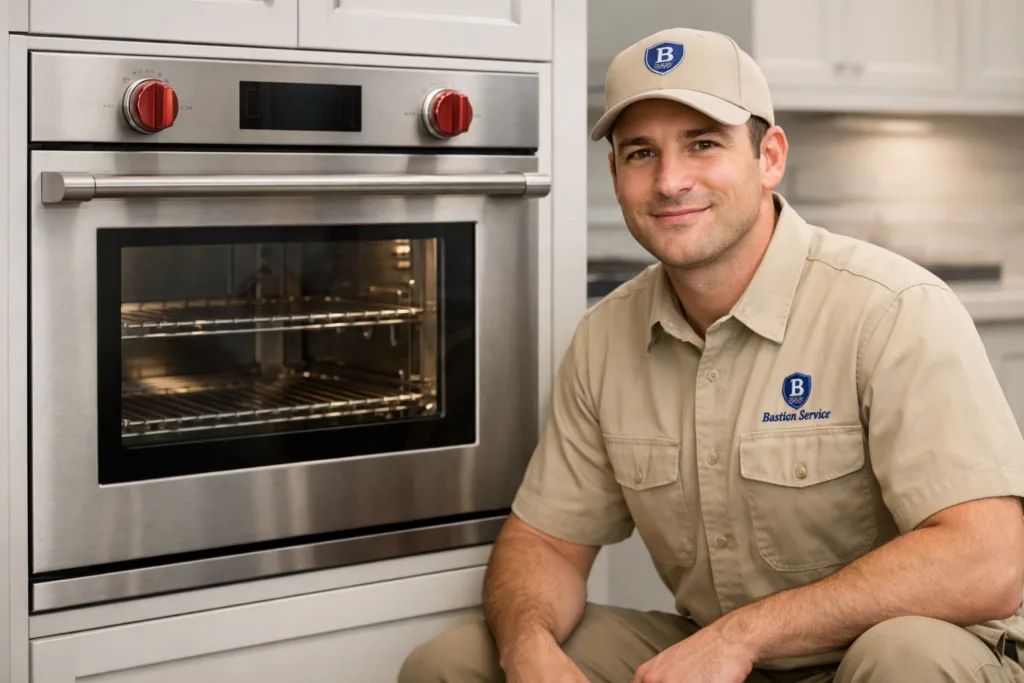




Cooking problems tend to show up first as disruptions you can feel right away: a burner that keeps clicking, an oven that takes too long to preheat, or a range that no longer cooks evenly from front to back. With Wolf appliances, those symptoms can point to several different underlying faults, so it helps to look at how the issue appears during normal household use before deciding what repair path makes sense.
For specific Wolf appliance paths in Los Angeles, review Wolf Oven Repair in Los Angeles, Wolf Wall Oven Repair in Los Angeles, and Wolf Range Repair in Los Angeles.
Common Wolf appliance symptoms homeowners notice first
Most household problems do not begin with a completely dead appliance. More often, performance changes gradually. A cooktop may start igniting on the second or third try. An oven may still heat, but baked food comes out inconsistent. A wall oven may display erratic behavior even though it still turns on. These patterns matter because they help separate a minor component issue from a larger control, sensor, or power-related fault.
In Los Angeles homes where cooking appliances are used regularly, these early signs are often the best warning that service should happen before the problem spreads into repeated meal failures or a unit that stops working altogether.
Cooktop symptoms
Wolf cooktops often show trouble through ignition-related behavior. One burner may click continuously, fail to light, or ignite with a delay. Flame quality can also change, with heat seeming lower than expected or less stable than usual. In some cases, the cause is tied to moisture, residue buildup, or burner alignment. In others, the issue may involve ignition switches, spark components, or gas flow regulation.
If only one burner is affected, that detail is useful. If several burners begin acting up at the same time, diagnosis may lean more toward shared ignition or control components rather than a single burner part.
Oven symptoms
Wolf ovens commonly develop problems that show up as slow preheat, uneven baking, temperature drift, or food that consistently finishes too early or too late. Homeowners sometimes describe this as the oven “feeling off” even though the display appears normal. That kind of complaint can be linked to heating components, temperature sensors, electronic controls, door seal wear, or calibration issues.
When an oven still operates but no longer cooks predictably, it is usually a sign that the fault is already affecting performance enough to justify inspection rather than waiting for complete failure.
Range symptoms
A Wolf range can present combined issues because it includes both surface cooking and oven functions. You may notice a burner ignition problem at the same time the oven struggles to hold temperature. Those issues may be unrelated, or they may indicate a broader electrical, control, or supply problem. Intermittent shutdowns, inconsistent performance when multiple functions are used together, or tripping a breaker are all signs that the symptom pattern should be evaluated carefully.
Wall oven symptoms
Wall ovens often reveal faults through uneven heating, control display errors, door problems, fan behavior that seems abnormal, or a unit that starts and stops unpredictably. Because built-in units are used differently than freestanding appliances, homeowners may notice heat retention and airflow problems more quickly during everyday cooking. If the oven resets, stalls during preheat, or struggles to maintain a set temperature, those are meaningful clues rather than minor quirks.
Why similar symptoms can lead to different repairs
One of the most important things to understand about Wolf appliance problems is that the visible symptom is not always the failed part. For example, an oven that does not heat properly could have a weak heating component, a faulty sensor, a control issue, or a door that is not sealing as it should. A cooktop burner that clicks nonstop may have an ignition issue, but it could also involve moisture, switch problems, or a condition affecting spark performance.
That is why part-swapping based on guesswork often wastes time and money. Symptom-based diagnosis is more useful because it looks at when the issue occurs, whether it happens every time, and whether other functions are affected at the same time.
When a Wolf appliance problem becomes urgent
Some performance issues are inconvenient but stable for a short period. Others should be treated as prompt service concerns. If a cooktop or range burner will not ignite normally, keeps clicking, produces unreliable heat, or behaves differently from one day to the next, continued use is not a good idea. If an oven or wall oven shuts off unexpectedly, cannot maintain temperature, or shows repeated control errors, it is better to stop relying on it for regular cooking until the fault is identified.
Gas-related symptoms deserve extra caution. If you notice a strong or persistent gas smell, stop using the appliance and address safety first. Repeated clicking without ignition, especially when performance changes suddenly, should also be taken seriously and checked before routine cooking continues.
How to tell whether repair is likely worth it
Repair is often a reasonable choice when the problem appears isolated and the appliance has otherwise been performing well. A single clear fault is very different from a pattern of repeated breakdowns, multiple failing functions, or signs that broader wear is affecting reliability. The real question is whether the repair is likely to return the appliance to consistent daily use instead of serving as a short-term patch.
Age can matter, but it should not be the only factor. A newer appliance with an electronic fault may still require a careful cost review, while an older unit with one identifiable problem may still be a solid repair candidate. What matters most is the overall condition of the appliance, the severity of the current issue, and whether related components show signs of strain.
What to note before scheduling service
Homeowners can make diagnosis much easier by paying attention to the exact pattern of the problem. Helpful details include:
- whether the issue happens on every use or only sometimes
- whether one burner, one oven cavity, or one function is affected more than others
- whether the problem began suddenly or worsened gradually
- whether there are unusual sounds, smells, display errors, or shutdowns
- whether preheat, ignition, or temperature hold is the main complaint
Even small observations can help narrow the cause. A burner that fails only after cleaning points to a different starting place than one that has weakened over time. An oven that reaches temperature but does not hold it suggests a different issue than one that never preheats fully.
What homeowners in Los Angeles should expect from the evaluation process
For Wolf appliance repair in Los Angeles, the most useful service visit is one that focuses on how the appliance is failing in actual household use, not just whether it powers on. That means looking at symptom timing, consistency, heat performance, control behavior, and whether multiple functions are involved. For cooktops, ovens, ranges, and wall ovens alike, the goal is to identify the fault accurately enough to decide whether repair is straightforward, whether additional issues may be present, and whether continued use should be avoided until the problem is corrected.
When the symptom pattern is understood clearly, homeowners can make better decisions about timing, budget, and whether repair is the right next step for the appliance they have.


