
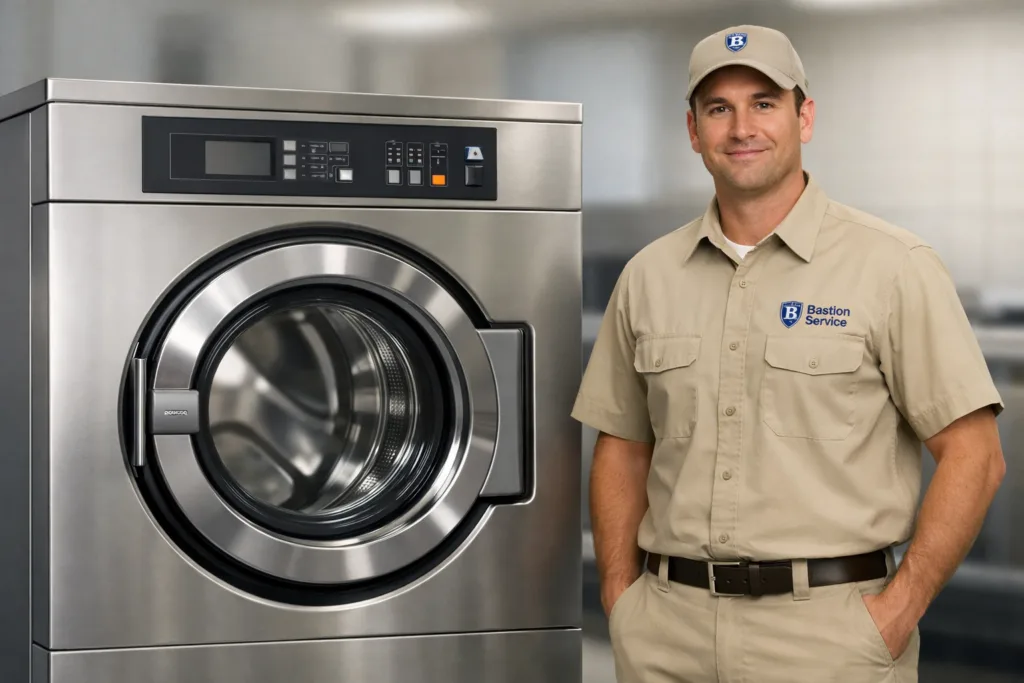




When a Wascomat washer fails during daily operations, the immediate concern is not just the machine itself but the backlog it creates. Wet loads waiting for extraction, interrupted staff routines, delayed room turns, and repeated reset attempts can quickly affect productivity. Bastion Service provides Wascomat washer repair for businesses in Venice with a service approach centered on testing the actual failure, identifying what is causing the interruption, and helping operators move toward the most sensible repair path.
Related commercial service paths in Venice include Wascomat Commercial Repair in Venice, Commercial Washer Repair in Venice, and Wascomat Dryer Repair in Venice.
Many washer complaints start with one visible symptom but involve several connected issues. A unit that will not spin may actually have a drain problem. A cycle that stops mid-program may trace back to a door lock fault, a control issue, or a water level problem. That is why service should begin with symptom-based evaluation rather than assumptions based on a single error or recent behavior.
Common Wascomat washer problems that disrupt operations
Wascomat washer failures usually follow recognizable patterns. Understanding those patterns can help determine urgency and whether continued use is likely to cause additional damage.
Washer will not start or will not complete the cycle
If the washer powers on but does not begin, pauses partway through, or shuts down before the cycle finishes, the cause may involve the door lock system, control communication, input problems, water fill faults, or a component that is failing only under load. Intermittent no-start issues often become full stoppages after repeated attempts to keep the unit running.
This type of problem matters because incomplete cycles create rewash work, tie up staff, and make it harder to plan load flow across the rest of the laundry room.
Drainage problems and standing water in the drum
A Wascomat washer that drains slowly, leaves water behind, or stops before extraction may have a blocked drain path, drain valve issue, pump problem, sensor fault, or control-related interruption. In some cases, the washer cannot move into high spin because the water level does not drop as expected.
Typical signs include:
- water remaining in the basket after the cycle ends
- loads coming out much wetter than normal
- repeat drain errors or cycle cancellations
- manual resets needed to finish the load
Spin failures, excessive vibration, or aborted extraction
If the machine struggles to ramp up, shakes heavily, or repeatedly stops during extraction, the issue may relate to suspension wear, drive components, out-of-balance detection, bearing condition, or mounting stress. High-speed instability should be addressed quickly because vibration can spread wear to other assemblies and may create cabinet, frame, or floor-related concerns.
Even when the washer still appears usable, repeated vibration usually means the unit is no longer operating the way it should. That often leads to longer cycle times, wetter loads, and more strain on nearby equipment and staff workflow.
Leaks, overfilling, or poor water intake
Water around the washer can come from more than one source. Possible causes include door seal wear, hose deterioration, drain path failure, inlet valve issues, overfill conditions, or pressure-sensing problems. If the washer fills too slowly, does not reach the correct level, or keeps taking on water unexpectedly, service should focus on the fill system and the controls that govern it.
Leaks become more urgent when they affect flooring, create slip hazards, or make it difficult to keep surrounding equipment areas safe and usable.
Noise, burning odor, or signs of mechanical strain
Grinding, rumbling, belt noise, harsh motor sound, or a burning smell usually indicates a washer that should be taken seriously before another full day of use. These symptoms may point to bearing wear, pulley or belt problems, motor stress, support failure, or electrical issues that worsen under repeated cycling.
If the washer is also tripping breakers, slowing under load, or sounding different during spin than it did previously, the unit should be evaluated before it is pushed through more loads.
Why the visible symptom is not always the real failure
On a busy laundry floor, it is easy to focus on what operators see first: not draining, not spinning, leaking, or stopping early. But with a Wascomat washer, that surface symptom may be the result of another fault upstream. A spin complaint may start with incomplete draining. A no-start complaint may involve the lock circuit rather than the control itself. A leak may be tied to overfill behavior instead of a torn seal alone.
That is why testing matters before parts are selected or repair decisions are made. A symptom-first guess can lead to unnecessary replacement, repeated downtime, and added labor without solving the actual issue. A proper diagnosis helps determine whether the problem is isolated or whether multiple systems are contributing to the failure.
When to stop using the washer and schedule repair
Some washer problems allow limited operation for a short period, while others should be treated as immediate service situations. If a machine is leaking, shaking hard during extraction, failing to drain, producing burning odor, or repeatedly stopping before cycle completion, continued use can turn a contained repair into a larger one.
It is usually best to stop using the washer when:
- water is reaching the floor around the machine
- the unit cannot complete normal extraction
- vibration is severe enough to affect stability
- loads remain too wet for normal downstream handling
- the machine trips power or shuts down unexpectedly
- there is abnormal grinding, rumbling, or electrical odor
Prompt service is also warranted when a machine still runs but requires frequent resets, shows recurring fault behavior, or performs inconsistently from one load to the next.
Repair planning for Venice businesses
For businesses in Venice, repair planning is often about more than replacing one failed part. The important questions are whether the fault is isolated, how the downtime affects scheduling, whether other wear has developed around the main issue, and whether the repair is likely to restore stable operation rather than temporary function.
In many cases, repair remains the practical option when the problem is tied to a pump, valve, lock assembly, drain component, drive part, sensor issue, or a specific control-related failure. Replacement becomes a more serious consideration when the washer has multiple major faults, recurring service history, heavy structural wear, or significant bearing and drive problems combined with control issues.
How symptom patterns help narrow the service path
The most useful service call often starts with a simple record of what the washer is doing. For example, whether the unit fails at the same stage every time, only struggles with heavy loads, leaks only during fill, or leaves water behind after certain programs can all help narrow the diagnosis faster.
Helpful details to note before scheduling service include:
- whether the machine powers on normally
- which part of the cycle the failure happens in
- whether water remains in the drum
- if the problem is constant or intermittent
- whether unusual noise appears during wash, drain, or spin
- if the issue began suddenly or worsened over time
That information can make the visit more efficient and help determine whether the issue points toward drainage, controls, fill components, extraction, or mechanical wear.
Service-focused next steps for a Wascomat washer problem
If a Wascomat washer in Venice is no longer starting reliably, draining correctly, completing cycles, or handling extraction without noise or vibration, the best next step is to schedule service based on the exact symptom pattern rather than continue trial-and-error operation. Timely diagnosis can reduce avoidable downtime, prevent secondary damage, and give your team a clearer repair decision based on the actual condition of the machine.





