
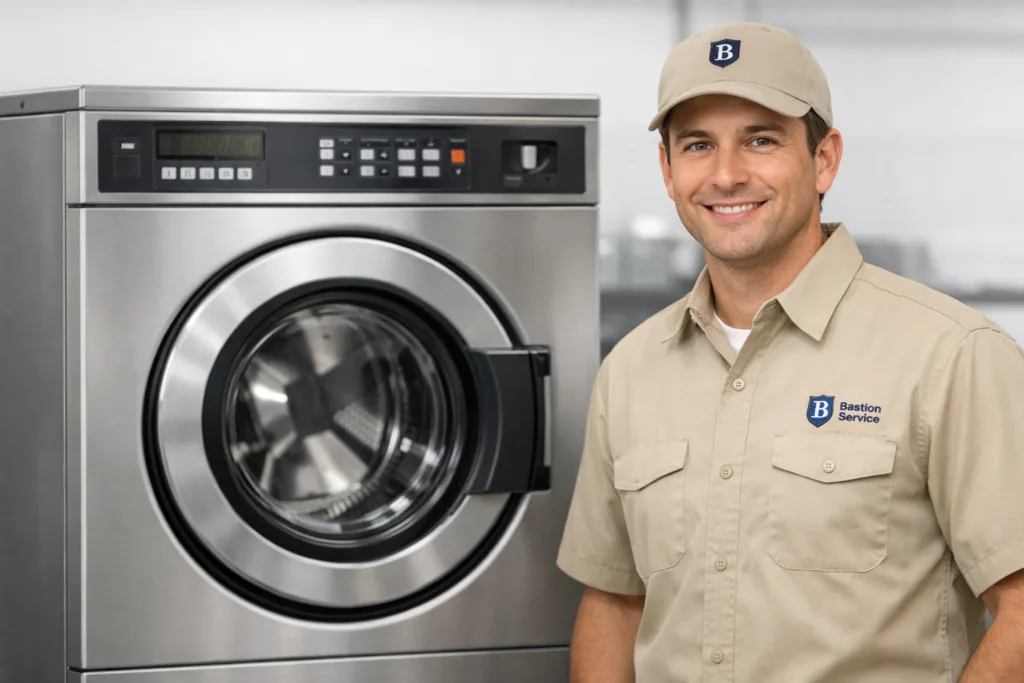




Washer downtime can quickly disrupt sorting, staffing, and load turnaround. When a Wascomat unit starts leaving water in the drum, stopping before extraction, leaking, or failing to respond at startup, the next step should be symptom-based service that identifies the actual failure and what it will take to restore normal operation. Bastion Service helps businesses in Palms evaluate Wascomat washer problems, schedule repair based on urgency, and avoid unnecessary delay when daily workflow depends on reliable laundry equipment.
Related commercial service paths in Palms include Wascomat Commercial Repair in Palms, Commercial Washer Repair in Palms, and Wascomat Dryer Repair in Palms.
Common Wascomat washer symptoms and what they usually indicate
Washer will not start or will not complete the cycle
If the machine powers on but does not begin, locks up during a program, or repeatedly stops before the end of the cycle, the cause may involve the door lock assembly, control response, water level sensing, fill issues, motor-related faults, or a failed step in the sequence that prevents the next action from starting. This is one of the most important symptoms to diagnose correctly because several different faults can look the same from the operator side.
Not draining or leaving standing water
Drain complaints often trace back to a restricted drain path, pump failure, hose blockage, debris in the system, or a control issue that is not sending the washer into proper drain and spin stages. A washer that does not clear water fully may also refuse to advance into extraction, which can make the problem look like a spin failure when drainage is actually the first issue.
Weak spin, wet loads, or poor extraction
When loads come out too wet, the washer may be dealing with imbalance detection, drain delay, motor problems, sensor errors, worn mechanical parts, or control faults that interrupt the high-speed spin sequence. For businesses in Palms, this often creates a second layer of disruption because drying times increase and machine turnover slows.
Leaking during fill, wash, or drain
Water on the floor can come from a worn door seal, cracked hose, pump leak, overfill condition, loose connection, or internal failure related to the tub or drain system. The timing of the leak matters. A leak during fill points in a different direction than a leak that shows up only during drain or high-speed spin, which is why symptom detail helps narrow the repair path faster.
Vibration, banging, or repeated out-of-balance faults
Excessive movement can indicate worn suspension parts, mounting problems, load distribution issues, bearing wear, or drum-related mechanical deterioration. If the washer is shaking hard enough to move, strike internally, or stop repeatedly, continued use can increase damage to nearby components and make a smaller repair turn into a larger one.
Long cycles, poor wash results, or temperature concerns
If cycle times are running longer than normal, linens are not coming out clean, or water heating appears inconsistent where applicable, the fault may involve fill performance, heating elements or related controls, sensors, drain delay, or programming problems. These issues may not stop the washer entirely, but they still reduce output and create preventable bottlenecks.
Why the same symptom can have different causes
Wascomat washer failures are often sequence-related. A machine may appear to have a spin problem when it is actually waiting on proper drainage. A unit that seems dead at startup may be responding to a door lock fault or a control input that never verifies. A mid-cycle shutdown can be tied to water level, motor behavior, overheating, or an interruption in safety monitoring.
That is why troubleshooting should start with observed behavior, error patterns, and the stage of the cycle where the problem appears. Identifying whether the failure happens during fill, wash, drain, extract, or restart helps determine whether the repair is likely electrical, mechanical, hydraulic, or control-related.
Signs the washer should be taken out of regular use
Some symptoms justify immediate service rather than waiting for a convenient opening in the schedule. It is usually best to stop routine use when the washer:
- Leaks onto walking surfaces
- Will not complete cycles consistently
- Produces loud grinding, banging, or metal-on-metal noise
- Shows severe vibration or walking
- Will not drain and leaves repeated standing water
- Displays recurring fault codes or control interruptions
- Creates unusually hot smells or signs of electrical stress
Running through these conditions can increase damage, affect nearby equipment, and make recovery more expensive than addressing the original fault promptly.
What a service visit should help determine
For Palms businesses, washer repair is not just about replacing a part. The service decision should clarify what failed, whether the issue is isolated or part of a larger wear pattern, and whether the machine is a good repair candidate based on current condition and operating demands.
A useful visit should help answer questions such as:
- Is the problem tied to draining, extraction, controls, the door lock system, or mechanical wear?
- Is the unit safe to run in limited use, or should it remain offline?
- Is the likely repair straightforward, or will parts and follow-up labor be needed?
- Has this symptom probably caused secondary damage?
- Does repair still make sense compared with the machine’s overall condition?
Repair versus replacement for an aging Wascomat washer
Many washer problems are repairable when the failure is limited to one system and the rest of the machine remains in solid working condition. In those cases, targeted repair can restore throughput without the disruption of replacing equipment. That is often true for isolated pump issues, lock failures, certain control-related faults, and some hose or seal problems.
Replacement becomes more worth considering when the washer has multiple active issues, major bearing or drum wear, repeated breakdown history, or repair costs that no longer align with expected remaining life. The right decision usually depends on workload, condition, downtime tolerance, and whether this is a first major failure or part of an ongoing pattern.
How to prepare for Wascomat washer service
Before scheduling repair, it helps to note exactly what the washer is doing and when the problem occurs. Useful details include whether the unit fills, drains, locks, spins, leaks, or stops at the same point each time. If staff has seen an error code, recurring noise, or a specific cycle stage where the machine fails, that information can shorten diagnosis time.
Helpful preparation may include:
- Recording the cycle stage where the machine stops
- Noting whether the basket still contains water
- Describing the type of noise, if any
- Identifying whether the leak appears during fill, wash, drain, or spin
- Listing how often the issue occurs and whether it is getting worse
Service planning for businesses in Palms
When a Wascomat washer supports daily production, delay has a direct cost in labor, backlog, and scheduling pressure. Service should be arranged around the symptom severity, the machine’s role in your operation, and whether continued use risks added damage. For businesses in Palms, the most effective next step is usually to schedule repair once repeat faults, drainage problems, leaks, or extraction issues start affecting output, so the machine can be evaluated promptly and the repair plan can be based on actual operating condition rather than guesswork.


