
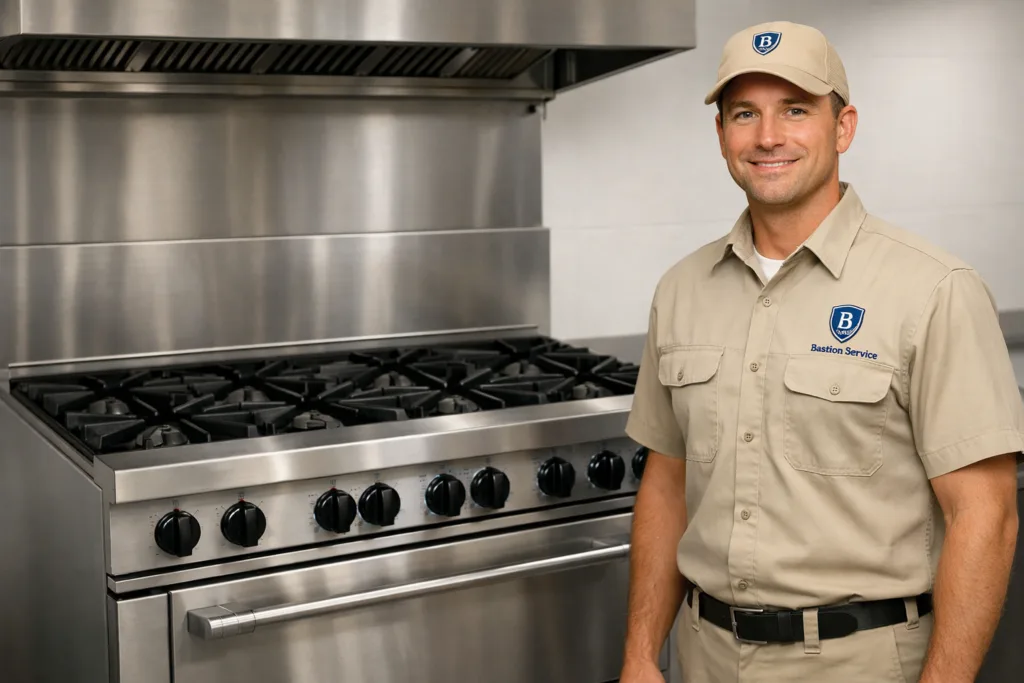





Range trouble tends to show up first in production: burners that do not light on cue, oven heat that drifts during prep, or controls that stop responding the way staff expects. For businesses in Rancho Park, repair service should center on symptom-based testing, safe operation, and scheduling that limits disruption to the kitchen. Bastion Service works on Vulcan range problems by isolating the fault, confirming which components are affecting performance, and helping managers decide whether the unit should stay in use, be limited, or be repaired right away.
Related commercial service paths in Rancho Park include Vulcan Commercial Repair in Rancho Park, Vulcan Oven Repair in Rancho Park, and Vulcan Fryer Repair in Rancho Park.
Why a symptom-based diagnosis matters
A Vulcan range can show the same outward problem for several different reasons. A burner that clicks but does not light may involve the igniter, gas flow, burner port blockage, switch failure, or wiring damage. An oven that runs cold may point to the sensor, thermostat, burner assembly, ignition sequence, or a control issue. Testing the actual failure pattern is what keeps a repair focused and helps avoid replacing parts that are not causing the outage.
That matters in Rancho Park kitchens where the range supports daily prep, line work, and timed cooking. If staff are rotating pans to find a working spot, relighting burners, or extending cook times to compensate, the equipment is already affecting labor, consistency, and throughput. Service is most useful when it identifies both the immediate fault and any related wear that could trigger another shutdown soon after repair.
Why is my Vulcan range not lighting, heating, or holding temperature?
These are usually signs that one of the range’s core operating systems is no longer performing normally. Ignition problems can prevent burners from lighting at all or cause delayed ignition. Heating problems often show up as weak flame, slow recovery, or an oven section that never reaches the set temperature. Temperature-holding issues may come from sensor drift, thermostat inaccuracy, burner performance problems, or controls that are no longer cycling correctly.
From a service standpoint, the key question is not just whether the unit still turns on. It is whether it can produce stable, repeatable heat under normal workload. If a range only works part of the time or only after repeated attempts, that usually means the fault is already interfering with reliable operation.
Common Vulcan range symptoms and what they often indicate
Burners that do not ignite or take too long to light
If surface burners are failing to light, clicking continuously, or lighting only after several tries, the issue may involve ignition components, clogged burner openings, contamination, gas valve problems, or electrical faults affecting the ignition circuit. In active kitchens, delayed ignition quickly becomes a workflow problem because staff start avoiding that burner or shifting production elsewhere.
Repeated failed starts also deserve prompt attention because they often get worse, not better, with continued use.
Weak flame or uneven burner output
When one burner runs lower than the rest, flame looks irregular, or heat drops under load, likely causes include restricted gas flow, burner wear, regulator-related issues, or buildup affecting combustion. These problems can show up as slower pan response, inconsistent searing, or difficulty keeping multiple stations moving at the same pace.
Oven section not reaching or maintaining temperature
An oven that preheats slowly, overshoots, runs cool, or cycles unpredictably can affect bake results, holding consistency, and timing across the shift. Possible causes include a failing temperature sensor, thermostat drift, ignition trouble, burner issues, or controls that are no longer regulating heat correctly. If product quality is changing from batch to batch, the range should be evaluated before waste and rework increase.
Knobs, valves, or controls that feel wrong
Stiff knobs, loose control response, settings that do not match actual output, or controls that work intermittently can point to worn valves, damaged switches, internal wear, or heat exposure around the control area. These failures often progress gradually, which is why operators may adapt to them before realizing the range is no longer functioning normally.
Intermittent shutdowns or inconsistent performance during busy periods
If the range performs acceptably during slow periods but struggles once several burners are in use, that can indicate a fault that becomes more obvious under heat or demand. Intermittent issues are especially important to diagnose because they often turn into full outages during peak production, when downtime is hardest to absorb.
Signs the range should be serviced sooner rather than later
- Burners need repeated attempts to ignite
- Flame is uneven, weak, or inconsistent across the top
- Oven temperature no longer matches the setting
- Staff are changing workflow to work around the unit
- Controls feel loose, stiff, or unreliable
- Performance drops sharply during busy service windows
- There are signs of excess heat, abnormal clicking, or intermittent operation
In most cases, those symptoms mean the range is no longer dependable enough for normal kitchen use. Waiting can increase downtime, create more product inconsistency, and turn a targeted repair into a larger service visit.
When continued use may make the repair more involved
Operating a faulty range day after day can add stress to ignition parts, controls, valves, and burner components. A weak ignition problem can lead to repeated failed starts. Poor combustion can create uneven heating and residue buildup. Temperature control issues can cause overuse as staff keep adjusting settings in an attempt to stabilize output.
For Rancho Park businesses, the practical concern is whether the unit is still supporting safe, repeatable production or whether it is being kept alive through workarounds. Once staff start compensating regularly, the equipment problem is already affecting operations enough to justify a service call.
Repair or replace?
Many Vulcan range problems are repairable when the main structure of the unit is still solid and the fault is limited to serviceable parts. Repair is often the sensible choice when the range still fits the kitchen layout, supports current production needs, and has a manageable problem in one system rather than broad wear across the whole unit.
Replacement becomes a more serious consideration when there are repeated major failures, heavy deterioration across multiple components, or repair costs that no longer align with the condition of the equipment. The value of diagnosis is that it separates an isolated failure from a range that is reaching the point of recurring downtime.
How to prepare for a service visit
It helps to note exactly what the range is doing and when the problem appears. Useful details include whether the issue affects top burners, the oven section, or both; whether the failure is constant or intermittent; whether it happens only after the unit heats up; and whether operators hear clicking, smell unburned gas, or notice delayed ignition. If temperature is the complaint, noting whether the oven runs hot, cold, or erratically can speed up diagnosis.
Businesses in Rancho Park can also save time by identifying the most disruptive symptom first. In many kitchens, the priority is not every minor complaint at once, but the specific fault that is limiting production today.
What a service-focused repair call should accomplish
A productive visit should confirm the active fault, identify the parts or systems responsible, and determine whether the range can remain in operation safely before repair is completed. It should also clarify whether the current problem is isolated or part of broader wear that could affect near-term reliability.
When a Vulcan range is not lighting, heating evenly, or holding temperature, the next step is to schedule service based on the actual symptom pattern rather than guesswork. For Rancho Park businesses, that means faster decisions, fewer workarounds in the kitchen, and a better path back to steady daily operation.


