
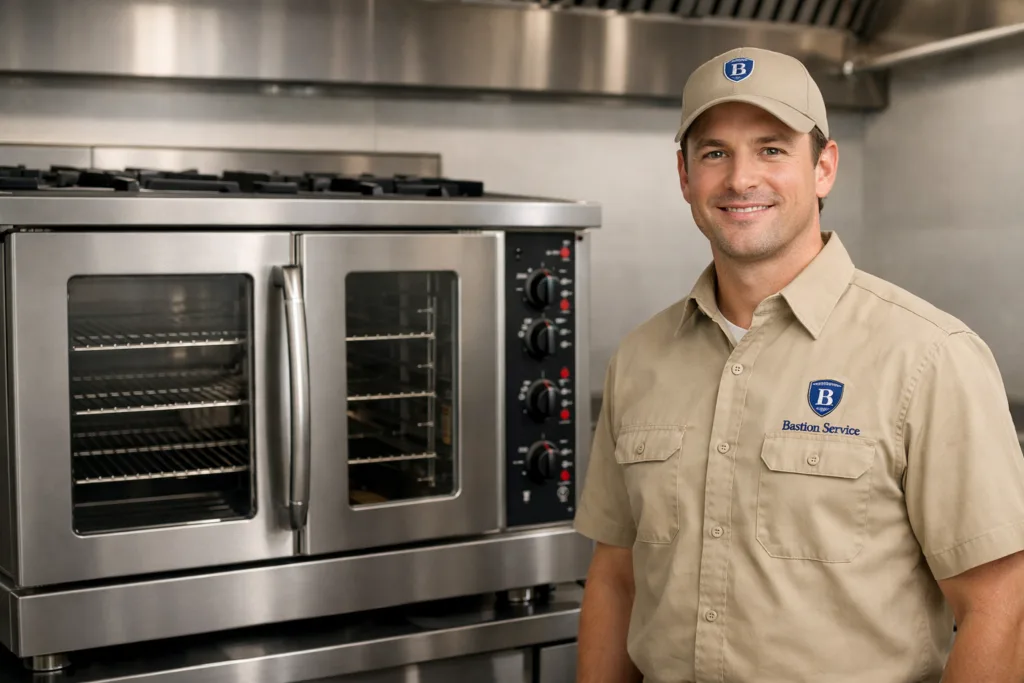




When a Vulcan oven starts missing temperature, heating unevenly, or shutting down during production, the effect shows up immediately in ticket timing, food quality, and staff workflow. For businesses in Rancho Park, service works best when the problem is tied to the exact symptom pattern rather than treated as a generic heating issue. Bastion Service evaluates how the oven is starting, heating, cycling, and recovering so the repair decision matches the failure and the urgency of your kitchen schedule.
Related commercial service paths in Rancho Park include Vulcan Commercial Repair in Rancho Park, Commercial Oven Repair in Rancho Park, and Vulcan Range Repair in Rancho Park.
Service starts with the symptom pattern, not guesswork
Two ovens can show the same complaint for very different reasons. One unit may fail to reach set temperature because of a weak ignitor or heating component, while another may appear underpowered because of sensor drift, airflow trouble, or a control issue. That is why repair planning should begin with how the oven behaves during preheat, during active cooking, and between loads.
For Rancho Park businesses, this matters because downtime is not the only cost. An oven that still runs but bakes unevenly or recovers slowly can create waste, slow prep, and force staff to make constant manual adjustments. A proper diagnosis helps determine whether the oven can remain in limited use until repair, or whether continued operation is likely to cause a larger interruption.
Why a Vulcan oven may stop heating properly
Not heating at all
If the oven will not heat, likely causes depend on the model and fuel type, but common failures include ignition problems, power supply issues, control faults, safety circuit interruptions, failed relays, wiring problems, or worn heating components. In some cases the oven appears dead; in others, the controls respond normally while no usable heat is produced.
Heating, but not reaching set temperature
When the oven starts heating but stalls below the selected temperature, the issue often points to reduced heat output, inaccurate sensing, thermostat or control calibration problems, or a component that works intermittently as the unit warms up. This kind of failure is especially disruptive because it can look minor at first while still affecting consistency on every batch.
Temperature swings during operation
If the cavity temperature rises and falls more than it should, or staff notice that cook times vary throughout the day, the problem may involve the temperature sensor, control board behavior, cycling components, or airflow that no longer supports stable heat. These patterns are often blamed on loading or operator habits until the inconsistency becomes too obvious to ignore.
What uneven baking and hot spots usually mean
Uneven results are one of the most common reasons businesses schedule Vulcan oven repair in Rancho Park. A unit that browns more on one side, cooks differently from rack to rack, or leaves the center underdone may have airflow problems, fan-related issues on convection models, door seal wear, internal obstruction, or inaccurate temperature feedback to the control system.
These problems do more than affect product appearance. They can lead to repeated batches, excess cook time, and unnecessary waste. If staff are rotating pans more often than usual, changing rack positions to compensate, or avoiding parts of the oven cavity, those are strong signs the unit needs service rather than more operator adjustment.
Slow preheat and poor temperature recovery
An oven that takes too long to preheat or struggles to recover between loads can slow the entire kitchen. This symptom may point to weakening heat production, control issues, sensor inaccuracy, or airflow limitations that become more noticeable during busy periods. The oven may still function, but not at the pace daily operations require.
Recovery problems are especially important in kitchens that depend on repeatable turnover. If the unit performs acceptably during light use but falls behind during rush periods, the repair decision should account for real production demand, not just whether the oven eventually gets hot.
Ignition faults, startup delays, and unexpected shutdowns
Intermittent startup is rarely a problem that stays small. If the oven clicks, tries to ignite repeatedly, starts late, or shuts off during a cook cycle, possible causes include ignition system wear, flame-sensing faults, safety cutoffs, loose wiring, or unstable controls. A unit that restarts later can still be at risk of a more complete failure during service hours.
Unexpected shutdowns should be taken seriously because they interrupt production and can be harder on other components when staff repeatedly cycle the oven to get it running again. If the pattern is becoming more frequent, scheduling service early is usually the better business decision.
Why temperature accuracy matters even when the oven still runs
An oven does not have to fail completely to create a serious operating problem. If the actual cavity temperature no longer matches the setpoint, businesses may see undercooked product, overbrowning, longer bake times, or inconsistent results across shifts. This can come from calibration drift, sensor wear, control instability, or a heating system that no longer responds the way the oven expects.
In practice, these cases often show up as staff habits: setting the oven higher than normal, extending cook times, or avoiding certain menu items on that unit. When those workarounds become routine, the issue has usually moved beyond normal adjustment and into repair territory.
When to stop using the oven until it is checked
- The oven is overheating or running far above the selected temperature.
- It shuts down mid-cycle or loses heat without warning.
- Ignition is delayed or inconsistent enough to interrupt workflow.
- Controls respond erratically, display errors, or do not hold settings.
- Staff must constantly monitor the unit to prevent poor results.
- There is a strong or persistent gas smell.
If there is any gas odor, stop using the oven immediately. If needed, leave the area and contact the gas utility or emergency service before arranging repair. Safety conditions should be handled before normal appliance service is scheduled.
Repair or replacement depends on more than age
Many Vulcan oven problems are worth repairing when the fault is isolated and the unit still fits the kitchen’s production needs. A targeted repair often makes sense for ignition failures, sensor problems, controls, fan issues, and other component-based faults when the rest of the oven remains in solid working condition.
Replacement becomes more likely when breakdowns are repeating, heat performance stays unreliable, major components show broad wear, or the downtime impact is becoming harder to justify. For businesses in Rancho Park, the key question is not simply how old the oven is, but whether a repair will return it to stable, predictable operation.
How businesses can prepare for a service visit
It helps to note exactly what the oven is doing before service is scheduled. Useful details include whether the problem happens during preheat or after the oven is hot, whether the issue affects every cycle or only some, how long startup takes, whether the temperature appears high or low, and whether any error codes or shutdown patterns are present.
It is also helpful to know if staff have been compensating by changing cook times, increasing temperature settings, rotating pans, or restarting the unit. Those details can speed diagnosis and help identify whether the issue is related to sensing, heat generation, airflow, or control behavior.
What good oven service should help you decide
Effective service should explain what is failing, how that failure relates to the symptom you are seeing, whether continued use is likely to create more risk, and what the repair means for uptime. For a busy kitchen, the goal is not simply to make the oven turn on again. The goal is to restore stable heat and dependable performance that supports daily production.
If your Vulcan oven is causing uneven baking, slow preheat, ignition trouble, temperature drift, or repeated shutdowns in Rancho Park, the next step is to schedule service before those symptoms create a larger outage. A focused evaluation gives your business a clearer repair path, more predictable scheduling, and a better chance of restoring normal kitchen flow without unnecessary delay.


