





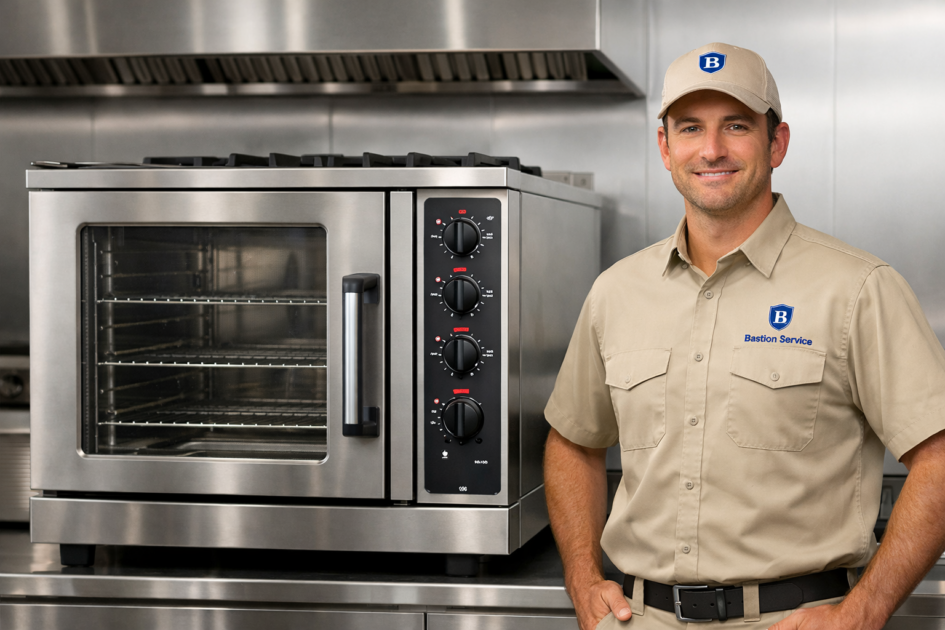
When a Vulcan oven starts missing temperature, heating unevenly, or shutting down mid-cycle, the issue quickly turns into delayed tickets, inconsistent food quality, and lost time for staff. For businesses in Culver City, the most useful next step is to schedule service based on the exact symptom pattern so the fault can be traced to the right component instead of guessing at parts. Bastion Service handles Vulcan oven repair with attention to the symptoms that affect daily kitchen output, recovery time, and safe operation.
Related commercial service paths in Culver City include Vulcan Commercial Repair in Culver City, Commercial Oven Repair in Culver City, and Vulcan Range Repair in Culver City.
Why Vulcan oven problems should be diagnosed by symptom
The same oven can show similar performance issues for very different reasons. Slow preheat may be tied to ignition weakness, burner trouble, a sensor reading problem, poor door sealing, or a control fault. Uneven cooking may point to airflow issues, calibration drift, gasket wear, or inconsistent heat production across the cycle. Because of that, service decisions are more accurate when they begin with how the oven is failing during actual use rather than with assumptions about a single bad part.
For kitchens in Culver City, that matters because small temperature problems often show up first as operational workarounds. Staff may rotate pans more often, extend cook times, restart the oven, or avoid certain menu items during busy periods. Those adjustments may keep service moving for a short time, but they also signal that the oven is no longer performing the way the business needs it to.
Why is my Vulcan oven not heating evenly or reaching set temperature?
This is one of the most common service concerns on a Vulcan oven, and it can come from several sources. If the oven never reaches the selected temperature, the cause may involve ignition components, burner performance, gas delivery, temperature sensing, relays, or the main control system. If it reaches temperature but does not hold it steadily, the issue may be more related to sensor accuracy, calibration drift, door leakage, or intermittent control behavior.
Uneven heating can also develop when one part of the oven cavity is getting proper heat while another is not. In that situation, the service visit may focus on airflow, convection-related components, burner distribution, or heat loss around the door. What matters most is not just whether the oven gets hot, but whether it heats consistently enough to support repeatable results from one batch to the next.
Common Vulcan oven symptoms and what they may indicate
Not heating at all
If the oven powers on but produces no usable heat, the problem may involve ignition failure, a gas valve issue, a burner fault, a safety-related interruption, or an electrical supply problem. Some units appear to start normally while the heat sequence never completes. That distinction is important because it helps narrow the diagnosis between control-side and heat-side failures.
Slow preheat
An oven that eventually gets hot but takes far too long to do it can create production bottlenecks all shift long. Slow preheat may be caused by weak ignition, unstable burner output, sensor inaccuracy, heat loss through worn gaskets, or controls that are not managing the heating cycle correctly. In business use, this often shows up as delayed openings, slower batch turnover, or longer recovery between loads.
Temperature swings during operation
Wide fluctuations above or below the set point can affect bake quality, holding consistency, and timing. Temperature swings may be related to thermostat or sensor drift, control board issues, relay problems, or heating components that are cycling erratically. If staff are constantly adjusting settings to chase stable performance, the oven likely needs service rather than more trial and error.
Uneven baking or hot spots
When one rack finishes faster than another, or product browns unevenly from side to side, the issue may be tied to airflow restrictions, convection component wear, burner imbalance, or sealing problems that let heat escape. This type of symptom often gets mistaken for a loading or recipe issue at first, especially when the oven still appears to be functioning. A repair inspection helps confirm whether the inconsistency is coming from the equipment itself.
Ignition delays or repeated attempts to start
If the oven hesitates before lighting, clicks repeatedly, or starts unpredictably, the ignition system should be checked promptly. Delayed ignition can involve igniters, flame sensing, gas flow, controls, or related safety components. Repeated failed starts are not just inconvenient; they can become more disruptive as the problem worsens and can lead to shutdowns during active service periods.
Unexpected shutdowns
An oven that drops out while in use may have a control issue, overheating condition, sensor fault, power interruption, or a problem somewhere in the operating sequence. Shutdowns are especially disruptive because they interrupt active production and make timing unreliable across the kitchen. If this is happening more than once, it is usually a sign that the fault is progressing.
Door and gasket problems
Not every heating complaint starts with the burner or control system. Worn gaskets, loose hinges, latch problems, and poor door alignment can let heat escape and affect cavity stability. The oven may then seem weak, slow, or inconsistent even though the heating system is still functioning. In practice, that can lead to longer cook times, uneven results, and unnecessary strain on the rest of the unit.
Display or control issues
If the display is blank, settings will not hold, buttons do not respond, or the control resets unexpectedly, the fault may sit in the interface, internal relays, main board, or incoming power path. These issues can resemble heating failures because they interrupt the way the oven manages temperature and timing. Proper diagnosis helps determine whether the problem is truly in the heat system or in the controls directing it.
Signs the problem is affecting more than one component
Some service calls reveal a single failed part. Others show a wear pattern that has spread into related systems. For example, a long-running heat retention problem can force the oven to cycle harder than normal. Repeated ignition trouble may strain adjacent components over time. Temperature drift can lead staff to run the oven longer or hotter, which may mask the original issue while adding stress elsewhere.
That is why a service visit should look beyond the first visible symptom. If the oven is showing unstable heating, ignition trouble, and control inconsistency together, the repair decision may be different than it would be for one isolated failure. Businesses in Culver City benefit from understanding whether the problem is targeted and repairable in a straightforward way or part of a broader decline in performance.
When to schedule oven repair
Service should be scheduled when the oven is no longer predictable enough for daily production. That includes repeated slow preheat, recurring temperature drift, unreliable ignition, shutdowns during use, inconsistent bake results, or visible wear around the door that affects heat retention. It is also worth calling for service when staff have started compensating for the oven in ways that were not previously necessary.
- Cook times keep changing for the same menu items
- Staff rotate pans to work around hot spots
- The oven needs multiple start attempts
- Recovery time between loads is getting longer
- The control panel behaves unpredictably
- The unit stays in use, but confidence in the results is dropping
Those are all signs that the issue is no longer minor. Even if the oven still runs, unstable performance can be enough to justify repair before the unit reaches a full outage.
Repair or replace: how businesses usually evaluate the decision
Many Vulcan oven problems can be repaired effectively when the unit is still structurally sound and the failure is limited to serviceable components. That is often the practical path when the oven still fits production needs and the problem is centered in ignition, sensing, controls, burners, or door-related wear.
Replacement becomes a more serious discussion when the oven has recurring faults across multiple systems, downtime is becoming frequent, or the cost of restoring reliable operation starts to approach the value of the equipment in use. For a business, the decision is rarely about one repair bill alone. It also includes lost production time, staff disruption, menu limitations, and whether the oven can return to stable day-to-day performance after service.
How to prepare for a service visit
A few details can make oven diagnosis faster and more useful. Before the appointment, it helps to note whether the oven fails during preheat, under load, at a specific temperature range, or only after running for a while. If the issue is intermittent, tracking when it occurs can help narrow the cause. It is also helpful to identify any error behavior, unusual noises, ignition delays, or signs of heat escaping around the door.
Useful details to have ready include:
- Whether the oven is not heating, underheating, or overheating
- If the problem happens every cycle or only sometimes
- Whether the display or controls act abnormally
- If shutdowns occur during preheat or during cooking
- How long the performance issue has been developing
- Whether staff have noticed uneven results in specific areas of the cavity
That information helps connect the repair visit to real operating conditions instead of a general description like “it is acting up.”
Service focused on restoring usable, consistent oven performance
For businesses in Culver City, oven repair is not just about making the unit turn on again. It is about restoring stable heating, repeatable results, and confidence that the equipment can support the workload without constant adjustment from staff. When a Vulcan oven starts showing signs of unreliable performance, scheduling repair based on the actual symptoms is the most practical way to reduce downtime and decide on the right next step for the kitchen.


