
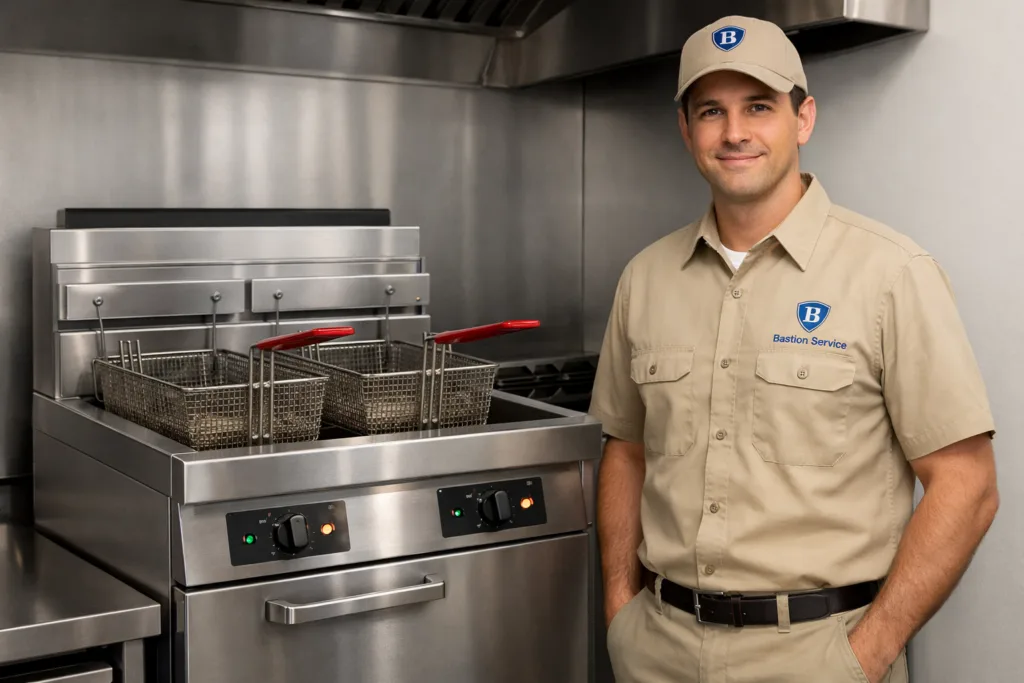




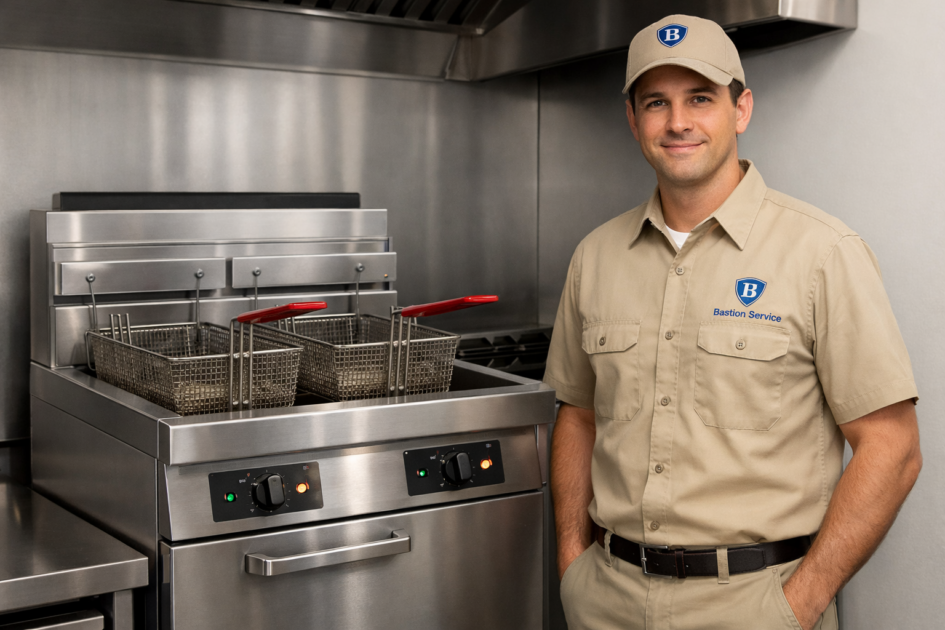
Fryer problems rarely stay minor for long. When a Vulcan unit starts missing temperature, recovering too slowly between batches, leaking oil, or shutting down during service, the priority is to identify the failed component or system before more downtime affects output. For restaurants, hotels, cafeterias, and other food-service businesses in Los Angeles, repair scheduling is often driven by how quickly the fryer issue is affecting ticket times, food consistency, and safe operation.
Related commercial service paths in Los Angeles include Vulcan Commercial Repair in Los Angeles, Commercial Fryer Repair in Los Angeles, and Vulcan Oven Repair in Los Angeles.
Bastion Service handles Vulcan fryer repair for businesses that need symptom-based troubleshooting, informed repair recommendations, and a realistic path back to stable operation. That includes checking how the fryer heats, how it holds temperature under load, whether ignition and safety components are functioning correctly, and whether wear around valves, controls, or oil containment is creating larger reliability problems.
Common Vulcan fryer problems in Los Angeles kitchens
Not heating or not reaching the selected temperature
If the fryer does not heat at all, heats only part of the time, or stalls below the target oil temperature, the fault may involve the thermostat, temperature probe, high-limit safety, ignition system, gas valve, wiring, or control board. In day-to-day kitchen use, this usually shows up as longer cook times, pale product, uneven results, or a fryer that appears to be on without producing the expected heat.
This type of issue should be checked promptly because running below the proper temperature can affect food quality while also putting extra strain on burners, controls, and safety components.
Slow recovery between batches
Slow recovery is one of the most disruptive fryer complaints because the unit may still operate, but not well enough to support volume. A Vulcan fryer that lags after each drop can create backup on the line, force longer hold times, and make cooks adjust procedures to compensate for the equipment.
Possible causes include weak burner performance, airflow restrictions, carbon buildup, sensor drift, control issues, or heat transfer problems inside the fryer system. If recovery has become noticeably slower during busy periods, service is often warranted before the unit progresses to complete failure.
Temperature swings and inconsistent cooking
Wide oil temperature fluctuations can cause product to come out too dark, too light, greasy, or inconsistent from one batch to the next. Staff may notice that cook times no longer match the usual routine, or that results vary even when the same procedure is used.
These symptoms can point to thermostat or probe problems, control faults, burner irregularities, or cycling issues that are preventing stable heat regulation. Because temperature instability directly affects product quality and throughput, it is usually more than a minor calibration concern.
Ignition failure or unreliable startup
If the fryer clicks but does not light, lights intermittently, or requires repeated reset attempts, the problem may be tied to the ignition module, flame sensing, gas delivery within the unit, wiring, or safety devices interrupting normal startup. A fryer that starts unpredictably can create service delays and may shut down again after briefly returning to operation.
Repeated restarts are rarely a dependable answer. The better approach is to confirm whether the issue is isolated to one failed part or whether another condition is causing the ignition system to drop out.
Shutdowns during operation
A fryer that heats normally and then turns off mid-shift may be dealing with overheating, a high-limit trip, control failure, electrical interruption, or an ignition-related fault. This can be especially disruptive when the fryer seems normal at startup but becomes unreliable only after sustained use.
Mid-cycle shutdowns are worth addressing quickly because the visible symptom does not always indicate the actual cause. In some cases, a safety device is reacting correctly to another problem elsewhere in the unit.
Oil leaks and drain-valve problems
Oil under or around the fryer should not be ignored. Leaks may come from the drain valve, fittings, seals, filter-area components, or other wear points that develop over time. Even a small leak can interrupt workflow, create slip risk, and make routine cleaning more difficult.
Beyond the mess, oil leakage can complicate inspection of nearby components and may point to a condition that will continue to worsen with use.
Why accurate diagnosis matters before repair decisions
With fryers, the most obvious symptom is not always the root cause. A temperature complaint may start with a control issue, but the underlying fault could involve sensing, gas performance, or a safety component reacting to abnormal conditions. A startup failure may look like ignition trouble while actually stemming from another part of the circuit.
That is why a symptom-based service visit matters. Confirming the complaint, observing how the fryer behaves under operating conditions, and checking the related systems helps avoid unnecessary parts replacement and reduces the chance of repeated downtime after an incomplete repair.
Why is my Vulcan fryer not heating or recovering temperature properly?
This usually comes down to one of a few categories: the fryer is not producing full heat, the controls are not reading oil temperature accurately, the unit is cycling incorrectly, or heat transfer is being reduced by buildup or component wear. From the kitchen side, the signs are familiar: the fryer takes too long to preheat, drops too far after a batch, struggles to rebound, or never seems to hold a steady frying temperature.
Because several different failures can create the same complaint, service is less about guessing from the symptom and more about testing the parts and systems that control heating, ignition, and temperature regulation.
When service should be scheduled
Scheduling repair makes sense when the fryer is showing any of the following:
- Delayed heat-up or failure to reach the set temperature
- Slow recovery after normal basket loads
- Frequent temperature swings
- Intermittent ignition or failed startup
- Shutdowns during production
- Oil leaks around the base, valve, or filter area
- Cook times that keep getting longer
- Inconsistent product color or texture from batch to batch
If staff is already adjusting procedures to work around the fryer, that usually means the issue has moved beyond routine operation and into repair territory.
When continued use can make the problem worse
Some fryer issues should not be pushed through a busy shift. Overheating, unstable ignition, recurring shutdowns, and oil leaks can all expand the repair scope if the unit continues to run in an abnormal condition. What starts as a single failed component can lead to added wear on burners, controls, valves, or safety parts.
There is also the operational cost to consider. Once a fryer is affecting consistency, speed, or safe workflow, the impact is no longer limited to the equipment itself. It is affecting the kitchen’s ability to produce at the expected pace.
Repair versus replacement considerations
Not every Vulcan fryer problem points to replacement, and not every older unit is a poor repair candidate. The decision usually depends on the overall condition of the fryer, the severity of the present fault, recent repair history, oil containment condition, and the cost of restoring reliable performance.
If the issue is limited to a serviceable control, ignition component, sensor, valve, or related part, repair may be the most practical choice. If the fryer has multiple ongoing faults, repeated shutdowns, major wear, or broader reliability concerns, replacement may deserve consideration. A proper service assessment helps separate a targeted repair from a temporary fix that may not support daily production.
Preparing for a fryer service visit
Before service is scheduled, it helps to note the exact symptom pattern. Useful details include whether the fryer fails at startup or only after heating, whether the temperature runs low or swings high and low, whether the problem happens every shift or only during peak volume, and whether any oil leakage is visible. Knowing when the issue started and how it has changed can shorten diagnosis time.
If possible, businesses should also be ready to describe whether the unit is still operating partially, completely down, or affecting output enough to require priority scheduling.
Service-focused support for Los Angeles kitchens
For food-service operations in Los Angeles, fryer repair needs to lead to a usable decision: repair now, stop using the unit, or plan for replacement based on condition and downtime risk. When a Vulcan fryer is no longer heating correctly, recovering properly, or operating safely, the most useful next step is to schedule service around the symptom pattern and the urgency of the kitchen’s workload. That approach helps limit disruption, protect output, and move the unit back toward reliable operation with fewer assumptions.


