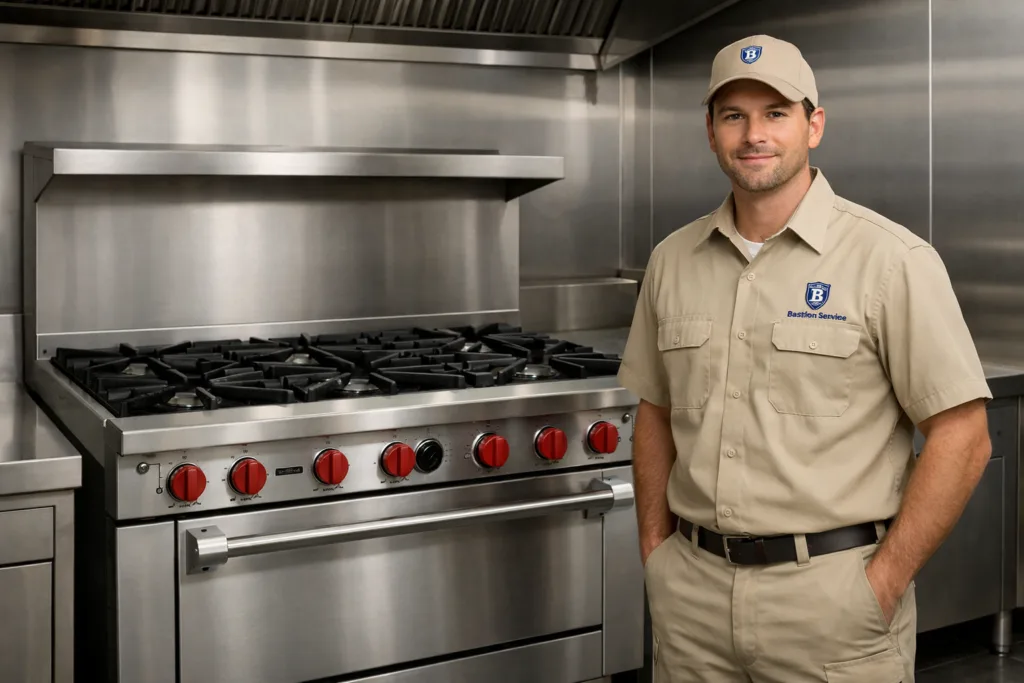




Range problems can slow prep, interrupt line timing, and create inconsistent results long before the unit stops working entirely. For restaurants and other food-service businesses in Los Angeles, service is usually most effective when the issue is described by symptom, operating pattern, and urgency rather than by guessing at parts. Bastion Service works from that symptom pattern to determine whether the fault is tied to ignition, burner performance, oven temperature control, gas flow, switches, valves, or heat-stressed components, then helps schedule repair around the level of disruption.
Related commercial service paths in Los Angeles include Vulcan Commercial Repair in Los Angeles, Vulcan Oven Repair in Los Angeles, and Vulcan Fryer Repair in Los Angeles.
What usually causes a Vulcan range to stop lighting, heating, or holding temperature
One symptom can come from several different failures. A burner that will not light may involve an ignition component, clogged ports, alignment trouble, a faulty switch, or a gas delivery problem. An oven that will not hold temperature may point to thermostat drift, a sensing issue, ignition trouble, a valve problem, or uneven heat distribution inside the cavity. That is why a range should be evaluated as a system instead of treating every symptom as a single-part failure.
In busy kitchens, early warning signs often show up as slower recovery, uneven flame, repeated clicking, product inconsistency, or controls that no longer feel normal. These issues may seem manageable for a shift or two, but they often lead to more downtime when staff start working around them.
Common Vulcan range symptom groups
Burners that click, spark, or fail to light reliably
If a burner clicks repeatedly without lighting, lights only after several attempts, or works intermittently, the problem may involve the ignition path, burner condition, switch response, or gas flow. When multiple burners begin showing similar behavior, the pattern matters. A single affected burner can suggest a localized fault, while repeated ignition trouble across sections may indicate a broader issue that needs prompt inspection.
Delayed ignition should not be ignored in a production kitchen. Even if the burner eventually lights, unreliable startup can affect workflow and signal wear that is likely to worsen under daily heat and cleaning cycles.
Weak flame, uneven heat, or slow cooking performance
Low flame output, unstable flame pattern, and uneven heating often show up as longer ticket times, poor pan performance, or inconsistent cooking across burners. Possible causes include restricted burner ports, valve wear, pressure-related issues, buildup, or component wear affecting normal flame distribution.
These problems are easy to underestimate because the range may still appear usable. In practice, reduced burner performance can create hidden costs through longer cook times, repeated adjustments by staff, and uneven product quality during service.
Oven section not reaching temperature or drifting during use
When the oven runs cool, overshoots, cycles unpredictably, or struggles to recover after the door opens, the fault may involve controls, sensors, igniters, valves, or internal heat delivery. Temperature drift is especially disruptive when the menu depends on repeatable baking, roasting, or holding performance.
If staff have started rotating product more often, extending cook times, or changing settings to compensate, the range may already be outside normal operating performance even if it has not fully failed.
Hot spots, scorching, or uneven baking results
Uneven results inside the oven usually point to a heat distribution problem rather than a simple preference issue. Hot spots, pale areas, or inconsistent browning can be tied to burner operation, controls, internal wear, or airflow-related conditions within the unit.
Once the kitchen begins adapting recipes or pan placement around the equipment, repair usually becomes more cost-effective than continuing to work around the problem.
Controls, knobs, and valves that do not respond normally
Loose knobs, stiff valve action, settings that do not match the actual flame, or controls that feel erratic can indicate wear in high-use components. These faults can affect both performance and safe operation because the range is no longer responding predictably during service.
What starts as a minor control complaint can become a larger operating issue when staff cannot repeat settings reliably across shifts.
Why intermittent problems deserve faster service
Intermittent faults are some of the most disruptive because they are easy to delay and hard for staff to trust. A burner that fails only during peak use, an oven that drifts after preheat, or ignition trouble that appears after the unit gets hot often points to a component breaking down under operating conditions. These patterns usually become more frequent over time.
Scheduling service while the problem is still intermittent can reduce downtime because the symptom history is clearer and the repair is less likely to expand into surrounding component damage from continued use.
When continued use can make the repair larger
Using the range through repeated ignition failure, unstable flame, sticking controls, or major temperature swing can place more stress on related parts. Staff may rely harder on the remaining burners, run longer cook cycles, or repeatedly restart the same section to keep production moving. That extra strain can turn an isolated fault into a broader repair.
- Repeated clicking without consistent ignition
- Burners that drop out during use
- Noticeably weak or uneven flame
- Oven temperatures far above or below the set point
- Controls that stick, slip, or respond unpredictably
When these symptoms appear, it is usually better to have the unit checked before returning it to full workload.
Repair versus replacement for a Vulcan range
Many range problems are still good repair candidates when the main structure is sound and the issue is limited to serviceable components. Burner faults, ignition issues, thermostat-related problems, valve wear, and control failures are often repairable if the overall unit remains in solid working condition.
Replacement becomes a stronger consideration when the range has multiple active issues across different sections, ongoing temperature instability after prior service, heavy wear affecting daily reliability, or repair costs that no longer match the condition of the equipment. The useful question is whether the current problem is isolated or part of a larger pattern of declining performance.
How to prepare for a service visit
The most helpful details are usually simple and specific. Knowing which burners are affected, whether the oven is underheating or overheating, when the problem started, and whether it appears during startup or under load can speed up diagnosis. If the issue is intermittent, noting what happens just before the fault appears can be especially useful.
- Which section is affected: top burners, oven, or both
- Whether the problem is constant or intermittent
- Any clicking, delayed ignition, flame change, or odor
- Whether the oven runs cool, hot, or unevenly
- How the problem is affecting production or service flow
Range repair service for Los Angeles kitchens
For Los Angeles operations, the goal is not just getting the unit running again but restoring stable, repeatable performance that fits daily production demands. When a Vulcan range begins affecting burner reliability, oven output, control response, or recovery time, the next step is to narrow the symptom pattern and schedule repair before the disruption spreads to prep, line timing, and product consistency. A focused service call helps determine what is failing, whether continued use is increasing risk, and what repair path makes the most sense for the kitchen.