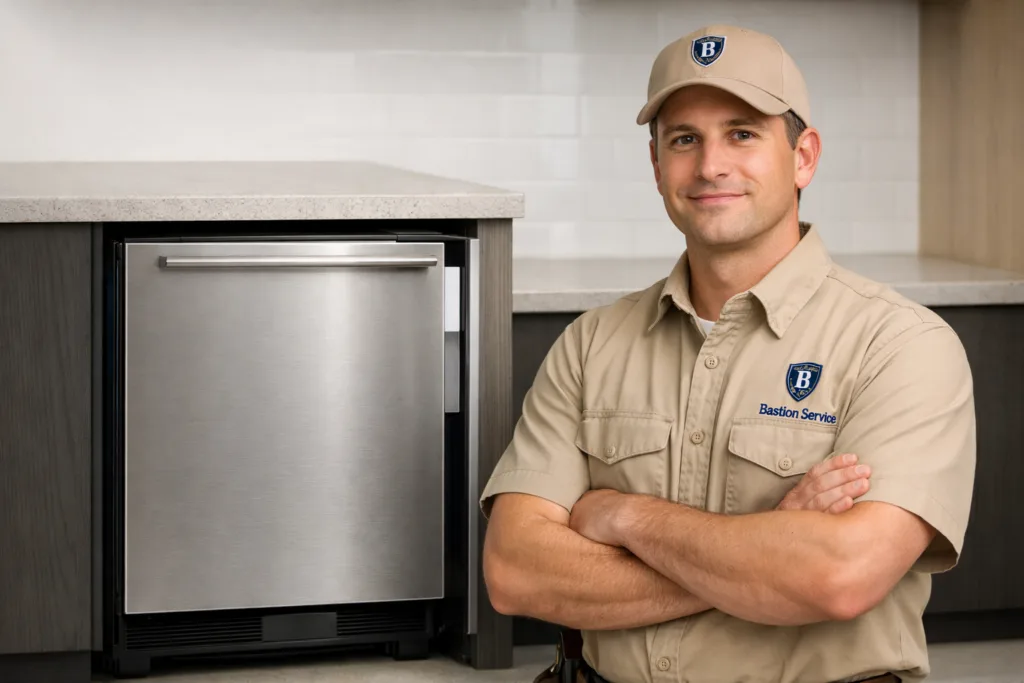
Ice makers fail in a few predictable ways, but the reason behind the symptom is not always obvious from the outside. A U-Line unit that makes no ice at all can have a very different problem than one that makes small batches, leaks during fill, or freezes the bin into a solid block. For homeowners in Mar Vista, the useful first step is separating a water-supply issue from a temperature, drain, sensor, or harvest-cycle problem so the repair decision is based on what the machine is actually doing.
Common U-Line ice maker symptoms and what they can mean
Most residential service calls start with one of a handful of complaints: no ice, slow production, leaking, odd cube quality, clumping, or frost where it does not belong. While these symptoms can overlap, each one points technicians toward a different part of the system.
No ice production
If the unit is powered on but the bin stays empty, the issue may involve a failed water inlet valve, restricted water flow, a fill problem, a control fault, or temperatures that never reach the range needed for a proper freeze-and-harvest cycle. Sometimes the machine sounds like it is running, but the ice-making sequence is not progressing as it should.
Slow ice production
When the unit still makes ice but not enough for normal household use, attention usually turns to cooling performance, fill consistency, condenser condition, and whether the machine is taking too long to freeze or release each batch. Slow production is often dismissed as a minor issue, but it can be an early sign of a larger problem developing.
Leaks or water around the cabinet
Water on the floor, around the toe-kick, or inside surrounding cabinetry should be addressed quickly. Leaks can come from a loose connection, cracked line, overflow condition, drain restriction, or melting caused by unstable temperatures. Even a small leak can damage adjacent finishes if it continues unnoticed.
Clumped ice, hollow cubes, or sheets of ice
Changes in cube shape and texture usually mean the machine is not filling, freezing, or harvesting correctly. Hollow cubes can point to water-supply issues. Clumping may suggest partial melting and refreezing. A sheet of ice in the bin often means the cycle is off or water is entering where it should not.
Frost buildup or repeated icing inside the unit
Frost that keeps returning can indicate sealing problems, airflow issues, control trouble, or refrigeration-related faults. If the inside of the machine develops heavy frost or the bin repeatedly freezes over, the problem is typically beyond simple cleanup.
Why the same symptom can come from different faults
An undercounter ice maker combines water delivery, refrigeration, sensing, harvesting, and drainage in a compact space. That means one visible symptom can have several possible causes. No ice, for example, might be caused by low water pressure, a failed valve, an issue with temperature regulation, or a problem in the harvest sequence.
This is why guesswork tends to waste time. Replacing a single visible part without confirming the full cycle can leave the original issue unresolved. Helpful service should identify where the sequence is breaking down and whether the fault is isolated or part of broader wear inside the unit.
When a repair should not wait
Some problems are inconvenient but stable for a short time. Others can get more expensive if the machine keeps running. Homeowners in Mar Vista should move quickly when an ice maker is leaking, building repeated frost, making harsh noises, or running without producing usable ice.
- Water pooling beneath the unit or inside nearby cabinetry
- Constant cycling with little or no ice production
- Loud clicking, grinding, or abnormal harvest noises
- Recurring solid ice clumps or a frozen-over bin
- Frost that returns soon after being cleared
- Unpredictable shutoffs or repeated restarts
These signs suggest the machine is not completing its normal cycle correctly. Continued use may add stress to working parts or allow moisture problems to spread beyond the appliance.
Built-in ice makers need fast attention when leaking
Many U-Line ice makers are installed tightly into finished kitchen or bar cabinetry. In that setting, leaks and meltwater do more than affect the machine itself. Moisture can reach flooring, trim, cabinet panels, and the installation cavity where it is harder to spot early. What looks like a minor drip at the front edge can become a much larger cleanup if the source is left alone.
For built-in units, quick diagnosis matters not just for restoring ice production but also for limiting damage around the appliance.
Repair versus replacement
Not every U-Line ice maker problem means the unit should be replaced. Many issues come down to a specific component failure, water-path problem, adjustment, or serviceable operating fault. Repair often makes sense when the appliance is otherwise in good condition and the diagnosis points to a targeted fix.
Replacement becomes a more serious consideration when there are multiple failing systems, repeated leak history, advanced wear, or a refrigeration problem that outweighs the value of the machine. Prior repair history matters too. If the same symptom keeps returning after earlier work, the better choice may be different than it was the first time.
Repair is often reasonable when
- The issue is limited to one identifiable part or system
- The cabinet fit and installation are still worth preserving
- The unit has been otherwise reliable
- There is no major surrounding water damage
Replacement may deserve consideration when
- Multiple systems are failing at the same time
- The appliance has ongoing leak-related damage
- The same problem has returned after previous repairs
- The diagnosis points to major sealed-system or extensive internal failure
What a useful service visit should check
A worthwhile repair visit should focus on the full ice-making process rather than one symptom in isolation. That usually includes checking water supply, inlet operation, fill behavior, freezing performance, harvest timing, drain function, seals, and signs of abnormal frost or temperature instability.
That kind of testing helps answer the questions homeowners actually care about: what failed, whether the unit is worth repairing, and whether continued use risks more damage. For a household ice maker, the goal is not just to get it running for the moment, but to understand whether it can return to normal daily use without repeating the same problem.
Practical next steps for homeowners
If your U-Line ice maker has stopped making ice, is producing less than normal, or is leaving water where it should not, it is best to stop relying on it until the cause is identified. Emptying the bin, watching for fresh leaks, and noting when the unit cycles or makes unusual sounds can help clarify the symptom pattern. From there, a proper diagnosis can determine whether the repair is straightforward or whether replacement should be part of the conversation.
For homes in Mar Vista, that symptom-based approach is the most reliable way to decide what to do next without overcommitting to a repair before the actual fault is known.