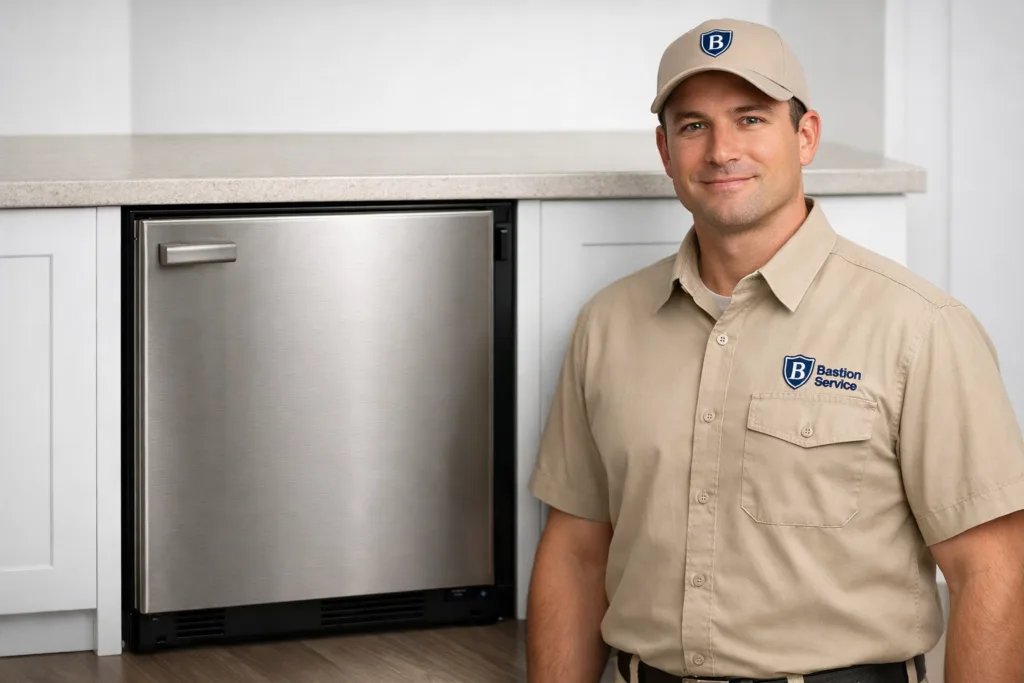
When a freezer starts warming, icing over, or running far longer than normal, the first priority is protecting food and figuring out whether the issue is isolated or spreading through the cooling system. With U-Line units, the same symptom can come from several different causes, so the most useful next step is to look at how the problem appears in everyday use: where frost forms, how the door seals, whether the fan is moving air, and whether temperatures swing during the day.
Common U-Line freezer problems in Fairfax homes
Many freezer failures begin as small changes rather than a complete shutdown. You may notice soft frozen food, frost on shelves or the rear panel, moisture near the door, or a cabinet that sounds different than usual. Those early signs often reveal whether the problem is related to airflow, defrost operation, controls, door sealing, or the cooling system itself.
Not freezing hard enough
If the freezer is cold but not cold enough, several faults are possible. Restricted airflow, a weak evaporator fan, dirty coils, a door gasket leak, or a control issue can all reduce performance. In some cases, the unit may seem to recover after the door stays closed for a while, but that does not mean the underlying problem has resolved. Intermittent cooling usually points to a part or condition that is getting worse.
Frost buildup on the back wall or around stored food
Heavy frost often means moisture is entering the compartment or the freezer is not defrosting properly. A worn gasket, a door that does not close squarely, or a defrost component failure can all produce the same result. Once frost blocks airflow, temperature becomes uneven, with some areas freezing solid while others warm up enough to affect food safety.
Water leaking onto the floor
A puddle under a freezer may come from melting frost, a blocked drain, or condensation caused by warm air entering the cabinet. Even occasional leaking deserves attention. Water around the appliance can damage surrounding flooring and usually indicates that ice, drainage, or sealing issues are developing behind the scenes.
Fan noise, buzzing, or nonstop running
U-Line freezers normally make some operating noise, but new rattling, clicking, buzzing, or longer run times can point to strain. A noisy fan motor, ice striking a fan blade, failing start components, or a control problem can all change the sound profile. If the unit seems to run constantly without reaching the right temperature, it is usually compensating for a cooling problem rather than simply working harder by design.
What different symptom patterns can mean
Paying attention to the pattern helps separate a simple repair from a more involved one. For example, a freezer that is warm everywhere may indicate a broader cooling failure, while one that is frosted in one area and thawing in another often suggests an airflow or defrost problem.
- Soft food with little or no frost: possible fan, control, or sealed-system trouble
- Thick frost near the back panel: common with defrost or door-seal issues
- Ice near the door opening: often linked to warm air infiltration
- Cold temperatures that swing noticeably: may point to sensor or thermostat-related faults
- New noise plus weak cooling: often a fan, compressor-start, or airflow concern
These observations do not replace testing, but they help explain why guessing based on one symptom alone can lead to the wrong repair.
Why U-Line freezer problems should be diagnosed rather than guessed
It is common for a freezer to show one visible symptom while the true fault is somewhere else. Frost might look like a door problem but actually be caused by a failed defrost heater. Weak cooling may seem like a compressor issue when the real cause is a fan not circulating cold air. Because U-Line products can be sensitive to airflow, controls, and temperature management, replacing parts without confirmation can add cost without fixing the core issue.
A proper evaluation usually looks at temperature behavior, frost pattern, fan operation, door closure, drain condition, control response, and overall cooling performance. That approach gives homeowners a better idea of whether the repair is straightforward, whether additional wear is involved, and whether the appliance is worth repairing.
When to stop using the freezer as normal
If food is thawing and refreezing, the freezer should not be trusted for long-term storage until the problem is addressed. Repeated temperature swings can affect food quality even if everything appears frozen again later. The same caution applies if the door does not stay sealed, the interior is developing recurring ice, or the unit is leaking water onto the floor.
You should also be cautious if the cabinet feels unusually warm on the outside, the compressor seems to run almost nonstop, or the appliance has become noticeably louder. Those signs often mean the freezer is under strain and may continue declining with continued use.
Repair or replacement: what usually makes sense
Many U-Line freezer issues are repairable, especially when the failure involves a fan motor, sensor, control, door gasket, drain problem, or defrost component. Those repairs can restore normal operation without replacing the appliance. In contrast, replacement becomes more worth considering when there is a major sealed-system failure, repeated expensive breakdowns, or overall wear affecting multiple systems at once.
For most homeowners in Fairfax, the decision comes down to three things: the condition of the freezer, the cost and type of the failed part, and the likelihood that the repair will return stable performance. A single targeted repair is very different from a unit showing signs of broad age-related decline.
What to check before service
Before scheduling service, it helps to note a few details about how the freezer is behaving. Small observations often make the problem easier to identify.
- Whether the freezer is fully warm or only fluctuating
- Where frost or ice is collecting
- Whether the door closes firmly every time
- Whether noise happens constantly or only at startup
- Whether leaking is occasional or steady
- Whether the problem started suddenly or slowly worsened
If possible, also check whether food near the back is colder than food near the door, since uneven temperatures often point to airflow or circulation trouble rather than a total cooling loss.
Focused help for U-Line freezer repair in Fairfax
Freezer problems are easiest to address before food loss, heavy icing, or compressor strain turns a smaller issue into a larger one. If your U-Line freezer is not holding temperature, building frost, leaking, or making new fan noise, symptom-based testing is the best way to determine the repair path and whether the unit remains a good candidate for continued use in your home.