
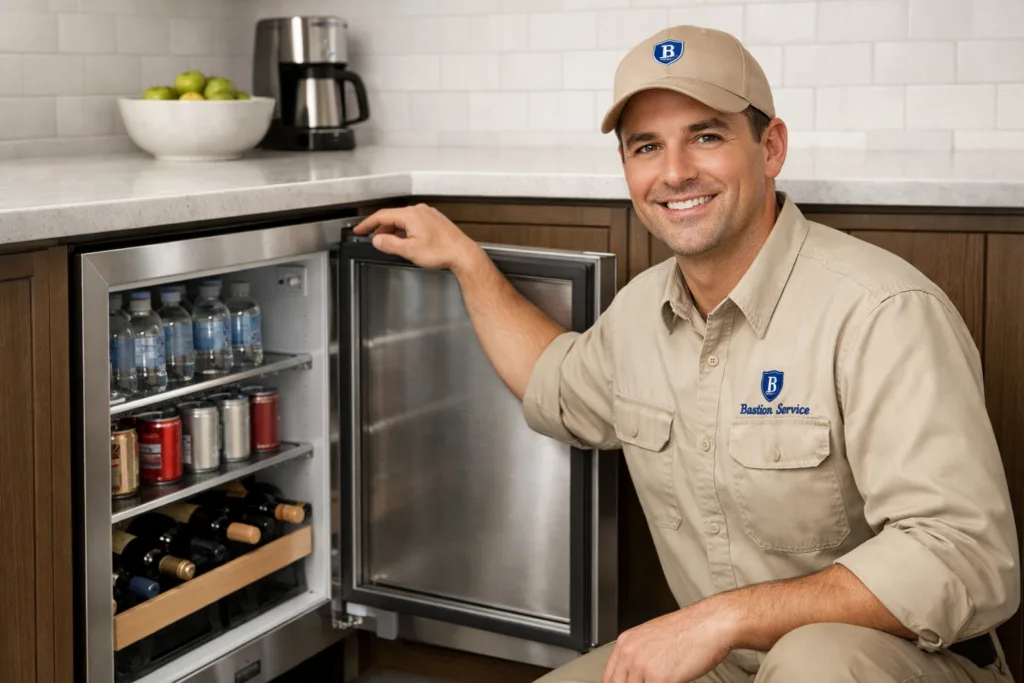





Specialty refrigeration problems tend to start small. A cabinet may still cool, but not evenly. An ice maker may cycle, but produce less ice than usual. A wine cooler may hold a rough range while drifting enough to affect storage quality. With U-Line units, those early signs are worth paying attention to because they often reveal whether the issue is a simple airflow or water problem or something deeper in the control or sealed cooling system.
For specific U-Line appliance paths in Fairfax, review U-Line Refrigerator Repair in Fairfax, U-Line Freezer Repair in Fairfax, and U-Line Ice Maker Repair in Fairfax.
Start with the symptom pattern, not the part
Many U-Line complaints sound similar at first: warm temperatures, frost, water, noise, or inconsistent operation. The cause, however, can be very different from one unit to another. A temperature complaint may come from a fan problem, a sensor reading issue, poor door sealing, restricted condenser airflow, a defrost fault, or a refrigerant-related failure. A leak may be tied to a blocked drain, a loose connection, or an ice maker fill problem rather than the cabinet itself.
That is why symptom pattern matters. Whether the problem is constant or intermittent, getting worse or staying about the same, affecting the whole appliance or only one area can tell a lot about where the failure is developing. In Fairfax homes, this helps narrow down whether the unit is a good candidate for repair or whether larger replacement decisions may be approaching.
Common U-Line refrigerator problems
A U-Line refrigerator may show trouble in ways that are easy to miss at first. You might notice beverages are not as cold as usual, food spoils sooner, or the compressor seems to run longer than normal. Some refrigerators also develop water under the unit, interior condensation, or a fan noise that becomes more noticeable over time.
Common causes include:
- Dirty condenser surfaces reducing heat release
- Evaporator or condenser fan failure
- Door gasket wear allowing warm air inside
- Thermistor or thermostat problems affecting temperature control
- Defrost system faults leading to airflow restriction
- Sealed-system issues causing weak or incomplete cooling
If the refrigerator no longer returns to temperature after the door has been closed for a normal amount of time, that usually points to more than routine fluctuation. Ongoing warm storage should be addressed promptly to reduce food loss and avoid extra strain on the cooling components.
What freezer symptoms usually mean
Freezer problems often become obvious only after performance has already dropped. Ice crystals on food, soft items, frost buildup on walls or shelves, and a door that no longer seals tightly are common warning signs. In some cases the freezer still seems cold, but not cold enough to preserve food safely over time.
Several symptom groups are especially useful:
- Heavy frost buildup: often linked to door sealing problems, moisture intrusion, or a defrost failure
- Softening food: may indicate weak cooling, poor airflow, or control inaccuracy
- Constant running: can point to heat exchange issues, air leaks, or a struggling compressor system
- Uneven freezing: sometimes caused by blocked vents or fan problems
A freezer that is partially working can be harder to evaluate than one that fails completely, but partial cooling is often an important clue. It may suggest that the system is still operating but no longer doing so efficiently enough to maintain proper temperature.
Ice maker issues that should not be ignored
U-Line ice makers can fail in several different ways. Some stop producing ice entirely. Others make small batches, create hollow or irregular cubes, leak water, or leave the storage area wet. In many households, the first sign is simply slower production or a change in cube quality.
Typical causes include:
- Water supply restrictions
- Inlet valve problems
- Scale buildup affecting operation
- Sensor or control faults
- Drainage issues
- A failing ice-making assembly
If the unit hums but does not complete a cycle, or if water is pooling near the base, it is best not to let the problem continue unchecked. Water can affect surrounding flooring and cabinetry, and repeated incomplete cycles can place added wear on internal components.
Wine cooler temperature drift and storage concerns
Wine coolers often show subtle symptoms before an outright breakdown. The display may seem normal while the actual cabinet temperature shifts. Bottles may feel warmer than expected, fans may run louder, or humidity may seem less stable than before. Because wine storage depends more on consistency than on extreme cold, even modest temperature swings can matter.
Common causes of wine cooler performance issues include fan trouble, sensor inaccuracy, control board problems, door seal leaks, blocked airflow, or declining cooling-system performance. When a wine cooler is cycling irregularly or drifting out of range in Fairfax, the concern is not just convenience. The appliance may no longer be protecting the contents the way it was designed to.
How to read noise, leaks, and frost
Some of the most useful diagnostic clues come from secondary symptoms rather than temperature alone.
Unusual noise
Buzzing, clicking, rattling, or grinding can point toward fan interference, compressor starting trouble, loose mounting hardware, or pump-related issues in certain units. A sound that repeats on a pattern is often more meaningful than a one-time noise.
Water where it should not be
Leaks may come from defrost drain blockage, condensation problems, loose water connections, or an ice maker fill issue. Water under or inside the appliance should not be dismissed as normal, especially if it returns after cleaning.
Visible frost or condensation
Frost often means warm air is entering where it should not, moisture is not being managed correctly, or the defrost system is not clearing buildup as intended. Condensation around doors or inside the cabinet can also suggest gasket wear or temperature imbalance.
When a problem is urgent
Some symptoms justify scheduling service as soon as possible:
- The refrigerator or freezer is no longer holding safe food temperatures
- The appliance is leaking onto the floor
- The compressor tries to start repeatedly without stabilizing
- The unit runs almost nonstop with poor results
- Frost returns quickly after being cleared
- The ice maker is overflowing, leaking, or not shutting off correctly
- The wine cooler is drifting enough to affect storage conditions
These patterns can indicate active component stress rather than a harmless nuisance. Continued use may increase wear or lead to secondary damage.
When repair makes sense and when replacement may be smarter
Repair is often worthwhile when the appliance is otherwise in solid condition, the fault is limited to a specific system, and the expected result is stable operation afterward. This is especially true for issues involving fans, controls, sensors, drains, valves, gaskets, or isolated electrical components.
Replacement becomes more reasonable when a unit has major sealed-system failure, advanced corrosion, repeated breakdowns across different parts, or repair costs that are too close to the value of the appliance. Age matters, but condition matters more. A well-kept unit with one identifiable failure is a very different case from an appliance with multiple developing problems.
What homeowners can notice before scheduling service
Before service is arranged, a few observations can make the problem easier to define:
- Whether the issue is constant or intermittent
- Whether the whole appliance is affected or only one section
- If the noise happens during startup, shutdown, or throughout the cycle
- Whether leaks appear after ice production, defrosting, or door opening
- How long the symptom has been present and whether it is getting worse
These details can help separate a simple use or maintenance issue from a deeper mechanical or cooling-system problem.
What a useful diagnosis should accomplish
A worthwhile service visit should confirm the complaint, narrow the failure to the correct system, and explain the next step in plain terms. That may mean recommending a repair, advising against further use until the issue is corrected, or explaining why replacement is the better investment. For homeowners in Fairfax, the goal is not just to get the unit running again for the moment, but to understand whether the fix is likely to restore dependable operation for the household.
Whether the appliance in question is a refrigerator, freezer, ice maker, or wine cooler, the most important thing is to match the repair decision to the actual symptom history. That leads to better choices, fewer unnecessary parts, and a more realistic expectation of long-term performance.




