
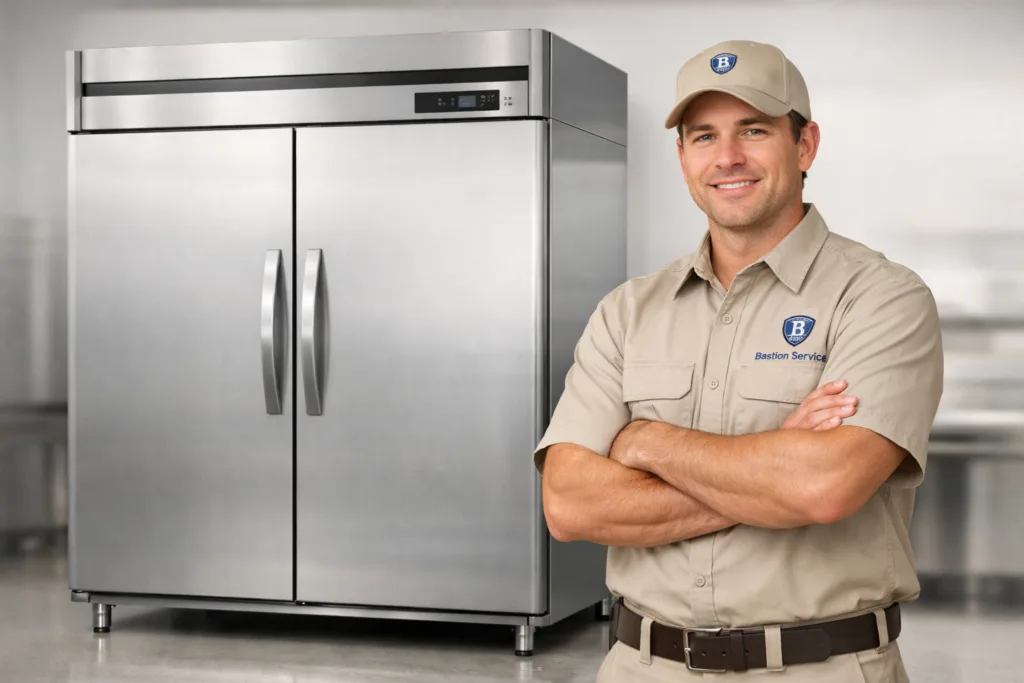




Freezer problems can interrupt prep, storage, and daily workflow faster than many teams expect. When a Turbo Air unit starts running warm, icing over, leaking, or making new noises, the most useful next step is service based on testing rather than assumptions. In Cheviot Hills, businesses often need to know not just what symptom is showing up, but whether the freezer can be stabilized quickly, whether inventory is at risk, and whether the repair is likely to hold up under normal use.
Related commercial service paths in Cheviot Hills include Turbo Air Commercial Repair in Cheviot Hills, Commercial Freezer Repair in Cheviot Hills, and Turbo Air Refrigerator Repair in Cheviot Hills.
Bastion Service works on Turbo Air freezer issues by tracing the symptom back to the part of the system that is actually failing. That matters because the same complaint, such as “not freezing,” can come from very different causes including airflow restriction, defrost failure, sensor error, door gasket leakage, fan problems, or compressor-related trouble.
Service-focused Turbo Air freezer repair for businesses in Cheviot Hills
A freezer that is only slightly off temperature can still create serious disruption. Staff may start moving product around, opening doors more often to check conditions, or overloading other cold storage to compensate. Over time, those workarounds add stress to the equipment and make the original problem harder to judge.
That is why repair planning should start with how the unit is behaving in real operation: cabinet temperature, recovery time after door openings, frost pattern, fan movement, control response, and any change in sound or cycling. For businesses in Cheviot Hills, that kind of diagnosis helps determine whether the issue is a targeted repair, a developing system failure, or a sign that continued use may cause more damage.
Common Turbo Air freezer symptoms and what they may mean
Not freezing well or struggling to stay at temperature
If the cabinet is no longer holding a stable freezing temperature, several faults may be involved. Dirty condenser coils can reduce heat transfer. Evaporator fan problems can limit circulation inside the cabinet. A weak door seal can allow warm air intrusion. Sensor or control issues can cause inaccurate cycling. In some cases, the problem goes deeper into the refrigeration system itself.
One useful clue is timing. If the freezer falls behind mainly during heavy use, airflow and door-related issues are more likely. If it stays warm even when closed and lightly loaded, the unit may need more extensive testing of controls, fans, and cooling performance.
Frost buildup on walls, shelves, or around the evaporator area
Frost is often more than a cosmetic issue. On a Turbo Air freezer, heavy ice can point to a gasket that is no longer sealing, a door that is misaligned, a failed defrost component, or circulation problems that let moisture collect and harden. Once ice starts blocking evaporator airflow, the cabinet may show uneven temperatures from top to bottom or front to back.
If frost buildup keeps returning after manual clearing, the root cause usually has not been corrected. Continued operation in that condition can overwork fans and extend compressor run time.
Freezer runs constantly or cycles in an unusual pattern
A unit that rarely shuts off may be fighting heat intrusion, restricted airflow, dirty coils, sensor inaccuracies, or declining cooling capacity. Short cycling can be different and may suggest electrical trouble, control board faults, start component failure, or compressor stress.
Either pattern deserves prompt attention. Constant running raises wear and energy use, while repeated short starts can be hard on major components. What matters most is not just that the cycle changed, but why it changed.
Fan noise, buzzing, clicking, or new vibration
Sound changes often show up before a complete cooling failure. A scraping or whirring noise may come from a fan blade hitting ice or from a failing fan motor. Clicking may relate to relays, controls, or compressor startup trouble. Rattling can be as simple as loose panels, but it can also appear when vibration increases because a motor or compressor is under strain.
New noises are worth scheduling service for even if the freezer is still working. Catching the problem early may prevent a shutdown during normal business hours.
Water on the floor or moisture inside the cabinet
Water around a freezer can come from blocked drains, defrost issues, excess condensation, or warm air entering through a damaged gasket or poorly closing door. Interior moisture often leads to more frost, and floor moisture can create a safety problem for staff.
When a leak appears alongside temperature swings or frost, those symptoms are often connected rather than separate problems.
Why similar symptoms can lead to different repairs
One of the most important parts of Turbo Air freezer repair in Cheviot Hills is separating the symptom from the cause. A warm cabinet does not automatically mean a failed compressor. Frost does not automatically mean the unit is near replacement. Loud operation does not always mean a major mechanical failure.
Good diagnosis answers practical questions that matter to a business: is the problem isolated to one component, is it part of a broader wear pattern, can the freezer continue operating temporarily, and is the repair likely to restore stable performance without repeat downtime soon after?
When service should be scheduled right away
Some conditions should not be pushed off. Schedule service promptly when the freezer cannot maintain freezing temperatures, recovery time has become much slower, ice is blocking airflow, alarms are repeating, or the compressor is struggling to start. Those issues can quickly move from inconvenience to product loss.
- The cabinet temperature keeps drifting upward
- Frost returns shortly after being cleared
- The door is not sealing tightly
- Fans stop, slow down, or become unusually loud
- The unit runs almost nonstop with poor results
- Water leakage is creating slip risk or more ice buildup
Even intermittent symptoms are worth attention. A freezer that “usually works” but sometimes swings in temperature may be easier to repair before the fault becomes constant.
Signs continued use may cause more damage
Sometimes the freezer still appears to be running, but the operating conditions are already harmful. Ice-blocked airflow can strain fan motors. Heavy condenser buildup can push the system into long run cycles. Repeated hot starts can add stress to the compressor. Door seal failure can create nonstop moisture intrusion that keeps feeding the same icing problem.
If the unit is no longer protecting stored product, if severe noise has developed, or if cooling performance has dropped sharply, limiting use and arranging repair is often the safer business decision than trying to get through another day of operation.
Repair or replacement: what businesses usually need to weigh
Many Turbo Air freezer problems are repairable without replacing the unit. Gaskets, door hardware, evaporator fans, sensors, drains, controls, and defrost components are all issues that can often be corrected when addressed in time. Replacement becomes a more serious consideration when there is major compressor damage, repeated system-level trouble, or overall wear that makes future reliability uncertain.
For businesses in Cheviot Hills, the decision usually comes down to a few practical points:
- Whether the repair addresses the true source of the failure
- How the freezer is affecting daily workflow right now
- The cost of repair compared with the unit’s condition and age
- Whether the equipment is still suited to current storage demands
A repair decision is easier when it is based on actual operating condition rather than guesswork or the assumption that every cooling problem means the same thing.
How to prepare for a freezer repair visit
A little preparation can make diagnosis faster and more accurate. If possible, note the current temperature, how long the issue has been happening, whether the problem is constant or intermittent, and any changes in noise, frost pattern, or alarms. It also helps to know whether the trouble started after cleaning, loading changes, a power interruption, or a period of heavy door use.
Businesses can also be ready to explain whether product is already being relocated, whether the unit recovers slowly after openings, and whether staff have noticed water, ice, or weak door closure. Those details often help narrow down the fault before parts testing even begins.
What a useful repair appointment should accomplish
A productive service call should do more than confirm that the freezer is underperforming. It should identify the failed or failing component, check whether airflow and defrost conditions are contributing to the issue, evaluate how the controls are responding, and clarify whether the problem appears contained or part of a larger decline.
For a Turbo Air freezer in Cheviot Hills, the goal is to move quickly from symptom to repair decision so the business knows the urgency, the likely scope of work, and the next step for restoring stable freezer operation with as little downtime as possible.


