
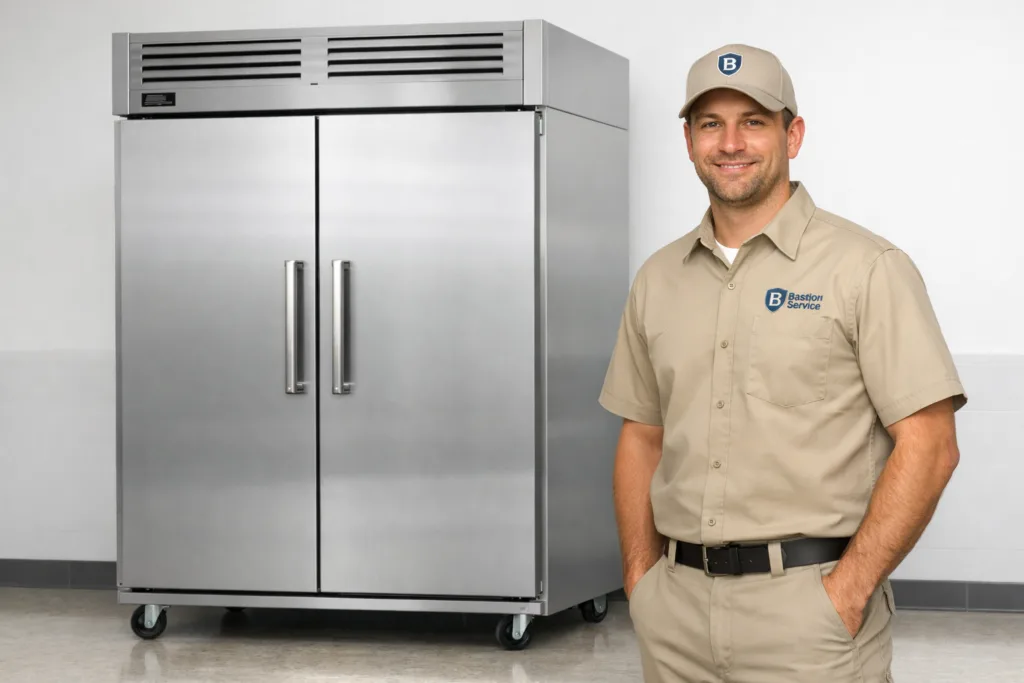




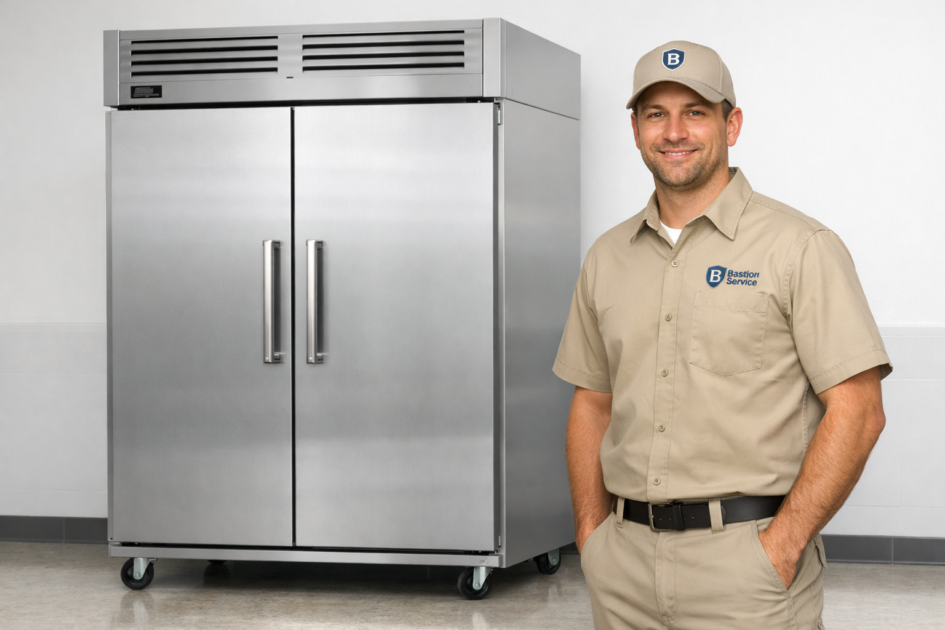
When Turbo Air refrigeration equipment begins affecting product temperatures, prep flow, or storage reliability, the next move should be a service visit focused on what the unit is actually doing in the field. Restaurants, cafés, markets, and other Brentwood businesses often see the same outward symptoms from very different causes, so repair planning works best when the problem is tied to the cabinet behavior, operating conditions, and component response rather than assumptions.
For specific equipment paths in Brentwood, review Turbo Air Refrigerator Repair in Brentwood, Turbo Air Freezer Repair in Brentwood, and Commercial Appliance Repair in Brentwood.
Bastion Service helps local businesses evaluate Turbo Air refrigerator and freezer problems with repair scheduling built around downtime impact, inventory risk, and whether the equipment should stay in limited use or be taken offline. That approach is especially important when one failing unit starts affecting kitchen timing, cold storage capacity, or staff workflow across the day.
What Turbo Air refrigeration equipment problems do you troubleshoot?
Service calls commonly involve refrigerators and freezers that are running warm, drifting above set temperature, developing heavy frost, leaking water, circulating air unevenly, or struggling to recover after normal door openings. Some units run constantly without pulling down properly. Others appear to cool part of the cabinet while leaving warm zones in another section. These patterns matter because they point the diagnosis in different directions.
Typical fault areas include condenser blockage, evaporator icing, failed fan motors, thermostat or sensor issues, control board problems, defrost component failure, door gasket leakage, drain restrictions, and compressor or sealed-system trouble. In business-use equipment, even a small performance drop can quickly become an operating problem once doors are opened repeatedly and product loads change throughout service hours.
Refrigerator problems that should be checked promptly
Cabinet running warm during normal use
If a Turbo Air refrigerator is no longer holding a stable temperature, the problem may involve restricted airflow, a weak fan, dirty heat exchange surfaces, a control issue, or a refrigerant-related loss of cooling capacity. Staff may first notice product temperatures climbing, longer run times, or the need to keep adjusting settings. When that happens, the issue is usually beyond routine observation and should be diagnosed before food loss or a wider component failure follows.
Slow temperature recovery after door openings
Recovery problems are important in busy kitchens because a unit may look acceptable when closed but fail once normal traffic begins. A refrigerator that takes too long to pull back down can indicate airflow restriction, evaporator problems, door sealing issues, or declining cooling performance. That symptom often shows up during peak use, which is why operators may notice it before they see a complete cooling failure.
Uneven temperatures from shelf to shelf
When one area stays cold and another turns warm, the issue is often linked to air circulation rather than a simple setpoint problem. Fan performance, frost around the evaporator, blocked vents, damaged interior airflow paths, or loading patterns can all play a role. A symptom like this should not be ignored, because product in the warm section may be affected long before the full cabinet appears to fail.
Freezer symptoms that can signal a larger fault
Frost buildup that keeps returning
Repeated frost or ice accumulation usually means moisture is getting in or the defrost cycle is not doing its job. On a Turbo Air freezer, that can reduce airflow, drive longer run times, and eventually leave the cabinet unable to maintain proper storage conditions. The source may be a gasket issue, door alignment problem, failed heater, sensor fault, timer or control failure, or a combination of airflow and moisture intrusion.
Freezer not pulling down to target temperature
If the cabinet stays above target, softens product, or takes too long to recover after loading, the repair decision should not wait. Freezer performance issues can come from fan problems, iced coils, control faults, compressor trouble, or a sealed-system issue that limits capacity. In a business setting, delayed response usually means greater inventory exposure and a harder recovery once the unit falls further behind.
Constant running or unusual noise
A freezer that runs almost nonstop, starts and stops irregularly, or develops new fan or compressor noise should be checked before the stress spreads to other components. Unusual sounds do not always mean a major mechanical failure, but they often indicate a unit working harder than it should. Combined with warm temperatures or frost, that symptom becomes more urgent because it may point to a cooling fault already affecting normal operation.
Leaks, condensation, and moisture issues
Water around the unit, interior dripping, or recurring condensation can come from a blocked drain, overflow during defrost, icing that redirects water, or door sealing problems that increase moisture entry. These complaints are often treated as minor until they create slip hazards, packaging damage, or cabinet icing that begins to interfere with airflow. A service assessment helps determine whether the moisture issue is isolated to drainage or part of a wider cooling and defrost problem.
Why symptom patterns matter during repair planning
Many refrigeration complaints overlap. A warm cabinet may look like compressor trouble but actually come from airflow loss or heavy evaporator icing. A freezer covered in frost may seem to need a defrost part when the main contributor is repeated moisture intrusion through a poor door seal. A leaking unit may be dealing with a simple drain blockage, or the leak may be one sign of a broader cooling failure. Reading the full pattern helps avoid replacing the wrong part and helps set realistic expectations for timing, labor, and parts needs.
For Brentwood businesses, this also helps answer the practical question of whether the equipment can continue operating temporarily. If temperatures are only slightly affected and the symptom is controlled, limited short-term use may be possible. If the unit is running continuously, building ice quickly, or failing to recover at all, continued use may increase damage and make the outage longer.
When to schedule service without delay
Repair should be scheduled promptly when any of the following are happening:
- Cabinet temperatures are rising or fluctuating
- The refrigerator or freezer is no longer recovering normally
- Frost keeps returning after being cleared
- Fans sound abnormal or airflow feels weak
- Water is leaking onto the floor or collecting inside the cabinet
- Staff are repeatedly adjusting controls to compensate
- The unit runs continuously or short cycles unexpectedly
- One section of the cabinet holds while another turns warm
These are the types of operating signs that usually mean the equipment is no longer functioning as intended. Waiting often turns a manageable repair into a larger interruption, especially in locations where storage turnover is high and refrigeration space is already tight.
Repair or replacement?
That decision depends on more than the immediate symptom. Problems involving fans, controls, drains, gaskets, sensors, and some defrost components are often straightforward to address when the rest of the equipment is in solid condition. If the unit has repeated cooling failures, major sealed-system issues, advanced wear, or a repair history that keeps disrupting operations, replacement may be worth discussing.
The useful comparison is not just repair cost versus a new unit. Businesses also need to consider expected reliability after the repair, current equipment condition, parts availability, and how critical that refrigerator or freezer is to daily operations. A thorough evaluation makes that choice clearer and helps avoid spending money on a unit that will continue to create downtime.
Scheduling the next step
If your Turbo Air refrigeration equipment in Brentwood is showing warm cabinet conditions, airflow problems, recurring frost, leaks, or weak freezer recovery, the best next step is to schedule service and have the symptom pattern evaluated on site. That gives your team a repair path based on actual equipment condition, helps determine whether temporary operation is safe, and supports faster decisions about parts, timing, and how to protect daily operations while the unit is being restored.


