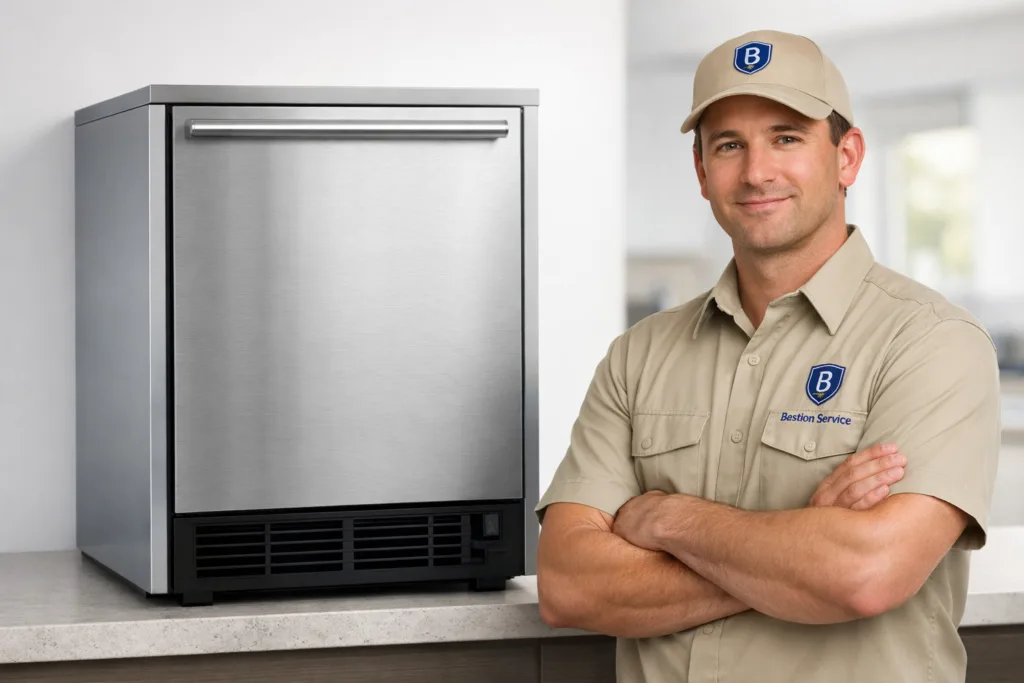
True Ice Maker Repair in Rancho Park

True ice maker repair in Rancho Park for no ice, slow ice production, leaks, clumped ice, and fill issues.

Local Rancho Park service 90-Day warranty Licensed & insured
True Ice Maker repair technician in Rancho Park
Анастасия Козлова review profile photo Tom Slack review profile photo Heather Dowell review profile photo Elias review profile photo Ami Radunskaya review profile photo
Real Google feedback 5.0 out of 5 80+ Google reviews
  • True ice maker support in Rancho Park
  • Clear diagnosis before repair decisions
  • Warranty for labor and parts
  • Fast scheduling based on availability
True Ice Maker Repair

True Ice Maker repair in Rancho Park for focused household appliance problems

When a True ice maker starts acting up in Rancho Park, the most helpful first step is a clear diagnosis and a practical repair plan based on the exact symptom pattern.

Bastion Service helps Rancho Park homeowners diagnose True ice maker problems and decide whether repair is practical based on the symptom, appliance condition, and repair path.

True ice maker repair support for Rancho Park homes.

Ice makers tend to fail in patterns, and those patterns matter. A unit that suddenly stops producing ice is often dealing with a different problem than one that still makes ice but does it slowly, leaks during the fill cycle, or drops cubes that are small, hollow, or stuck together. With a True unit, the most effective repair starts by tracing where the cycle is breaking down: water fill, freezing, harvest, storage, or drainage.

Start with the symptom, not the part

Many ice maker complaints sound similar at first, but they do not point to the same repair. “No ice” could mean no incoming water, a failed valve, a frozen line, a control issue, or a temperature problem that prevents the machine from completing a cycle. “Not enough ice” may look minor, yet it can be an early warning of restricted flow, weak cooling performance, or scale buildup affecting normal operation.

For homeowners in Rancho Park, paying attention to exactly what changed can save time and avoid unnecessary parts replacement. Was production normal and then suddenly gone? Did the cubes get smaller before the machine stopped? Does water appear only during certain parts of the cycle? Those details often narrow the diagnosis quickly.

Common symptom patterns

  • No ice at all: possible water supply interruption, failed inlet valve, sensor fault, frozen fill path, or cooling issue
  • Slow production: possible airflow problem, inconsistent temperature, mineral buildup, or weak fill volume
  • Small or hollow cubes: often linked to low water pressure, a restricted line, or an incomplete fill
  • Cloudy or odd-looking ice: can point to water quality issues, scale, or irregular freezing conditions
  • Leaking near the unit: may come from a loose connection, cracked line, overfill condition, or drain problem
  • Clumped ice in the bin: often caused by partial melting, temperature fluctuation, or harvest timing problems
  • Unusual clicking, humming, or grinding: may indicate trouble with the valve, fan, pump, or ice release sequence

What “no ice” usually means on a True ice maker

When a True ice maker stops completely, the cause is not always the ice maker assembly itself. In many cases, the machine is waiting on one basic requirement that is no longer being met. If water is not entering properly, the mold cannot fill. If the compartment is not getting cold enough, the unit may never begin a full freeze-and-harvest cycle. If a control or sensor is misreading conditions, the machine may shut down before it should.

A full no-ice complaint often needs testing rather than guesswork because several separate faults can create the same result. That is especially important if the unit still has power and appears to run normally but produces nothing.

Why slow ice production should not be ignored

Reduced output is easy to dismiss until the bin never seems to refill. In reality, slow production is often one of the earliest signs that something is drifting out of spec. Water may be entering too slowly, the freeze cycle may be taking too long, or airflow and temperature control may be inconsistent enough to stretch cycle times.

If the problem has been building gradually, that usually suggests restriction, wear, or performance loss rather than a sudden single-part failure. Catching it early can help prevent added strain on the machine and may keep the repair more contained.

Leaks, puddles, and overfill problems

Water around an ice maker should be taken seriously, even if the leak seems small. A minor drip can come from a line connection or fitting, while a larger puddle may point to overfilling, a cracked component, or trouble with drainage. Some leaks appear only during fill. Others happen after ice production, when meltwater or drainage cannot move where it should.

Because built-in and undercounter installations can hide the source, the visible puddle is not always where the fault begins. In a Rancho Park home, dealing with a leak promptly can help reduce the risk of damage to nearby flooring, trim, or cabinetry.

When cube shape tells you something is wrong

Ice quality is often one of the best clues a homeowner gets before total failure. Small cubes, hollow centers, thin slabs, or misshapen batches usually mean the unit is not receiving the right amount of water or is not freezing it evenly. Cubes that are cloudy or fuse together in the bin can suggest temperature inconsistency, partial melting, or contamination from scale and residue.

If the appearance of the ice changed before production dropped, that sequence is useful. It often points to a developing water-fill or cooling issue rather than a sudden shutdown.

Why accurate diagnosis matters with this type of repair

True ice makers rely on a chain of events happening in the right order. The water system, temperature controls, freezing process, and harvest mechanism all depend on one another. When one step fails, the symptom may appear somewhere else in the cycle. That is why replacing the most obvious part does not always solve the real problem.

For example, a unit that appears to have a bad ice maker head may actually be underfilling because of a weak inlet valve. A machine that seems to be overproducing or clumping ice may really be dealing with temperature fluctuation or poor door sealing around the ice compartment. The right repair is based on how the entire cycle behaves under load.

When to schedule service

Service is usually worth scheduling when the machine has stopped making ice for more than a short period, is leaking, is making smaller batches than usual, or is producing cubes with a visible change in size, clarity, or consistency. These issues rarely correct themselves for long, and temporary resets can hide a problem while it continues to worsen internally.

You should also have the unit checked if it starts cycling strangely, makes repeated noise during fill or harvest, or works one day and fails the next. Intermittent behavior often means a component is weakening and may soon stop working completely.

Signs continued use may make damage worse

  • Water is pooling around or under the appliance
  • The unit appears to overfill or freeze up inside
  • Ice is backing up, clumping, or melting and refreezing
  • The machine is making repeated noises but not finishing normal cycles
  • Production has dropped sharply and the unit seems to run longer than usual

Repair or replace?

That decision usually depends on the age of the appliance, the condition of the cooling and mechanical systems, the repair history, and whether the problem is isolated or part of a broader decline. Many True ice maker problems are repairable, particularly when they involve water supply faults, valves, sensors, drains, or specific cycle components.

Replacement becomes more likely when the unit has had repeated breakdowns, multiple systems are wearing out at once, or the repair cost no longer makes sense for the appliance’s remaining life. In most cases, the best choice comes from understanding whether the diagnosis points to one correctable fault or to a larger pattern of deterioration.

Helpful details to note before a visit

If you are preparing for service, it helps to note when the problem started and how it changed. Did the machine stop all at once, or did output slowly decline? Is the leak constant or only present during part of the cycle? Did cube size change before production stopped? Has the sound of the machine changed during fill, freeze, or harvest?

Those observations can help connect the symptom to the likely source of failure. For a household in Rancho Park, that often means a faster path to deciding whether the issue is tied to water delivery, temperature performance, drainage, or the harvest process itself.

What homeowners should avoid doing

It is understandable to try resets, repeated power cycling, or manual defrosting when the unit stops working, but those steps can blur the symptom pattern if done repeatedly. They may also allow a leak or freeze-up to continue unnoticed. If the machine is leaking or behaving inconsistently, limiting use until it is checked is usually the safer approach.

A one-time interruption can happen, but recurring symptoms usually mean the appliance is asking for more than a quick workaround. A methodical inspection is the best way to determine whether the repair is straightforward, whether another system is contributing to the issue, and what the most sensible next step is for the unit in your home.

Service options

True appliances we service in Rancho Park

Choose the True appliance type you need serviced in Rancho Park.

Customer reviews

Real customer feedback

Recent customer feedback for Bastion Service.

Rudi Camenzind review profile photo
Rudi Camenzind
Google review

“Andy was awesome! He fixed my freezer in no time! He is very knowledgeable about appliances and a great technician! Thank you Andy for a job well done👍🏽🙋‍♂️”

Aaron Perez review profile photo
Aaron Perez
Google review

“Came to my house very quickly and also fixed my dryer extremely fast and feels brand new! Highly recommend.”

Jo Anne Ghazi review profile photo
Jo Anne Ghazi
Google review

“I want to thank Andrew at AndyFix so much for fixing my oven. The service was very professional. They are so responsive and communicated with me throughout ordering the parts that were needed. It is now fixed and I’m so grateful. I will definitely call anytime I need an appliance serviced.”

Kira Morris review profile photo
Kira Morris
Google review

“The technician did exactly what he said he would do. He was expertly efficient and repair my appliance quickly. He even put shoe covers on!”

Michael Salisbury review profile photo
Michael Salisbury
Google review

“The best service ever”

Tom Slack review profile photo
Tom Slack
Google review

“Andrew was on time, found the problem and repaired it at a very reasonable price. Would highly recommend AndyFix Appliance Repair to anyone needing appliance service/repair. Very happy we chose him to repair our refrigerator/freezer. Andrew is now our go to guy to fix any of our appliances 😏👍🏻💪🏻”

FAQ

True Ice Maker Repair questions

Answers about diagnosis, repair options, timing, and next steps.

Why is my True ice maker not making ice in Rancho Park?

A True ice maker may stop making ice because of a water supply issue, a failed inlet valve, a sensor problem, or a cooling-related fault. Diagnosis is important because the same symptom can come from different causes.

Should I keep using a leaking True ice maker?

If your True ice maker is leaking, it is best to limit use until the cause is diagnosed. Continued operation can worsen water damage and may put additional strain on internal components.

What does it mean if my True ice maker makes small or cloudy cubes?

Small or cloudy cubes can point to restricted water flow, low fill volume, temperature inconsistency, or buildup affecting the freezing cycle. The pattern of production helps determine which issue is most likely.

How do I know if my True ice maker in Rancho Park should be repaired or replaced?

Repair is often the better choice when the problem is limited to a specific part or system. Replacement becomes more worth considering when the unit has repeated failures, multiple worn components, or repair costs that no longer make sense for its age and condition.

Ready to schedule?

Schedule True Ice Maker Repair in Rancho Park

Schedule True ice maker repair in Rancho Park with clear diagnosis, practical repair guidance, and dependable local service.

Call (323) 433-6360