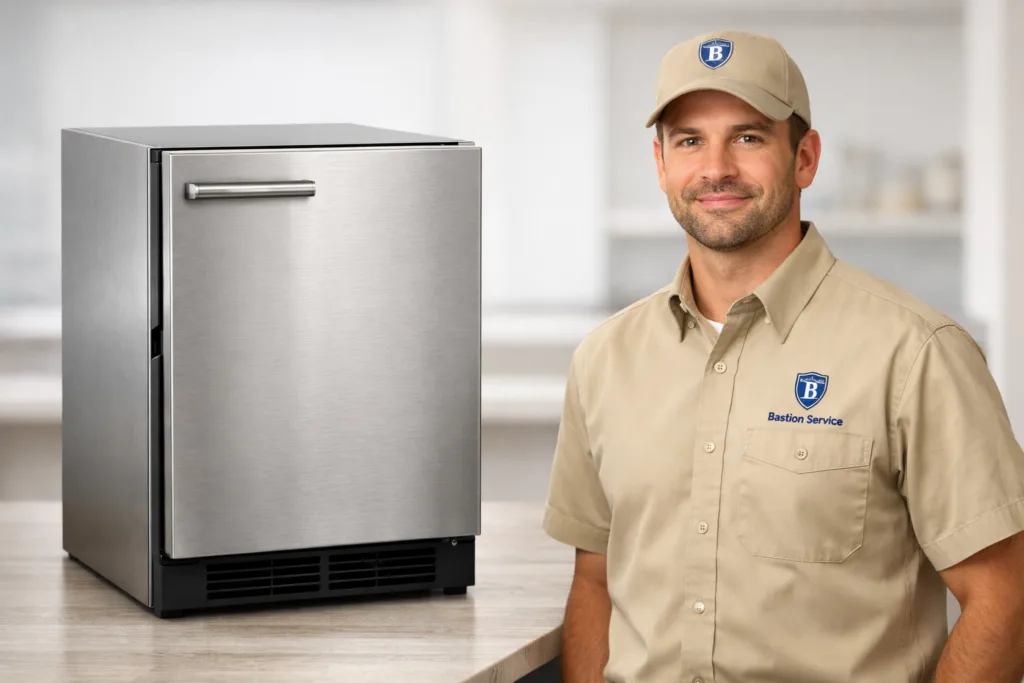
Many True ice maker issues look similar from the outside, but the repair path depends on what part of the cycle is failing. A unit that never fills, one that freezes but will not harvest, and one that leaks during operation can all appear to have the same “not making ice” problem. For homeowners in Hermosa Beach, it helps to look at the exact symptom pattern before deciding whether the issue is minor, urgent, or likely to affect nearby cabinets and flooring.
Common True ice maker problems in Hermosa Beach homes
Residential ice makers usually fail in a few recognizable ways. Paying attention to when the problem starts, whether it is constant or intermittent, and what the machine does just before it stops can make service much more straightforward.
No ice production
If the bin stays empty, the problem may involve the water supply, inlet valve, temperature control, sensor logic, or the harvest sequence. In some cases, the unit powers on normally and sounds active, but it never reaches the conditions needed to create and release a full batch of ice. When that happens, the failure may be in the fill stage, the freeze stage, or the release stage rather than in the entire machine.
Slow or inconsistent ice output
Reduced ice production often points to weak cooling performance, restricted airflow, mineral buildup, inconsistent fill volume, or a component that is working intermittently. This symptom is easy to ignore at first because the appliance still makes some ice, but slow production often shows that the system is no longer cycling at the speed it should.
Water leaking from the unit
Leaks can come from a loose connection, damaged line, drain issue, overfilling condition, or melting caused by poor freezing. Even a small amount of water should be taken seriously. What starts as a minor drip can lead to warped flooring, cabinet swelling, or hidden moisture around the appliance.
Clumped, hollow, or misshapen ice
Ice quality can reveal a lot about what is wrong internally. Clumped cubes may mean partial melting before harvest or storage issues inside the bin area. Hollow or undersized cubes can point to low water fill, while soft or cloudy ice may suggest temperature inconsistency or water-flow trouble. If the shape of the ice changes before output drops completely, the machine is often giving an early warning that service is needed.
Buzzing, clicking, or repeated cycling sounds
Unusual noises during fill or harvest can indicate a valve that is struggling to open, a motorized component that is not completing its movement, or a control sequence that keeps retrying the same step. Repeated clicking without normal ice production usually means the machine is trying to operate but cannot move through the full cycle.
What the symptom usually suggests
Looking at the symptom alone does not confirm the failed part, but it does narrow the likely causes:
- No fill at all: possible water supply restriction, valve failure, or control issue
- Ice forms but will not release: possible harvest-cycle fault, sensor problem, or temperature-related issue
- Small batches: possible low fill volume, scale buildup, or declining cooling performance
- Leaks during operation: possible drain problem, overfill condition, loose fitting, or uneven installation
- Intermittent operation: possible control fault, sensor inconsistency, or a part failing under load
This kind of symptom-based review is useful because it prevents random part swapping. Two machines with the same complaint can require completely different repairs.
When to stop using the ice maker
Some issues are inconvenient but manageable for a short time, while others should not be ignored. It is best to stop normal use if the unit is leaking onto the floor, repeatedly overfilling, making loud mechanical noises, or failing mid-cycle again and again. Running the machine in that condition can add water damage, increase scale buildup, or place extra stress on valves, pumps, and control components.
If the appliance is still cooling but producing poor-quality ice, it may seem tempting to keep using it until output stops completely. In practice, that often makes diagnosis harder because the original symptom gets buried under secondary problems.
Signs the problem is getting worse
A True ice maker rarely goes from perfect operation to total failure without some warning. Watch for these changes:
- Ice production becoming slower week by week
- Cubes changing size or shape
- Water appearing around the appliance only after certain cycles
- The machine needing restarts to begin working again
- Noises becoming more frequent or more mechanical-sounding
- Ice melting together in the bin
These are often signs that the problem is moving beyond routine maintenance and into component failure.
Repair versus replacement
Most household True ice maker problems are repairable when the issue is isolated to a valve, sensor, drain-related part, control component, fill problem, or another defined fault. Replacement becomes more likely when there are multiple failures at once, major internal wear, or a repair total that no longer makes sense for the condition of the appliance.
Age matters, but it should not be the only factor. A newer unit with a specific part failure may be worth repairing, while an older machine with repeated leaks, unstable cooling, and recurring cycle problems may not be the best candidate. The most useful way to decide is to compare the exact fault, the overall condition of the ice maker, and the likelihood of additional repairs in the near future.
When service is the right next step
Scheduling service makes sense when the ice maker has stopped producing, output has dropped noticeably, water is leaking, or the machine is stuck in an incomplete cycle. Homeowners in Hermosa Beach usually benefit most from service when they can describe what the appliance is doing in sequence, such as whether it fills, freezes, harvests, or shuts down at a specific point.
That detail helps narrow the problem faster and supports a more accurate repair plan. For a household True ice maker that is no longer operating normally, the goal is not just to get ice again, but to restore consistent performance without unnecessary parts or repeat failures.