
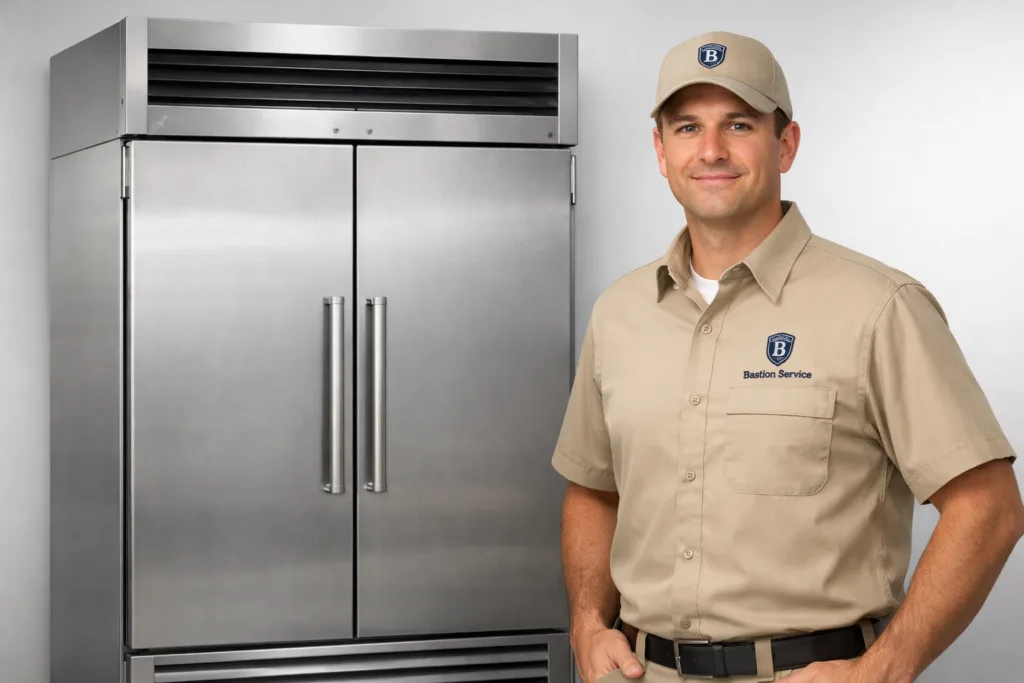




When a True refrigerator starts running warm, cycling unpredictably, leaking, or building ice where it should not, the smartest next step is service based on the actual failure rather than a guessed fix. For businesses in Rancho Palos Verdes, refrigeration problems can quickly affect product quality, prep flow, staffing, and daily operations. Bastion Service works with symptom-based diagnosis so the repair plan matches the equipment condition, urgency, and likely source of the problem.
Related commercial service paths in Rancho Palos Verdes include True Commercial Repair in Rancho Palos Verdes, Commercial Fridge Repair in Rancho Palos Verdes, and True Freezer Repair in Rancho Palos Verdes.
Some issues look simple from the outside but come from very different causes. A cabinet that is not holding temperature may involve airflow restriction, a failing evaporator fan, door sealing problems, sensor faults, defrost issues, condenser loading, or compressor-related trouble. Proper testing helps determine whether the unit can stay in limited use until repair, whether shutdown is the safer choice, and which repair path makes sense.
Common True Refrigerator Problems That Need Attention
Cabinet not holding temperature
If the cabinet temperature is drifting above setpoint, the refrigerator may be struggling with blocked airflow, dirty condenser coils, evaporator frost, control failure, weak door gaskets, or declining cooling performance. In a business setting, even a modest temperature increase can create product risk and disrupt workflow, especially when staff are opening the unit frequently during service hours.
Temperature issues should be evaluated early because a unit that is only slightly warm today can move into a full cooling failure with little warning. Longer recovery times after the door opens, warmer product in one section of the cabinet, or inconsistent readings during the day are all signs that service should not be delayed.
Unit runs constantly or short cycles
A True refrigerator that seems to run all day without satisfying temperature may be dealing with poor heat rejection, ventilation problems, ice restricting evaporator airflow, controls that are not cycling correctly, or a refrigeration system that is losing efficiency. Constant runtime increases wear and can push other components harder than normal.
Short cycling points to a different kind of concern. That pattern may suggest electrical faults, control-board issues, overload protection events, or compressor stress. When either condition appears, it helps to inspect the full operating pattern instead of replacing parts based on one symptom alone.
Frost buildup, ice formation, or blocked airflow
Frost on the evaporator cover, ice collecting inside the cabinet, or airflow that feels weak often indicates a defrost problem, door leakage, fan trouble, or moisture entering the box more than it should. Frost is not just a cosmetic issue. As buildup increases, airflow drops, cooling becomes uneven, and the refrigerator may run longer while holding temperature less effectively.
This is one of the most common situations where the visible symptom does not identify the failed part by itself. The repair decision depends on whether the source is defrost-related, airflow-related, or tied to a sealing problem around the door.
Water leaks or moisture inside the cabinet
Water under the unit or pooling inside can come from a blocked drain, defrost drainage issue, excess condensation, or ice melting from an airflow or defrost failure. In addition to mess and slip concerns, leaks can point to a cooling issue that is already affecting performance behind the scenes.
If water appears repeatedly, it is worth checking promptly. Ongoing moisture can damage surrounding surfaces, interfere with operation, and signal a fault that will not correct itself through normal cleaning.
Unusual noise, vibration, or changes in sound
A louder-than-normal refrigerator does not always mean an immediate breakdown, but it often means something has changed. Fan motors, loose panels, compressor mounts, drain line contact, or stress from restricted cooling conditions can all create rattling, buzzing, humming, or vibration that was not present before.
Noise matters most when it shows up with another symptom such as warming temperatures, heavy runtime, or frost buildup. In that case, the sound is often part of a larger operating problem rather than an isolated annoyance.
Why Accurate Diagnosis Matters
True refrigerator symptoms often overlap. The same warm-cabinet complaint can be caused by a failed fan motor, iced evaporator, dirty condenser, sensor fault, control issue, or a more serious cooling-system problem. Replacing the first likely part without testing can add cost while leaving the actual failure unresolved.
A proper diagnosis helps answer the questions a Rancho Palos Verdes business usually needs answered quickly: what is causing the problem, how urgent is it, and is repair still the practical option? That matters when the refrigerator supports inventory control, kitchen production, beverage storage, or other time-sensitive daily use.
Warning Signs That Service Should Be Scheduled Soon
- Cabinet temperature is rising above normal or fluctuating during the day
- The refrigerator runs almost nonstop or cycles on and off too frequently
- Ice is forming on interior panels, around the evaporator area, or near the door
- Water is leaking onto the floor or collecting inside the cabinet
- The unit is noisier than usual or vibrating during operation
- Recovery after loading is taking longer than normal
- Door gaskets are loose, torn, or not sealing evenly
- Staff notice uneven product temperature from one shelf area to another
These signs often start small, but they rarely stay small for long. Continued operation during overheating, heavy frosting, or airflow failure can increase component stress and raise the chance of product loss.
Common Causes Behind True Refrigerator Performance Issues
Airflow restrictions
Refrigeration depends on moving air where it needs to go. Dirty coils, blocked vents, evaporator ice, or failing fan motors can all reduce airflow and make the cabinet warm unevenly. When airflow drops, the refrigerator may still appear to cool in one area while struggling in another, which can make the problem easy to overlook at first.
Door sealing problems
If the door is not closing cleanly or the gasket is worn, warm air and moisture can enter the cabinet repeatedly throughout the day. That drives longer runtime, creates condensation or frost, and makes temperature control less stable. In busy operations, a marginal door seal can become a major cooling problem faster than expected.
Defrost system faults
When the defrost system is not working correctly, ice accumulates around the evaporator and eventually blocks normal airflow. The refrigerator may begin by showing subtle symptoms such as longer runtime or slightly higher cabinet temperature before moving into a more obvious no-cool complaint.
Controls and sensor problems
Faulty controls or sensors can cause inaccurate temperature response, improper cycling, or behavior that seems inconsistent from hour to hour. In these cases, the refrigerator may cool at times and fail at others, making it important to verify actual performance rather than relying on one brief observation.
Cooling-system stress or component failure
When the compressor is struggling or overall cooling performance is declining, the unit may run hard without reaching target temperature. These situations need careful evaluation because the right decision depends on equipment condition, repair scope, and whether the refrigerator can realistically return to stable service.
Repair or Replace?
Many True refrigerator problems are still worth repairing, especially when the issue is tied to fan motors, controls, sensors, gaskets, drainage, or other serviceable parts and the cabinet itself remains in good condition. In those cases, targeted repair can restore normal operation without replacing the entire unit.
Replacement becomes more likely when the refrigerator has a pattern of repeated major failures, declining performance after prior service, or repair costs that are difficult to justify relative to the unit’s condition and role in the business. The key is not choosing the cheapest immediate option, but choosing the option that best protects uptime and avoids repeat disruption.
How Businesses Can Prepare for a Service Visit
Before service is scheduled, it helps to note the exact symptom pattern: current temperature behavior, when the issue started, whether frost or leaks are present, and whether the noise or runtime changed suddenly or gradually. If staff have noticed alarms, inconsistent cooling by shelf area, or poor recovery after loading, those details can make diagnosis faster.
It is also useful to know whether the refrigerator is still cooling at all, whether product has already been moved, and whether the issue appears constant or intermittent. Symptom history often reveals whether the problem is tied to airflow, controls, defrost, or a larger cooling failure.
Service-Focused Support for Rancho Palos Verdes Businesses
True refrigerator problems are easier to manage when they are addressed before a minor cooling issue becomes a full interruption. For businesses in Rancho Palos Verdes, timely repair scheduling helps limit downtime, protect stored product, and reduce the chance that one failing component will affect others. If your unit is warming, leaking, frosting, or running abnormally, the next practical step is to schedule service and have the refrigerator evaluated based on its actual operating symptoms.


