
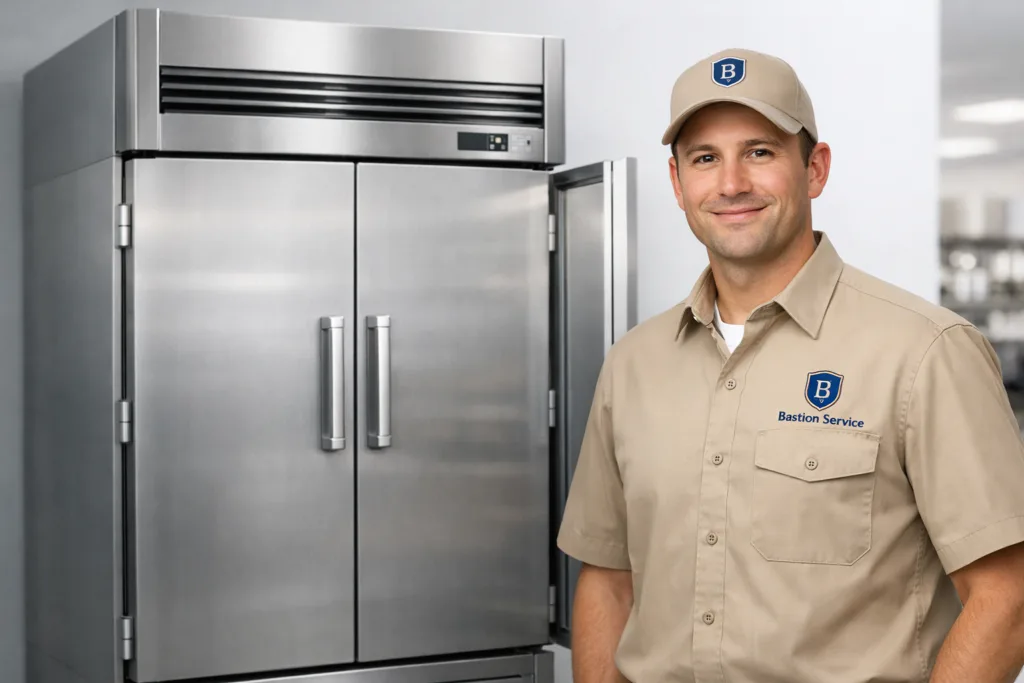




Temperature drift, repeat icing, water on the floor, or a refrigerator that suddenly will not recover after normal door openings can interrupt daily operations fast. For businesses in Mid-Wilshire, the most useful next step is service based on the actual symptom pattern, how the cabinet is behaving under load, and whether the problem points to airflow, controls, defrost, door sealing, drainage, or a deeper refrigeration fault. Bastion Service handles Traulsen refrigerator repair with that service-first approach so owners and managers can make informed decisions about scheduling, product protection, and downtime.
Related commercial service paths in Mid-Wilshire include Traulsen Commercial Repair in Mid-Wilshire, Commercial Refrigerator Repair in Mid-Wilshire, and Traulsen Freezer Repair in Mid-Wilshire.
Common Traulsen Refrigerator Symptoms That Need Repair
Cabinet not holding temperature
If the refrigerator is running warm, fluctuating through the day, or taking too long to pull back down after the doors open, several different failures may be involved. Condenser blockage, weak fan performance, sensor problems, control issues, door leakage, or sealed-system trouble can all create similar results. In a busy kitchen, market, hotel, or food-service space, unstable holding temperature is one of the clearest signs that repair should be scheduled before the issue affects inventory.
Frost or ice buildup inside the unit
Ice around the evaporator area, interior panels, or door openings usually means moisture is getting in or the unit is not completing normal defrost and airflow functions correctly. Worn gaskets, doors not closing fully, drain restrictions, and defrost component faults are common reasons. Frost is not just cosmetic. It can block air movement, reduce cooling performance, and force longer run times.
Constant running or repeated short cycling
A refrigerator that seems to run without stopping may be struggling to reject heat, circulate air, or reach the set temperature. A unit that starts and stops too often may have a control problem, an electrical issue, or a protection response tied to another failing part. Either pattern puts extra wear on the system and usually gets more expensive if ignored.
Noise, vibration, or fan-related problems
New rattling, clicking, buzzing, or grinding sounds can come from fan motors, blade interference, loose mounting hardware, compressor stress, or failing components around the refrigeration circuit. Some sounds are minor adjustments. Others are early warnings that airflow or cooling performance is about to drop.
Leaks, condensation, or drain issues
Water inside the cabinet or around the base of the unit can signal a clogged drain, defrost runoff problem, excess condensation from air intrusion, or ice melting in the wrong area. In working business environments, water leaks create cleanup problems and can become a safety concern in addition to the equipment issue itself.
Why a Traulsen Refrigerator May Stop Holding Temperature
One of the most common service requests is a Traulsen refrigerator that is no longer staying at the set temperature. That symptom does not automatically mean a failed compressor. It may be caused by poor condenser airflow, an evaporator fan that is not moving enough air, a control or probe reading incorrectly, a door that is leaking warm air, or heavy frost reducing circulation across the coil.
What matters is how the temperature loss shows up. A cabinet that starts warm in the morning points to a different likely cause than a unit that warms up only during heavy use. A refrigerator that cools again after being reset may indicate a control, sensor, or intermittent electrical issue rather than a continuous cooling failure. Service is most effective when those patterns are checked before parts are replaced.
Signs the Problem Is Getting Worse
Many refrigerator failures begin as partial performance issues rather than a complete shutdown. The cabinet may still cool, but not well enough. It may still run, but much longer than normal. Those early warning signs are often the best time to call for repair because the unit is still giving useful clues about the root cause.
- Product temperatures are becoming less consistent
- The cabinet struggles to recover after standard door openings
- Frost returns shortly after cleaning or defrosting
- Airflow feels weak or uneven inside the refrigerator
- The unit restarts repeatedly or shuts down unexpectedly
- Noise is becoming more frequent or more severe
- Condensation or leaks are spreading into the work area
When those symptoms are present, continued operation can add stress to motors, controls, and the refrigeration system.
What Technicians Look At During Diagnosis
Traulsen refrigerator problems often overlap, so service should begin with the operating condition of the full unit rather than assumptions about one part. A warm cabinet may trace back to airflow restriction. Ice buildup may come from a gasket leak. A noisy unit may be signaling a fan issue that is now affecting temperature stability.
Typical diagnostic focus includes:
- Actual cabinet temperature versus setpoint
- Condenser condition and heat rejection
- Evaporator airflow and fan operation
- Door alignment, closing pressure, and gasket sealing
- Sensor, control, and defrost response
- Drain path condition and moisture pattern
- Electrical behavior, cycling pattern, and component load
This kind of inspection helps determine whether the repair is likely to be a straightforward component replacement, a correction to airflow or sealing, or a larger system issue that affects planning and downtime.
When to Limit Use Until Repair Is Completed
Some problems allow temporary operation with close monitoring. Others should not be pushed through another shift. If the refrigerator is no longer maintaining safe holding conditions, if airflow is badly restricted by ice, or if the unit is making stronger mechanical noises while struggling to cool, limiting use may prevent a more serious failure.
Businesses in Mid-Wilshire should also be cautious when repeated resets are needed to keep the refrigerator running. Intermittent operation can create a false sense that the problem is minor when the actual fault is progressing. If temperatures are drifting and recovery is slowing, moving sensitive product and scheduling repair promptly is often the safer decision.
Repair Versus Replacement Considerations
Many Traulsen refrigerator issues are repairable without replacing the unit. Fan motors, probes, controls, gaskets, door hardware, drain issues, and defrost-related components are common service items. In those situations, targeted repair can restore stable operation and reduce disruption.
Replacement becomes a more serious consideration when the refrigerator has repeated major failures, poor overall condition, or a larger refrigeration-system problem combined with age and heavy wear. For businesses, the decision usually comes down to expected reliability after repair, cost relative to the condition of the cabinet, and how much downtime the operation can tolerate.
How to Prepare for a Service Visit
A few details can make diagnosis faster and more accurate. Before the appointment, it helps to note when the problem started, whether it happens all day or only at certain times, whether alarms or error behavior appeared, and whether the issue affects all sections of the cabinet or only one area. Photos of frost, leaks, or temperature display changes can also be useful if the symptom is intermittent.
It also helps to identify:
- Whether the unit is running constantly or cycling off and on
- Whether doors are closing normally
- If recent cleaning or loading changes happened before the issue appeared
- Whether any product had to be moved because temperatures were rising
- If noise started before cooling performance changed
Service for Mid-Wilshire Businesses
Traulsen refrigerator repair in Mid-Wilshire is most useful when it is tied to operating impact, not just the visible symptom. A refrigerator that is “still kind of cooling” can still create product risk, labor disruption, and preventable strain on the rest of the system. Scheduling service when the first warning signs appear gives businesses a better chance to address the fault before it turns into a full outage, a larger repair, or avoidable inventory loss.


