
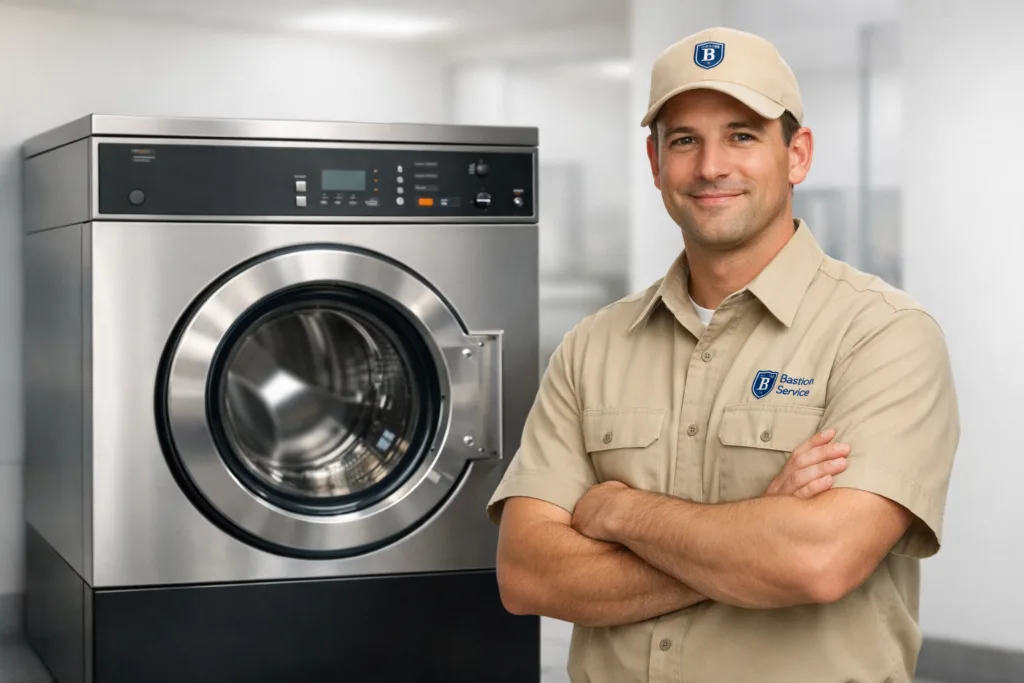





Washer problems can interrupt linen turnover, slow staff, and force workarounds that affect the rest of the day. For businesses in Rancho Park, service is most useful when the visit is focused on the actual failure pattern, what parts of the machine are involved, and whether the washer should stay in use or be pulled from operation until repaired. Bastion Service handles Speed Queen washer issues with that service-first approach so managers can make informed scheduling and repair decisions quickly.
Related commercial service paths in Rancho Park include Speed Queen Commercial Repair in Rancho Park, Commercial Washer Repair in Rancho Park, and Speed Queen Dryer Repair in Rancho Park.
Common Speed Queen washer symptoms that need repair attention
Washer will not start or stops before the cycle finishes
If the washer does not respond when staff try to begin a load, or if it starts and then shuts down partway through, the problem may involve incoming power, the door or lid lock system, user interface faults, timer or control failures, or a component that is preventing the machine from advancing safely. In some cases, the machine appears to have a major electrical issue when the real cause is a failed lock or sensing problem.
This symptom matters because repeated restart attempts can waste time and sometimes make the issue less predictable. When a washer is failing at random points in the cycle, it is usually better to schedule repair before the shutdown becomes constant.
Will not drain, will not spin, or leaves loads too wet
Standing water at the end of a cycle is one of the most disruptive washer problems for any operation handling towels, uniforms, bedding, or other daily laundry. A Speed Queen washer that will not drain or will not reach proper spin speed may have a blocked drain path, pump trouble, belt or drive wear, control issues, or a balance-related interruption that keeps extraction from completing.
When loads come out heavy and wet, the impact spreads beyond one machine. Dry times increase, workflow slows, and staff may start repeating cycles just to get acceptable results. That is usually a sign to stop relying on temporary fixes and have the drain and spin systems checked.
Slow fill, no fill, or incorrect water levels
A washer that fills too slowly, does not fill at all, or overfills can point to inlet valve trouble, restricted screens, hose issues, pressure-sensing faults, or control-related problems. These symptoms can also affect wash quality, cycle timing, and consistency from one load to the next.
In a busy laundry setting, fill issues are easy to overlook at first because the machine may still run. But once staff notice extended cycle starts, unusual water levels, or inconsistent performance, service should be planned before throughput drops further.
Leaks, drips, or water on the floor
Water around the washer may come from inlet hoses, drain components, pumps, door seals, internal tub-related leaks, or overflow conditions. Even a minor leak can create cleanup demands, increase slip risk, and contribute to rust or cabinet deterioration if it continues.
The source is not always obvious from where the water appears on the floor. A visible puddle near the front of the machine can still be caused by a different internal component, which is why inspection matters before parts are replaced.
Loud noise, shaking, or unusual movement
Grinding, squealing, banging, scraping, or strong vibration during wash or spin cycles can indicate worn bearings, suspension wear, loose hardware, drive problems, or mounting issues. A washer that moves more than normal may also be signaling a problem that will become more expensive if it is ignored.
These symptoms are worth addressing early. Excess vibration can accelerate wear across multiple assemblies and may eventually affect nearby utility connections or flooring around the machine.
Why a Speed Queen washer may not start or may fail to complete the cycle
When a cycle does not begin or does not finish, the cause is often more specific than it first appears. On a Speed Queen washer, this symptom can come from a faulty door or lid lock, a control board issue, timer failure, a draining problem that prevents the next step of the cycle, an overheating motor condition, or an electrical interruption affecting the machine under load.
Cycle failure can also look different depending on the stage where the washer stops. If it halts before filling, attention often turns to lock, control, or fill components. If it stops before draining or spinning, the fault may be tied to pump, drive, or sensor behavior. If it shuts down at inconsistent points, intermittent electrical or control faults become more likely.
That is why symptom details from staff are useful. Knowing whether the machine powers on, fills, agitates, drains, spins, or displays unusual behavior at a specific stage helps narrow the diagnosis and reduce wasted time.
When continued operation can make the repair worse
Some washer issues allow limited operation for a short time, but others should be treated as stop-use conditions. Repeated leaking, breaker trips, burning odors, hard mechanical noise, failed draining, or severe vibration are warning signs that continued use may lead to added damage or an unsafe situation.
Even softer symptoms can justify prompt service. Longer cycle times, unreliable starts, occasional shutdowns, or extraction that is getting weaker week by week usually mean the machine is no longer operating normally. Addressing those changes early may help avoid a larger failure during a busy period.
What a service visit should help you determine
A productive repair visit should identify the failed system, confirm whether the symptom is isolated or part of broader wear, and clarify whether the washer is a solid repair candidate. For operators in Rancho Park, that information matters because the best decision is not always just about getting the machine to run once more. It is about reducing downtime and choosing the repair path that supports reliable daily use.
Useful findings often include whether the problem is tied to drainage, controls, drive components, water fill parts, sealing components, or multiple systems at once. It should also be clear whether temporary use between diagnosis and repair is reasonable or whether the washer should remain out of service.
Repair versus replacement considerations
Many Speed Queen washer problems are repairable when the failure is limited to a pump, valve, lock assembly, control-related component, belt, or another defined part of the machine. Repair is often the practical choice when the rest of the washer is in sound condition and the issue has not created secondary damage.
Replacement becomes a stronger consideration when the unit has heavy overall wear, repeated recent failures, major structural problems, or multiple systems declining at the same time. For businesses in Rancho Park, the better decision usually depends on reliability after repair, expected downtime, and whether the machine can return to stable operation without repeated interruption.
How to prepare before scheduling washer repair
Before service is scheduled, it helps to note the exact symptom pattern. Useful details include whether the washer powers on, whether it fills, whether it drains, whether it spins, when the cycle stops, whether water is visible on the floor, and what kind of sound the machine is making. If staff have noticed the problem only under heavier loads or at certain times of day, that can also help narrow the cause.
It is also helpful to stop using the washer if the issue involves leaking, severe shaking, electrical odor, or repeated incomplete cycles that leave water in the tub. That reduces the chance of additional damage and makes the service decision more straightforward.
For Rancho Park businesses dealing with Speed Queen washer downtime, the next step is to schedule service based on the symptom, the effect on workflow, and whether the machine can be used safely in the meantime. A repair visit should leave you with a clear explanation of the problem, what should be fixed, and what to expect before the washer returns to regular operation.


