
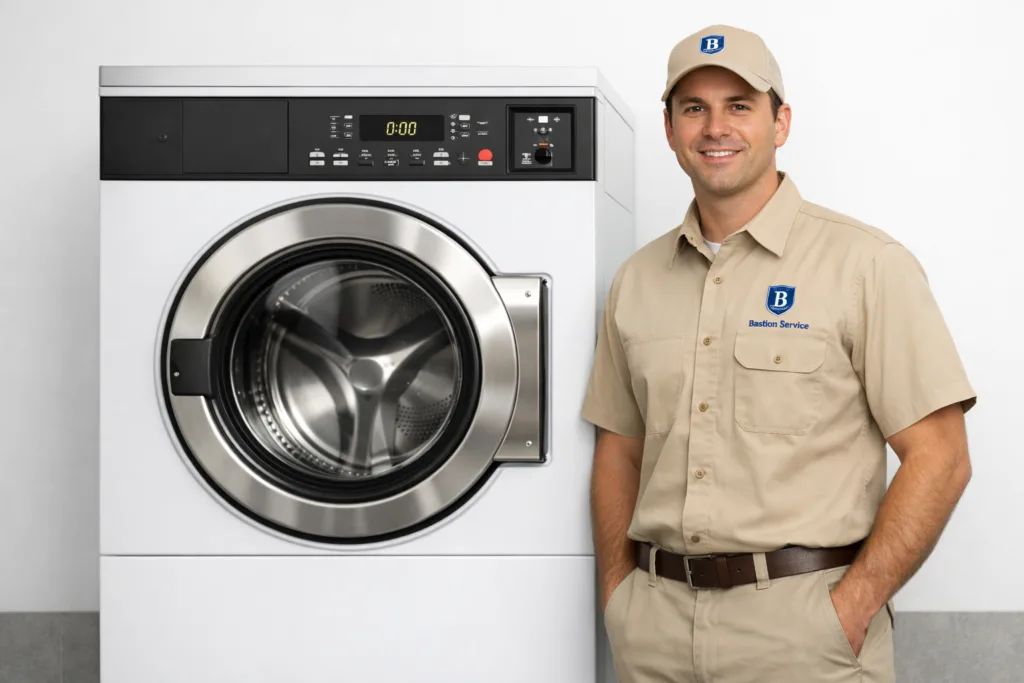




Washer and dryer problems can disrupt tenant service, guest turnover, staff workflow, and daily production far faster than many operators expect. For businesses in Century City using Speed Queen laundry equipment, the most effective next step is usually a service visit that identifies the actual fault, confirms whether the unit should remain in use, and sets repair scheduling around downtime risk instead of guesswork. Bastion Service works with local businesses that need a symptom-focused assessment and a repair path based on how the equipment is performing in real operating conditions.
For specific equipment paths in Century City, review Speed Queen Washer Repair in Century City, Speed Queen Dryer Repair in Century City, and Commercial Appliance Repair in Century City.
How Speed Queen laundry equipment problems usually show up
In business settings, laundry equipment rarely fails in a neat, obvious way. A washer may appear to have a drainage issue when the root cause is a pump failure, a control problem, or a lid or door lock fault preventing the cycle from advancing. A dryer with long dry times may be dealing with restricted airflow, a weak heating circuit, sensor problems, or wear in the drum support system that affects overall performance.
The most disruptive symptom patterns usually include:
- Washers that will not fill, drain, spin, or finish cycles
- Water leaking onto the floor or around the machine base
- Repeated vibration, banging, grinding, or scraping noise
- Dryers with no heat, low heat, overheating, or early shutoff
- Long dry times that create backups and reduce throughput
- Error conditions, intermittent shutdowns, or breaker trips
Because several different failures can create the same outward symptom, repair decisions are stronger when they start with testing and inspection rather than a part assumption.
Speed Queen washer symptoms that deserve attention
Washer issues often start as performance complaints before they become full shutdowns. A machine may leave clothes too wet, stop mid-cycle, fill slowly, or drain poorly for several days before the failure becomes impossible to work around. In laundry rooms, hotels, and other business environments, these early signs usually mean the unit should be checked before a peak-use period turns a manageable issue into a service emergency.
Washer not filling, draining, or spinning
When a washer will not move through the cycle correctly, the cause may involve the water inlet system, pump, drive components, control board, or a lock mechanism that prevents operation. If the tub holds standing water, the problem can point to a blocked drain path, a worn pump, or a control issue that stops the machine before drain or spin begins. If the unit fills but does not complete agitation or spin properly, drive-related wear or sensing problems may be part of the failure pattern.
Leaking water around the machine
Water on the floor should be addressed quickly, especially in multi-unit laundry rooms or properties where slip risk and surrounding damage are concerns. Leaks may come from hoses, pump connections, door seal wear, overfill conditions, internal tub problems, or cracks in components stressed by vibration. Even a small recurring leak can point to a larger internal issue that gets worse with continued operation.
Noise, vibration, and movement during cycles
Heavy vibration, banging, thumping, or grinding often signals more than an inconvenience. These symptoms may be related to suspension wear, mounting problems, unbalanced loads, bearing damage, or drive system deterioration. When the machine begins shifting out of position or making metal-on-metal sounds, it is usually wise to take it out of rotation until the cause is confirmed.
Speed Queen dryer symptoms that affect output
Dryer problems are especially costly because they slow the entire laundry flow even when the machine still appears to run. A dryer that tumbles without drying properly can create rework, longer turnaround times, and unnecessary energy use. In many cases, the complaint sounds simple at first, but the repair need depends on whether the issue comes from heat production, airflow restriction, sensor performance, control faults, or wear in moving components.
No heat, low heat, or overheating
A dryer with no heat may have a failed heating component, power supply issue, control fault, or a safety condition that has interrupted the heating circuit. Low heat or uneven drying can indicate a partial heating failure or an airflow problem that prevents the machine from operating as intended. Overheating deserves prompt inspection because it can involve restricted exhaust, thermostat problems, or controls that are no longer regulating temperature correctly.
Long dry times and repeated cycle complaints
Long dry times are not just a nuisance in a business environment. They reduce machine availability, create queue delays, and often raise utility costs. This symptom may be tied to clogged airflow paths, blower issues, sensor trouble, or weak heat output. If staff are repeatedly adding extra cycles to finish loads, the unit is already showing a repair symptom even if it still completes a program.
Drum problems and unusual dryer noise
When the drum does not turn smoothly, or the machine begins squealing, thumping, or scraping, the repair may involve the belt, motor, rollers, idler components, or related supports. Continued use can spread wear to adjacent parts and turn a targeted repair into a broader rebuild. Burning smells or repeated electrical trips should also be treated as stop-and-check conditions rather than routine performance complaints.
When symptoms point to a more urgent repair need
Some issues can wait for the next available service window, while others justify faster scheduling or taking the machine out of service immediately. Businesses should move quickly when laundry equipment shows any of the following:
- Recurring leaks
- Breaker trips or power-related shutdowns
- Burning odors
- Grinding, scraping, or severe banging noise
- Overheating or repeated thermal shutdowns
- Units stopping mid-cycle with customers, tenants, or staff waiting on output
These symptoms often indicate conditions that can worsen quickly, increase repair cost, or make continued operation a poor decision.
Repair planning for laundromats, hotels, and shared laundry rooms
The best repair choice is not based only on whether a part failed. It also depends on how much the machine outage is affecting turnover, staffing, floor safety, and service expectations. In some cases, a washer or dryer can remain in limited use until the repair visit. In others, the symptom pattern suggests that continued operation may lead to added damage, unreliable results, or avoidable disruption.
That is why intermittent faults matter as much as complete failures. A machine that works sometimes and fails during busy periods can be more disruptive than one that is fully down, because staff continue planning around equipment that cannot be trusted. A service inspection helps determine whether the unit is suitable for short-term use, needs immediate repair, or should be evaluated against replacement based on overall condition.
When repair is often the practical choice
Many Speed Queen washer and dryer problems are repairable when the machine structure is sound and the issue is isolated to serviceable parts such as pumps, valves, heating components, controls, belts, rollers, or sensors. Repair often makes sense when the symptom can be traced to a defined fault and the rest of the equipment remains in stable condition.
Replacement becomes a more serious consideration when there are repeated failures across major systems, signs of extensive wear, or multiple symptom groups appearing together. Examples include persistent leaks combined with noise and vibration, or a dryer with long dry times, overheating complaints, and shutdown issues at the same time. In those cases, the decision should be based on operating reliability, expected downtime, and whether additional failures are likely after the immediate repair is completed.
What a service visit is meant to clarify
A repair appointment is meant to answer practical questions that matter to operators: what is failing, whether the machine should stay in service, what repair scope is likely, and how quickly the issue should be addressed. For washer complaints, that may involve testing fill, drain, spin, locking, and mechanical systems. For dryer complaints, it often includes checking heat production, airflow, controls, drum movement, and safety-related shutdown conditions.
That process helps reduce uncertainty for managers, maintenance teams, and property staff who need to make decisions about scheduling, machine availability, and customer or tenant impact.
If your business in Century City is dealing with Speed Queen laundry equipment that is leaking, stopping mid-cycle, failing to dry properly, making unusual noise, or creating repeated service interruptions, a timely repair evaluation can help limit downtime and identify the right next step before the problem spreads to daily operations.


