
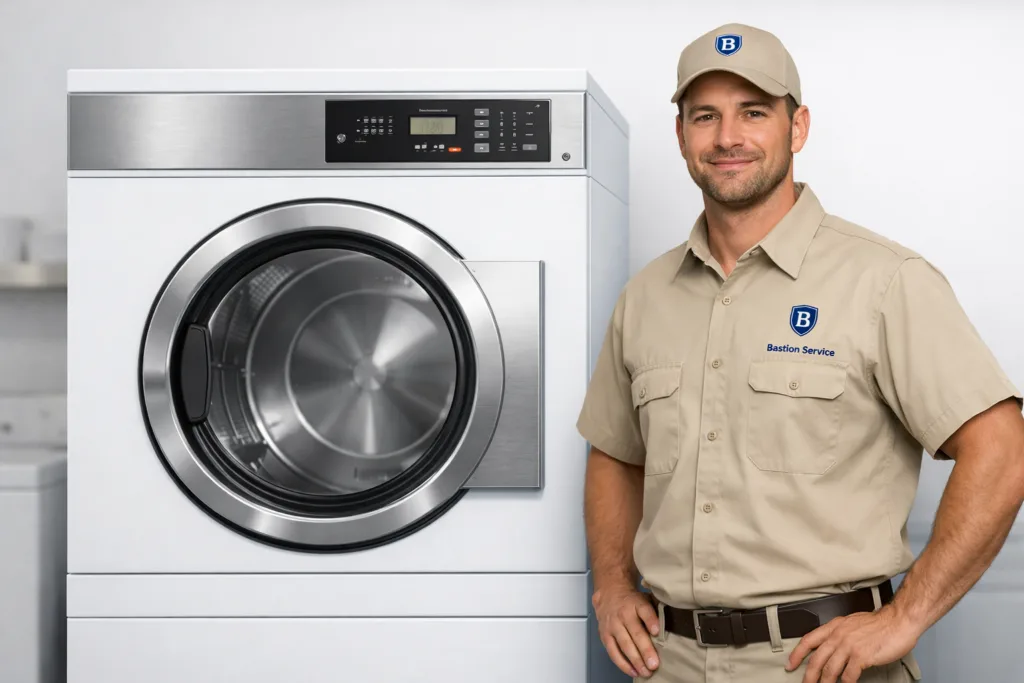






Dryer problems can disrupt workflow fast when loads start stacking up, linens stay damp, or staff have to rerun cycles to get usable results. For businesses in Mar Vista, the most efficient next step is service based on the exact symptom pattern, because no heat, long dry times, drum noise, shutdowns, and no-start complaints can come from very different failures. Bastion Service works on Speed Queen dryers with attention to the issue that is affecting daily operations now, so scheduling is based on function, safety, and likely downtime impact.
Related commercial service paths in Mar Vista include Speed Queen Commercial Repair in Mar Vista, Commercial Dryer Repair in Mar Vista, and Speed Queen Washer Repair in Mar Vista.
Speed Queen dryer issues that often need service
No heat or weak heat
If the drum turns but the load stays wet, the problem may involve the heating circuit, thermal protection, ignition components on gas units, thermostats, wiring, or incoming power. Some dryers still appear to be running normally while producing little or no usable heat, which leads to repeated cycles, wasted labor time, and unnecessary strain on other machines handling overflow.
Long dry times
When a dryer is heating but taking too long, restricted airflow is one of the first things to evaluate. Poor exhaust movement can trap moisture in the system and make the unit run longer than it should. Sensor problems, partial heating loss, and control issues can also cause inconsistent cycle completion. In a busy laundry setting, this usually shows up as reduced throughput before it becomes a full shutdown.
Will not start
A no-start complaint can come from a failed door switch, control board issue, timer problem, motor fault, start components, or a power-related problem. Because several faults produce the same symptom, this is one of the most important situations to diagnose correctly before ordering parts or taking the machine out of service longer than necessary.
Drum noise, vibration, or scraping
Thumping, squealing, rattling, or scraping sounds often point to worn support rollers, belt problems, idler issues, blower wheel trouble, or motor wear. These symptoms usually get worse under repeated use. If the machine is vibrating excessively or the drum no longer sounds smooth during operation, continued use can turn a repairable wear issue into damage affecting multiple components.
Stops mid-cycle or shuts down under load
Intermittent stopping can be tied to overheating, restricted airflow, motor protection, loose electrical connections, or failing controls. A dryer that quits after warming up or stops partway through heavier loads often needs testing under real operating conditions to determine whether the problem is thermal, mechanical, or electrical.
Why is my Speed Queen dryer not heating or finishing the cycle?
This symptom can come from more than one direction, which is why it should not be treated as a simple parts swap. A dryer that does not heat may have a failed heater-related component, but it may also be dealing with airflow restriction, safety cutoffs, sensor problems, ignition faults, or control issues that prevent the cycle from completing correctly.
If the machine heats somewhat but still does not finish well, businesses in Mar Vista should pay attention to whether loads are coming out warm but damp, whether cycle times are growing longer, and whether the problem affects every load or only certain ones. Those details help separate a venting problem from a control problem or a declining heat issue.
Symptoms that suggest airflow trouble
Airflow problems are common because the dryer can still seem operational while performance steadily declines. Watch for signs such as:
- Clothes, towels, or linens staying damp after a normal cycle
- Cabinet surfaces becoming unusually hot
- Drying times getting longer week by week
- Musty loads caused by moisture not clearing properly
- Frequent high-limit trips or shutdowns
- Lint buildup appearing heavier than usual around the unit
Restricted airflow does more than slow drying. It can raise internal temperatures, trigger safety devices, and shorten the life of heating and drive components. If one machine in a lineup is consistently lagging behind the others, airflow and heat output should be checked before the problem spreads into a larger repair.
How symptom-based diagnosis helps avoid repeat downtime
Two dryers can show the same complaint for completely different reasons. For example, long dry times may be caused by poor exhaust flow, weak heating performance, sensor errors, or a control that is ending cycles at the wrong point. A machine that will not start could be dealing with a simple switch issue or a deeper motor or board failure.
That is why diagnosis should match the way the dryer is failing in actual use. Useful service starts with what staff are seeing day to day: whether the machine is slow only on heavy loads, whether it overheats after running for a while, whether noise starts at startup or during coast-down, and whether shutdowns are random or repeatable. Those patterns help narrow the fault faster and support better repair decisions.
When to stop using the dryer and schedule repair
Some problems should be treated as urgent because continued operation can increase damage or create safety concerns. Service should be scheduled promptly if the dryer is:
- Producing a burning smell
- Overheating the load or cabinet
- Stopping repeatedly mid-cycle
- Making loud scraping, squealing, or pounding sounds
- Running with no heat while staff keep repeating cycles
- Failing to start consistently during normal use
Even if the dryer still runs, performance problems tend to become costlier when the machine stays in rotation without finding the source of the issue. In businesses where turnover matters, a declining dryer can affect staffing, customer timing, and the rest of the laundry flow very quickly.
Repair considerations for businesses in Mar Vista
Repair is often the right choice when the failure is tied to a specific component or system and the dryer is otherwise structurally sound. That includes many heating faults, drive issues, control failures, sensor problems, and airflow-related shutdown complaints. The key question is not just whether the unit can be restarted, but whether it can return to stable cycle performance without ongoing interruptions.
Replacement becomes a more serious consideration when there are repeated failures across multiple systems, severe wear in the drum or cabinet structure, or downtime that keeps returning after prior repairs. For most businesses, the practical decision comes down to expected reliability, not just the immediate invoice amount.
What to have ready before a service visit
To speed up diagnosis, it helps to note a few details before scheduling:
- Whether the dryer is gas or electric
- If the drum turns normally
- Whether the unit heats at all, heats weakly, or overheats
- If the problem happens on every cycle or only sometimes
- Any unusual sounds, smells, or visible error behavior
- Whether long dry times affect all loads or only larger ones
These details can make it easier to prioritize the visit, prepare for likely testing, and reduce unnecessary delays once the machine is inspected.
Service-focused next steps for Speed Queen dryer problems
When a Speed Queen dryer starts affecting output, the best next move is usually to stop guessing and schedule repair around the actual symptom. For businesses in Mar Vista, that means looking at heat performance, airflow, controls, drum movement, and shutdown behavior as part of one service decision. A timely diagnosis helps determine whether the issue is isolated and repairable, whether continued operation risks further damage, and how to get the machine back into dependable use with the least disruption to daily operations.


