
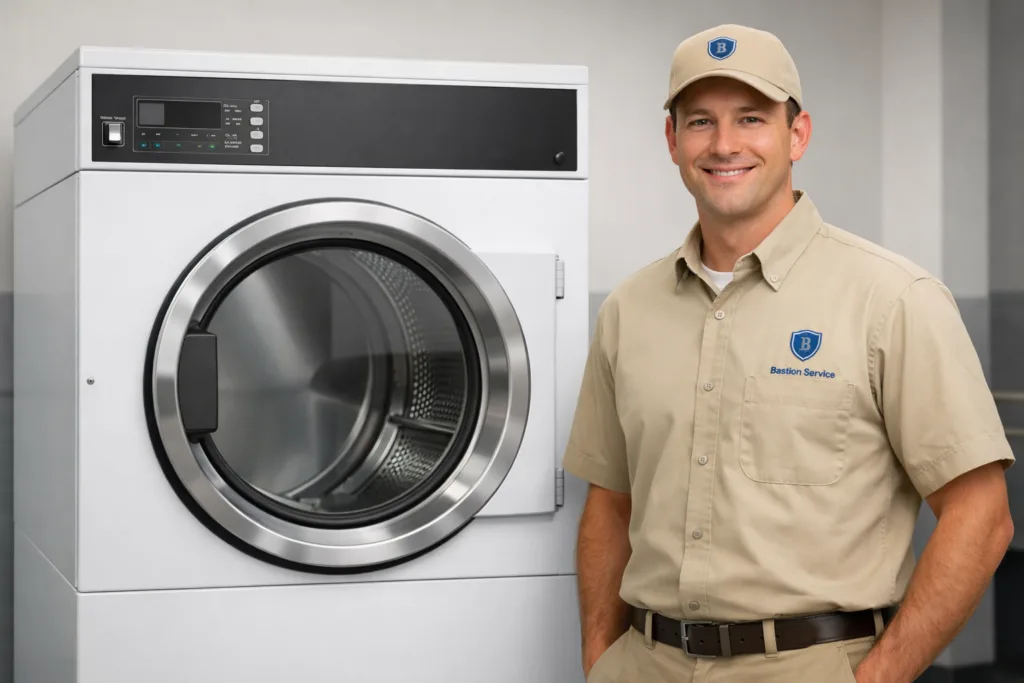




Dryer problems can disrupt load turnaround, staff workflow, and daily output faster than many teams expect. When a Speed Queen unit starts missing heat, taking too long to dry, shutting down, or making new noises, the best next step is service that verifies the actual failure before parts are ordered or labor is approved. Bastion Service helps businesses in El Segundo troubleshoot these issues based on how the dryer behaves during operation, so repair scheduling is tied to the symptom pattern and the impact on uptime.
Related commercial service paths in El Segundo include Speed Queen Commercial Repair in El Segundo, Commercial Dryer Repair in El Segundo, and Speed Queen Washer Repair in El Segundo.
What Speed Queen dryer problems usually point to
Many dryer complaints sound simple at first, but the cause is not always obvious. A machine that tumbles without heat may have a heating or ignition problem, but it can also be dealing with airflow restriction, control failure, sensor issues, or utility-related conditions. A dryer with long run times may not have lost heat completely; it may be producing weak heat, cycling incorrectly, or failing to move air the way it should.
For businesses in El Segundo, this matters because the repair decision should be based on how the machine is failing under real use. Re-running loads, changing settings to compensate, or pulling one dryer out of rotation often signals a problem that is already affecting productivity beyond the equipment itself.
Symptoms that should prompt dryer service
Runs but does not heat
If the drum turns but fabrics stay damp, likely causes include failed heating components, thermostats, igniters, gas-valve related issues, fuses, relays, wiring faults, or board problems. On some units, the complaint can also trace back to power-supply conditions that allow the dryer to run without producing proper heat. This is one of the clearest signs to schedule repair promptly, since every load that finishes wet adds labor delays and unnecessary machine run time.
Dry times are getting longer
Long dry times often develop gradually. Staff may notice loads need extra minutes, then a second cycle, then a change in loading habits just to keep pace. That pattern can indicate restricted exhaust flow, lint buildup in critical passages, weak heat output, sensor issues, or temperature regulation problems. Because the dryer still appears to be working, this symptom is easy to ignore until throughput drops enough to affect operations.
Shuts off before the cycle is finished
Unexpected shutdowns can be tied to overheating, motor stress, safety cutoffs, venting problems, electrical faults, or failing controls. If a Speed Queen dryer stops mid-cycle and then restarts later, or must be started again to complete one load, the machine may be protecting itself from an unsafe or unstable operating condition. Continued use can turn an intermittent issue into a larger repair.
Makes squealing, scraping, grinding, or thumping sounds
Noise complaints usually involve rollers, idler assemblies, bearings, supports, drum contact surfaces, belts, or related drive components. The exact sound often helps narrow the likely source. A squeal may suggest friction from a worn support part, while grinding or scraping can indicate more serious mechanical wear. When a dryer grows louder over time, that is usually a sign that the problem is progressing rather than staying isolated.
Produces a burning smell or excessive cabinet heat
A hot odor, overheated surrounding area, or abnormal cabinet temperature should be treated as a priority. These symptoms can result from blocked airflow, lint accumulation, stuck heating behavior, failing safety devices, or internal component damage. In a busy laundry setting, repeated use under these conditions can increase both repair cost and safety concerns.
Controls do not respond correctly
If the panel behaves inconsistently, settings do not match the dryer’s actual operation, or cycles fail to complete as expected, the issue may involve timers, sensors, interface components, boards, wiring, or supporting electrical parts. Control-related faults can be especially disruptive because they create unpredictable cycle behavior that is difficult for staff to work around.
Why airflow problems deserve extra attention
Airflow issues are behind many complaints that first look like simple heating failures. A Speed Queen dryer may have functioning heat but still perform poorly if hot, moist air is not moving through the system correctly. That can lead to longer dry times, overheating, repeated cycling problems, shutdowns, and avoidable wear on internal components.
Typical signs of airflow trouble include:
- Loads staying damp even though the dryer feels hot
- Cycle times increasing over time
- Cabinet or laundry-room heat building up more than usual
- Safety devices tripping or the machine shutting down mid-cycle
- Lint accumulation showing up where it normally does not
Because airflow restrictions can mimic other failures, they should be evaluated as part of the repair process rather than treated as a minor side issue.
How symptom-based diagnosis helps repair decisions
Two dryers with the same complaint do not always need the same repair. A no-heat issue on one machine may come from a failed component in the heating circuit, while another may be losing heat because of poor venting, a control fault, or a utility problem. A noisy dryer may only need support parts, or it may be showing signs of deeper drum or motor-related wear.
That is why diagnosis should look at the full pattern: whether the dryer heats at all, how it behaves under load, whether the shutdown is repeatable, what sounds are present, and whether the issue changes from cycle to cycle. A more accurate diagnosis helps prevent repeat visits and avoids replacing parts that do not solve the core problem.
When the problem is already affecting operations
Some dryer failures are obvious, but many begin as small workarounds. If staff are separating loads differently, extending cycle times, rotating work to other machines, restarting the dryer, or avoiding certain settings, the equipment issue is already influencing workflow. For hotels, laundromats, and other businesses in El Segundo that rely on predictable laundry output, those small adjustments can become daily bottlenecks.
Scheduling service early is usually the better move when you notice:
- Repeat no-heat or low-heat performance
- Cycles that finish with damp loads
- Frequent restart needs
- New scraping, grinding, or squealing sounds
- Burnt odors or unusual heat buildup
- Error behavior or inconsistent control response
Repair or replace?
In many cases, repair is the practical choice when the issue is limited to a defined component failure and the rest of the dryer remains in solid condition. Replacement becomes a more serious consideration when the unit has multiple active problems, a pattern of repeat breakdowns, severe wear across major assemblies, or downtime that no longer makes sense for the role the dryer serves.
The right call depends on more than age alone. Condition, workload, parts involved, and the cost of continued disruption all matter. A proper service evaluation should help determine whether the current issue is a focused repair or a sign that the machine is becoming unreliable in regular operation.
Preparing for a service visit
Before scheduling repair, it helps to note what the dryer is doing and when the symptom appears. Useful details include whether the unit heats at all, whether the problem happens on every load, what sounds are present, whether the dryer shuts down at a certain point in the cycle, and whether staff have noticed rising temperatures or longer run times. If there is an error display or a repeatable operating pattern, that information can also help narrow the likely cause more quickly.
Even basic observations can make the service visit more efficient, especially when the complaint is intermittent or tied to specific use conditions.
When a Speed Queen dryer starts affecting turnaround, staffing, or load consistency, timely repair service helps limit extra downtime and prevent a smaller issue from spreading into larger damage. For businesses in El Segundo, the most useful next step is to schedule diagnosis around the exact symptom, the urgency of the disruption, and the condition of the machine so the repair plan supports a return to steady operation.


