
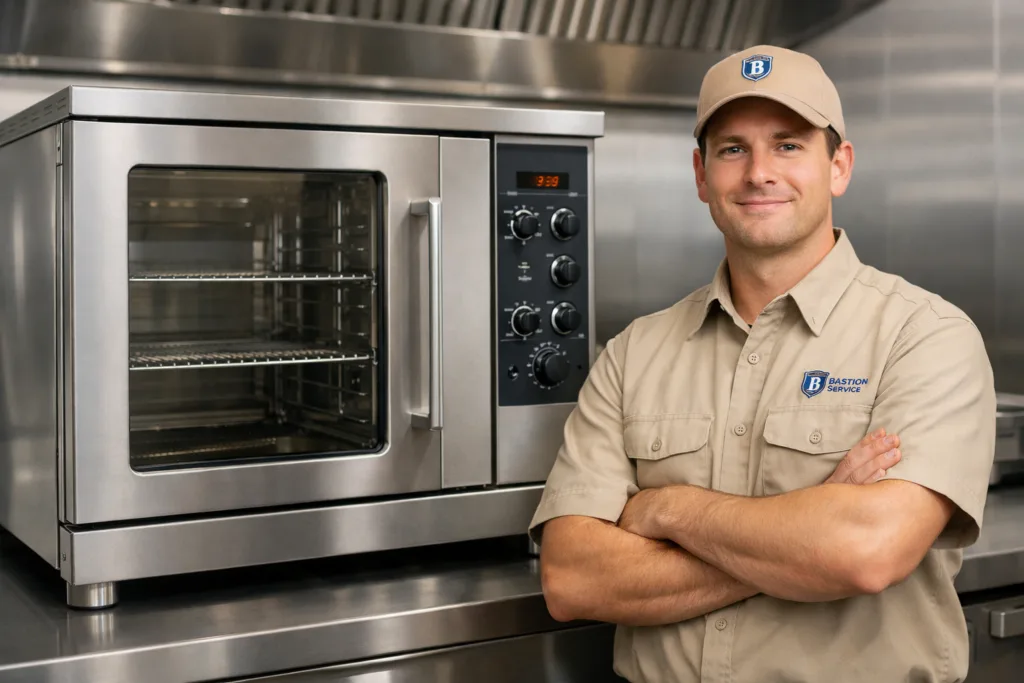




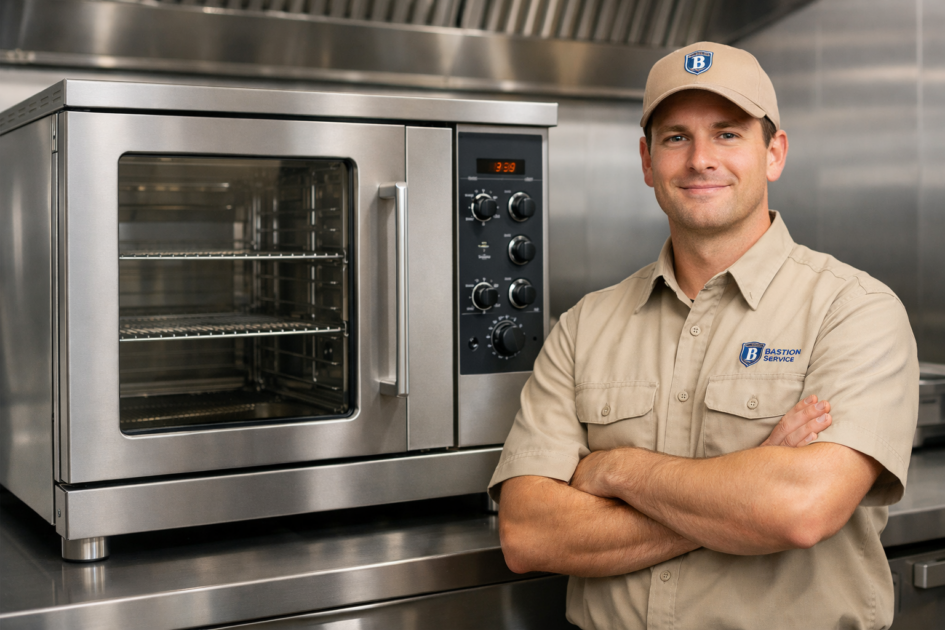
When a Southbend oven starts missing temperature, heating unevenly, or shutting down during production, the main issue is not just the fault itself but the disruption it causes to daily output. In Fairfax, restaurants and other food-service businesses often need service based on symptoms that affect timing, consistency, and safe operation. Bastion Service handles Southbend oven repair with a symptom-first approach so the visit is centered on what the unit is actually doing in the kitchen, what is causing it, and how quickly normal operation can be restored.
Related commercial service paths in Fairfax include Southbend Commercial Repair in Fairfax, Commercial Oven Repair in Fairfax, and Southbend Range Repair in Fairfax.
Service planning is usually easier when the symptom pattern is specific. An oven that runs cool, preheats slowly, or cycles unpredictably may have a very different repair path than one with ignition trouble or a failing control. That is why scheduling repair early matters: the same equipment can appear to be “working” while still creating product inconsistency, staff workarounds, and avoidable downtime.
Common Southbend oven issues that affect kitchen operations
Not heating evenly or reaching the selected temperature
If the oven cavity is too cool, overheats, or struggles to recover after the door is opened, the cause may involve sensor feedback, thermostat calibration, burner performance, heating components, door sealing, or control response. In a busy kitchen, these faults often show up as longer ticket times, undercooked batches, overbrowned edges, or the need to rotate pans more than usual.
Temperature-related problems are especially disruptive because staff may try to compensate by changing recipes, shifting rack positions, or extending cook times. That may help temporarily, but it does not correct the underlying fault and can make product quality harder to manage.
Slow preheat and weak heat recovery
A Southbend oven that takes too long to preheat or drops too much temperature during normal door openings may have weakened heating performance, airflow problems, calibration drift, or a control issue affecting how the heat system cycles. This often becomes most visible during rush periods when the oven cannot keep pace with repeated loads.
Slow recovery is more than an inconvenience. It can interrupt production planning, delay prep, and create inconsistent results between the first and later batches.
Ignition problems, delayed startup, or burner trouble
Gas oven issues often appear as delayed ignition, repeated clicking, inconsistent flame, failure to start, or shutdowns after startup. These symptoms may be tied to the igniter, flame sensing, burner condition, gas valve behavior, or control sequence problems. If startup is becoming unreliable, the unit should be inspected before the issue turns into a no-heat call during active service.
Burner-related faults can also affect how evenly heat is distributed. Even when the oven does light, weak or unstable burner performance can produce noticeable cooking inconsistency.
Control, display, or cycling issues
When the display is unresponsive, settings do not hold, the oven powers on and off unexpectedly, or the unit cycles in a way that does not match the selected temperature, the problem may involve switches, relays, wiring, safety cutoffs, or the main control path. These faults are often mistaken for a larger failure, but proper testing helps determine whether the issue is isolated or part of broader wear.
Why ovens develop uneven baking and temperature swings
Uneven cooking usually has more than one possible cause. A weak heating source, damaged seal, blocked airflow path, convection problem, misreading sensor, or drifting control can all create hot and cold spots. That is why replacing a visible part without testing the full heating cycle can lead to repeat service calls.
Temperature swings can be just as misleading. If the oven overshoots and then falls below target, the fault may be in the regulation side rather than the heat source itself. In practical terms, that means the repair decision should be based on measured performance, not on guesswork from the symptom alone.
Symptoms that usually mean service should be scheduled soon
- Recipes are suddenly taking longer than normal
- Products brown unevenly or finish inconsistently from rack to rack
- The oven does not reach the selected temperature during preheat
- Heat recovery is poor after the door opens
- Ignition becomes intermittent or startup takes multiple attempts
- The oven shuts off unexpectedly during operation
- Controls, displays, or temperature settings behave unpredictably
- Staff are compensating with manual timing changes or pan repositioning
These are the kinds of changes that often start small and become more disruptive over time. If operators are building workarounds into normal kitchen routines, the equipment is already affecting output.
What a service visit is trying to confirm
A productive repair visit is not only about getting the oven to turn on again. The goal is to identify which system is failing, whether the fault is isolated, and how that failure is affecting actual kitchen use. That includes checking heating performance, ignition behavior, temperature response, cycling, controls, and related wear that may be contributing to the complaint.
For businesses in Fairfax, that helps answer the questions that matter most: whether the oven can stay in rotation, what the repair is expected to restore, and whether the current issue points to a single failed part or a broader reliability concern.
When continued operation can make the problem worse
Running an oven with repeated failed starts, major temperature drift, inconsistent flame, or unstable controls can place extra strain on related components and increase the chance of a full outage. A unit that is still producing some heat may still be creating higher operating risk if it is cycling incorrectly or forcing staff to overcompensate.
Continued use also makes planning harder. A manageable repair is easier to schedule than a complete interruption in service after the oven stops heating altogether. If the symptom is recurring rather than isolated, it is usually worth addressing before the next busy shift exposes it again.
Repair decisions depend on the actual failure pattern
Many Southbend oven problems can be resolved by addressing a specific failed component, correcting calibration, repairing ignition-related faults, or restoring proper control function. Repair often makes sense when the oven structure is sound and the issue is limited to one system or a small group of related components.
A replacement discussion becomes more likely when failures are repeated, multiple systems are declining at the same time, or the oven can no longer support consistent production even after recent service. The right decision depends on condition, repair scope, and how much downtime the operation can realistically absorb.
How to prepare before the technician arrives
If possible, note the exact symptom pattern before service is scheduled. Helpful details include whether the oven fails during preheat or during use, whether the problem affects all racks or only certain zones, whether ignition is delayed every time or only sometimes, and whether the issue began suddenly or worsened over time.
It also helps to identify what the staff is seeing in real terms: longer cook times, uneven color, shutdowns, error behavior, or inability to hold a stable temperature. Those observations can shorten diagnosis time and help target the repair path more quickly once the unit is inspected.
Service-focused support for Southbend ovens in Fairfax
For Fairfax businesses, Southbend oven repair is usually about protecting workflow as much as fixing a part. When an oven is affecting timing, consistency, or reliability, the next step is to schedule service around the exact symptom, confirm the source of the problem, and move toward a repair that supports normal kitchen use again. Early attention is often the most practical way to reduce downtime, avoid escalating damage, and keep the equipment aligned with daily production needs.


