
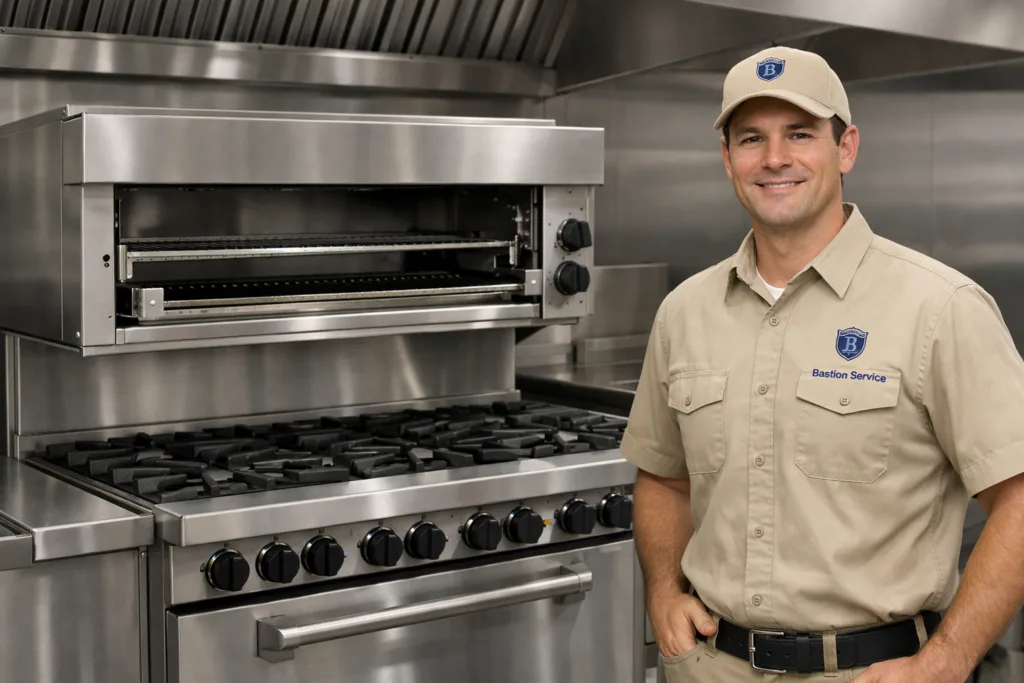




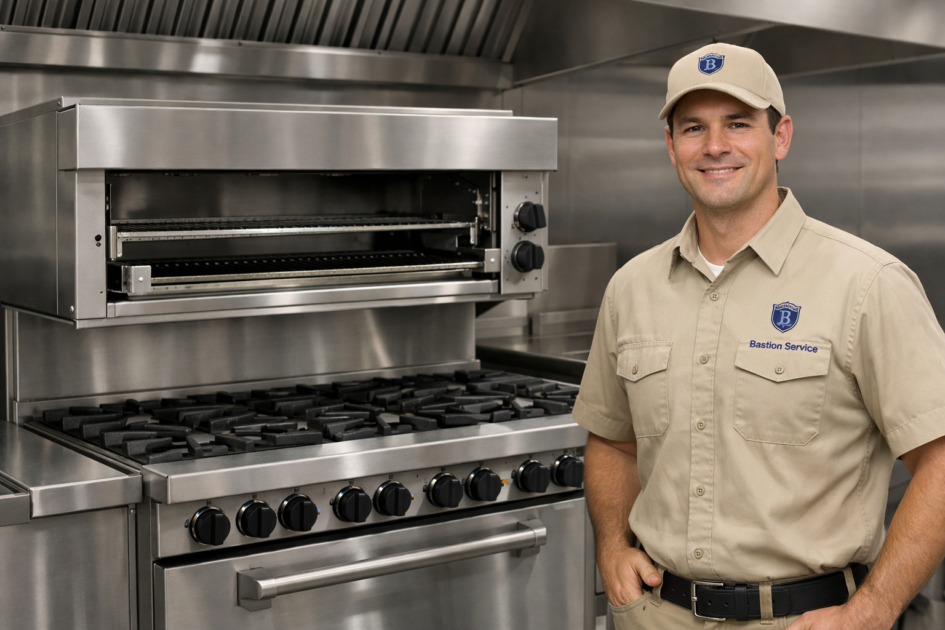
Southbend ovens and ranges are built for daily kitchen demand, but when heat output becomes inconsistent or a unit starts shutting down during service, the impact shows up fast in ticket times, product consistency, and staff workflow. For businesses in Fairfax, the most useful next step is to have the symptom traced to the actual failed component so repair decisions, parts planning, and scheduling are based on how the equipment is behaving in real operation.
For specific equipment paths in Fairfax, review Southbend Oven Repair in Fairfax, Southbend Range Repair in Fairfax, and Commercial Appliance Repair in Fairfax.
Bastion Service provides repair support for Southbend cooking equipment used in restaurants and other food-service businesses, with attention to downtime, safe operation, and whether the unit can remain in limited use until service is completed. That matters because the same complaint—slow heat, failed ignition, uneven cooking, or repeated resets—can come from very different causes.
Southbend oven and range problems that interfere with kitchen output
When cooking equipment stops performing normally, the issue is rarely just inconvenience. A range that will not hold flame or an oven that recovers too slowly can create backups across prep, cook line timing, and order flow. Southbend equipment often shows warning signs before total failure, and those early symptoms are usually the best time to schedule service.
Temperature control and uneven heating
If an oven runs too hot, too cool, or swings above and below the set point, the problem may involve sensors, thermostatic controls, calibration drift, relays, burners, or gas-flow components. Uneven cavity heat can also point to circulation or burner-performance issues depending on the unit design. In daily operation, these faults often show up as inconsistent bake results, longer cook times, scorched edges, undercooked centers, or staff needing to rotate product more than usual.
On a range, weak or unstable heat can make it harder to maintain pans at working temperature, slowing production during busy periods. What looks like a simple heat complaint may actually involve regulator issues, valves, ignition parts, or wear inside the burner system.
Ignition failures and delayed burner lighting
Ignition problems are common reasons businesses call for service on Southbend cooking equipment. Burners may click without lighting, light late, fail intermittently, or go out after startup. Some units will ignite only after several attempts, while others may work during slower periods and act up once the kitchen is under load.
These symptoms can be tied to igniters, flame-sensing components, switches, gas-path restrictions, wiring faults, or control issues. Because delayed ignition and unstable flame can affect both safety and reliability, this is usually not a problem to keep pushing through shift after shift.
Slow recovery and production delays
One of the more costly performance issues is slow recovery. An oven may eventually reach the target temperature but take too long to get there, or a range may lose output when multiple sections are in use. In practice, that means slower batch turnover, more waiting between orders, and line staff adjusting process just to compensate for equipment that no longer keeps pace.
Slow recovery is often linked to burner weakness, control problems, temperature sensing faults, restricted gas delivery, or other conditions that reduce normal heat transfer. It is worth diagnosing early because continued use under load can increase wear on related parts and make the outage more disruptive later.
Intermittent shutdowns and control problems
Some of the most frustrating Southbend issues are intermittent. A unit may power on normally, then shut off mid-cycle, trip a safety limit, stop responding to settings, or require repeated resets. These cases can involve internal wiring, heat-related control failure, safety devices, switches, boards, or electrical supply problems to the unit.
Intermittent faults matter because they rarely stay intermittent forever. If staff are already building workarounds around random shutdowns, the equipment is typically moving closer to a full failure that will be harder to absorb during regular service hours.
Symptoms that usually mean it is time to schedule repair
Businesses often delay service when the equipment is still partially running, but several patterns usually indicate that repair should be scheduled before the next rush:
- The oven takes noticeably longer to preheat or recover.
- Burners do not light on the first attempt or need relighting.
- Heat output changes during use without staff adjusting settings.
- One section of the range works while another becomes unreliable.
- The unit shuts down, resets, or loses flame during production.
- Food quality changes from batch to batch under the same settings.
- Staff are avoiding certain burners or compensating for hot and cold spots.
These are not just maintenance annoyances. They are signs that the equipment is affecting labor efficiency, consistency, and the ability to keep service moving.
What a repair diagnosis helps determine
For Southbend cooking equipment repair in Fairfax, diagnosis should answer more than whether the unit has a fault. It should clarify what failed, how urgent the issue is, whether continued operation is reasonable, what parts may be required, and whether the repair is likely to restore stable performance or simply postpone a larger decision.
This is especially important with ovens and ranges because similar symptoms overlap. A temperature complaint may come from a sensor issue, a weak burner, a control fault, or a gas-supply problem inside the unit. An ignition complaint may start with a single failed component but also reveal wear across a broader burner assembly. Proper testing helps separate isolated repairs from patterns of ongoing failure.
Repair planning for Southbend ovens and ranges
Once the fault is identified, the next question is usually how to plan the repair around kitchen operations. Some issues require the equipment to be removed from use immediately, while others allow a short scheduling window if the unit can still operate safely in a limited role. That difference matters for staffing, menu decisions, and daily output.
It also helps to know whether the problem is confined to one zone of the equipment or affecting the unit more broadly. A single burner issue may be manageable until service is performed, but repeated ignition failure, widespread heat inconsistency, or control-related shutdowns usually point to a more urgent repair need.
When repair makes sense and when replacement becomes part of the discussion
Many Southbend problems are repairable without turning into replacement decisions. If the unit is structurally sound and the failure is isolated to a burner component, ignition part, sensor, valve, or control element, repair is often the practical route. The value comes from restoring stable performance and avoiding the larger disruption of replacing a key piece of cooking equipment.
Replacement becomes more relevant when the equipment has a history of repeat failures, multiple systems are breaking down at once, or downtime costs are starting to outweigh the benefit of another major repair. For businesses, the real question is not just age. It is whether the unit can return to dependable service without continuing to interrupt production.
Details that help speed service
Before a visit, it helps to note exactly what the equipment is doing and when the problem appears. Useful observations include:
- Whether the issue happens during preheat, during peak use, or after cycling.
- Whether only certain burners are affected.
- Whether the flame appears weak, unstable, or delayed.
- Whether the oven overshoots temperature or struggles to reach it.
- Whether shutdowns happen randomly or after the unit has been hot for a while.
- Whether staff hear clicking, smell unburned gas, or have to restart the unit.
Specific symptom timing often shortens troubleshooting and helps determine whether the issue is tied to startup, heat load, control response, or fuel delivery.
Service support for Fairfax kitchens using Southbend equipment
When a Southbend oven or range starts causing production delays, inconsistent heat, ignition trouble, or repeated shutdowns, service should focus on restoring reliable kitchen performance as efficiently as possible. For Fairfax businesses, scheduling repair is the practical next step when the equipment is affecting output, creating uncertainty during service, or showing signs that a partial problem is turning into a full outage.
A focused evaluation helps determine what failed, whether the unit should remain in use, what repair path makes sense, and how to plan around downtime so the equipment can get back to stable operation with as little disruption as possible.





