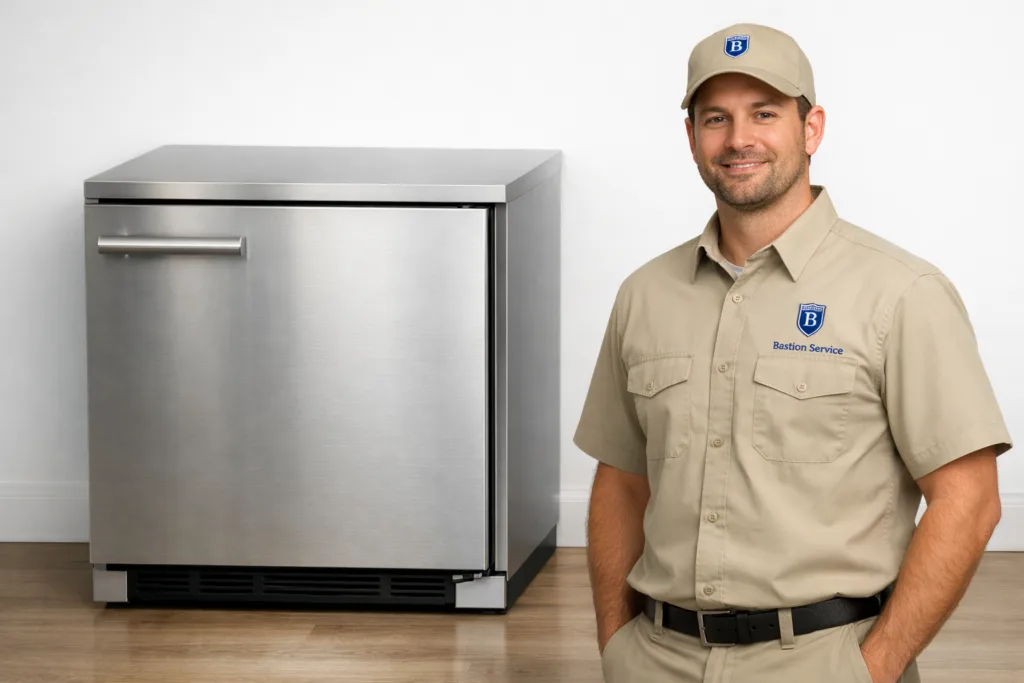
When a Perlick freezer starts losing temperature control, the fastest way to avoid food loss is to pay attention to the pattern of the problem. A unit that is slightly warm, frosting heavily, or running far longer than normal may have an airflow issue, a defrost failure, a sealing problem, or a cooling-system fault. Those symptoms can overlap, which is why the best repair decisions come from matching the behavior of the freezer to the component that is actually failing.
How freezer symptoms point to different problems
Freezers rarely fail in only one dramatic way. More often, they show smaller warning signs first: ice cream softens, frost appears near the door, drawers get harder to open, or the cabinet sounds different during the night. In Inglewood homes, these details matter because they help narrow down whether the problem is related to air circulation, moisture entering the cabinet, temperature sensing, or loss of cooling performance.
For example, a freezer that is cold in one section but not another often suggests uneven airflow. A freezer with thick frost on the back interior panel may be dealing with a defrost-system issue. A unit that seems to recover after being unplugged but then slips again usually has an unresolved component problem rather than a one-time glitch.
Common Perlick freezer problems in the home
Not freezing hard enough
If frozen food is soft, clumped together, or partially thawing, the freezer may not be maintaining a stable low temperature. Possible causes include a weak evaporator fan, a faulty sensor or control, dirty condenser surfaces, a loose door seal, or a more serious sealed-system issue. Uneven thawing is especially important to note, because it can show that cold air is not moving properly through the cabinet.
Frost buildup inside the freezer
Frost usually forms when moisture is getting inside or when the freezer is not clearing frost the way it should during normal operation. A worn gasket, a door left slightly ajar, a warped closing surface, or failed defrost components can all lead to similar-looking ice accumulation. Once frost builds up enough to restrict vents or cover interior panels, overall cooling starts to suffer.
Constant running or very long cycles
A Perlick freezer that seems to run all day may be struggling to reach the set temperature. That can happen when warm air keeps entering the cabinet, condenser airflow is restricted, the thermostat is reading incorrectly, or cooling efficiency has dropped. Long runtime is not just a comfort issue; it can also add wear to motors and starting components.
Buzzing, clicking, rattling, or fan noise
Some operating sound is normal, but new or persistent noise deserves attention. Repeated clicking can point to compressor start trouble. Buzzing may come from a motor or vibration. Scraping or rubbing can happen when ice interferes with a fan. If the sound changes when the door opens, that can be a helpful clue that the evaporator fan area should be checked.
Water near or under the appliance
Leaks around a freezer are often tied to a blocked defrost drain, excess condensation, melting ice from unstable temperatures, or door-seal problems that let humid air in. Even a small amount of recurring water can damage nearby flooring or cabinetry if it keeps happening.
Signs the issue is getting worse
Some freezer problems stay manageable for a short time, while others escalate quickly. You should stop treating it as a minor inconvenience if you notice any of the following:
- Food that no longer stays fully frozen
- Frost returning soon after removal
- The compressor running without reaching normal temperature
- Moisture collecting inside the cabinet
- Drawers, shelves, or vents blocked by ice
- New mechanical noise that repeats during every cycle
These symptoms usually mean the freezer is no longer operating within a normal range and continued use may place more strain on the unit.
What homeowners can check before service
A few simple observations can make the problem easier to identify. Check whether the freezer is warm all the time or only intermittently. Look at where frost is collecting: around the door, across the back panel, or throughout the cabinet. Notice whether the door closes firmly without bouncing back open. Also confirm that food packages are not packed tightly enough to block interior airflow.
It also helps to note whether the noise changes when the door is opened and whether the freezer seems to cool better after a manual reset or power cycle. Those details do not replace service, but they can help separate a door-seal or fan issue from a control or cooling-system problem.
When continued use can lead to more damage
Running a struggling freezer for too long can create secondary problems. If the cabinet is warming while the machine runs nonstop, the compressor may be under unnecessary stress. If frost becomes heavy enough to block vents, airflow drops further and temperature swings become more severe. Water leakage can also spread beyond the appliance itself and affect surrounding finishes.
If food safety is already questionable, move temperature-sensitive items elsewhere rather than waiting to see if the freezer stabilizes on its own. A short delay can turn a manageable repair into a more expensive situation.
Repair or replacement?
Many Perlick freezer issues are repairable, especially when the fault involves fans, sensors, controls, gaskets, drains, or start components. Replacement becomes a more serious consideration when there is major cooling-system failure, repeated costly breakdowns, or a broader decline in the appliance’s overall condition.
The right choice depends less on one symptom alone and more on the repair path, parts involved, and whether the freezer can return to consistent household use afterward. In many cases, a proper diagnosis shows that a targeted repair makes more sense than replacing the entire unit too soon.
What focused Perlick freezer repair should accomplish
Good service is not just about making the freezer cold again for a day or two. The goal is to identify why the temperature changed, why frost formed, or why the unit began leaking or making noise in the first place. That approach helps avoid unnecessary parts replacement and reduces the chance of the same issue returning shortly after the visit.
For homeowners in Inglewood, symptom-based Perlick freezer repair is most useful when it stays centered on the actual fault. Whether the issue is poor cooling, recurring frost, leaking water, or unusual operation, the next step should be based on what the freezer is telling you rather than guesswork.