





KitchenAid appliances tend to fail in patterns, and those patterns matter. A refrigerator that hums constantly, a dishwasher that finishes with cloudy glasses, or an oven that runs hot one day and cool the next can each have more than one possible cause. The most useful first step is to match the symptom to the system involved instead of assuming the most obvious part has failed.
How to read KitchenAid appliance symptoms before deciding on repair
Many household appliance problems start subtly. Temperatures drift a few degrees, cycles get longer, noise changes, or a small leak appears only occasionally. These early signs often point to wear in airflow parts, pumps, sensors, valves, heating components, or controls. Waiting too long can turn a limited repair into a larger one, especially when moisture, heat, or poor cooling is involved.
For homeowners in Rancho Palos Verdes, it helps to pay attention to what changed first. Did the appliance become louder before performance dropped? Did an error code appear after a power interruption? Did the problem begin after a heavy-use holiday weekend or after the unit was moved, cleaned, or loaded differently? Those details often narrow down the likely source of the failure.
Refrigerator and freezer problems that deserve quick attention
KitchenAid refrigerators and freezers often show trouble through warming food, frost buildup, weak ice production, water near the base of the unit, or sections that cool unevenly. Some units still sound normal while failing to hold safe temperatures, which can make the issue easy to miss at first.
Common causes include evaporator fan problems, restricted airflow, defrost faults, worn door gaskets, sensor errors, condenser issues, or electronic control failures. In built-in and premium-style models, even small airflow or sensor problems can affect performance noticeably because these systems rely on tighter temperature control.
- Fresh food section warm, freezer still cold: often points to airflow or defrost-related trouble.
- Freezer frosts over repeatedly: may indicate a defrost system issue or a sealing problem.
- Unit runs almost nonstop: can suggest dirty condenser conditions, weak cooling performance, or control and sensor faults.
- Water under crisper drawers or on the floor: commonly relates to a clogged drain, line issue, or condensation management problem.
If milk, leftovers, or frozen items are not staying consistently cold, continued use should be limited. Temperature instability can risk food safety and increase strain on major cooling components.
Ice maker and water-related complaints
KitchenAid ice maker issues are often reported as slow production, hollow cubes, clumping, leaking, jamming, or no ice at all. These symptoms may come from a water supply problem, a fill valve that is not opening correctly, a thermostat or sensor issue, or a fault within the ice maker assembly.
When the refrigerator also has cooling inconsistencies, it is usually better to look at the full system rather than treating the ice maker as a separate problem. Ice production often reflects broader temperature or airflow conditions inside the appliance.
Any recurring leak deserves prompt attention. Even a small amount of water can affect flooring, nearby cabinetry, or the space beneath the appliance if it continues over time.
Dishwasher symptoms and what they often mean
KitchenAid dishwashers usually reveal problems through poor cleaning, gritty residue, standing water, weak spray action, door leaks, unusual grinding noise, or dishes that never seem to dry properly. Because several systems work together during a cycle, one complaint can have multiple causes.
Poor wash performance may come from blocked spray arms, wash pump wear, low fill issues, filter buildup, or detergent and heating problems. Drain complaints can point to restrictions, pump trouble, drain hose issues, or a control problem that interrupts the cycle sequence.
Signs a dishwasher should not keep running
- Water remains in the tub after every cycle.
- The unit leaks onto the floor or from underneath the cabinet line.
- The door will not latch securely or pops open during operation.
- The motor hums without proper washing or draining.
- The dishwasher stops mid-cycle repeatedly.
Leaks and drain failures are worth addressing early because hidden moisture can spread beyond the visible area. A dishwasher that seems to work only sometimes often has an underlying mechanical or electrical issue rather than a simple clog alone.
Oven, wall oven, range, and cooktop performance issues
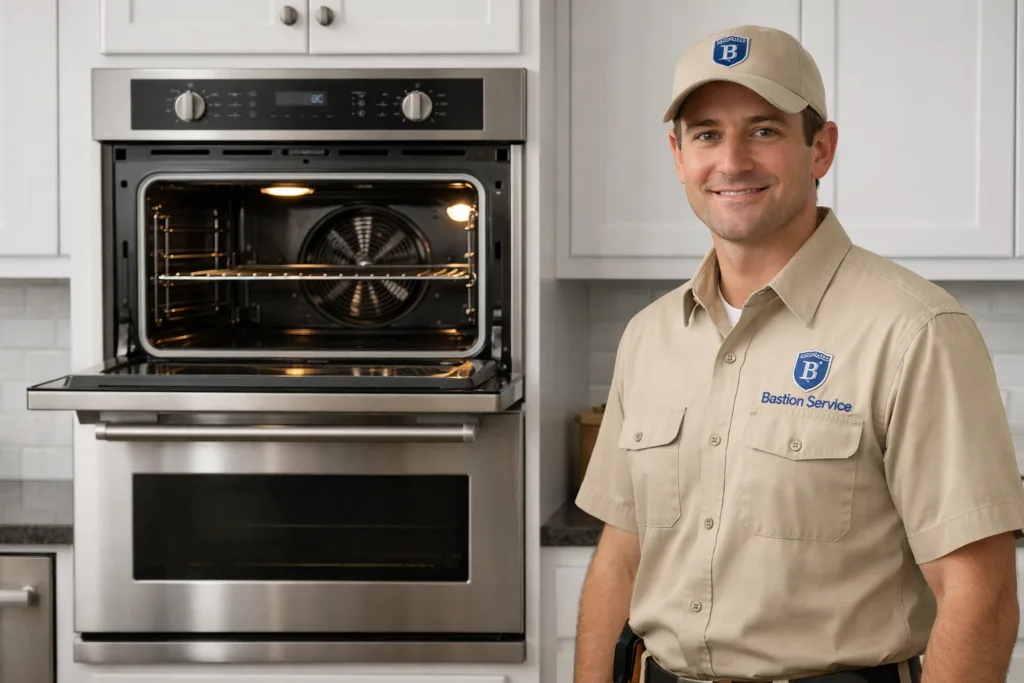
KitchenAid cooking appliances often develop symptoms such as slow preheating, uneven baking, burners that cycle incorrectly, weak ignition, temperature drift, or controls that respond inconsistently. The right diagnosis depends on whether the appliance is electric or gas and whether the complaint involves surface cooking, oven heating, or both.
Electric problems may involve bake or broil elements, infinite switches, relays, temperature sensors, wiring, or electronic controls. Gas-related issues may involve igniters, burner components, spark systems, valves, or flame regulation parts. In many cases, homeowners first notice the issue as cooking results that suddenly become unreliable.
Common cooking-related patterns
- Food burns on top but stays undercooked inside: may reflect temperature regulation or element performance issues.
- Oven takes much longer to preheat: often points to a weakening element, igniter, or sensor problem.
- Burner clicks repeatedly: can suggest ignition moisture, a switch issue, or burner alignment trouble.
- One burner heats only on high or low: may indicate a control or switch fault.
- Display works but oven does not heat: can involve relays, elements, thermal protection components, or control board failure.
If an oven overheats, a burner behaves unpredictably, or there is a persistent gas odor, stop using the appliance until the cause is identified. Safety takes priority over convenience with any heat-producing appliance.
Wine cooler issues that should not be ignored
KitchenAid wine coolers are designed for steady, controlled storage, so small temperature changes matter more than they might in a standard refrigerator. Problems often show up as temperature drift, excessive condensation, continuous running, interior light and display issues, or cooling that seems weak despite normal sounds.
Possible causes include fan trouble, thermostat or sensor failure, door sealing problems, control issues, or sealed-system concerns. If bottles are warming, labels are collecting moisture, or the unit seems to run nonstop, the issue may be more than simple placement or loading.
What certain symptom patterns usually suggest
Looking at the symptom pattern rather than one isolated event is often the fastest way to make sense of a KitchenAid problem.
- Intermittent operation: often indicates a sensor, control, switch, or connection issue instead of a complete mechanical failure.
- Buzzing, grinding, or rattling: may come from a fan motor, drain pump, compressor mounting issue, or a loose internal component.
- Longer cycles than normal: can point to heating trouble, control delays, poor drainage, or a system struggling to reach target temperature.
- Error codes or random resets: frequently involve control communication, power issues, or a failing component affecting the board.
- Moisture where it should not be: may be tied to drainage faults, line leaks, gasket wear, or condensation problems.
These patterns do not identify a part by themselves, but they are helpful for separating likely causes from guesswork.
When repair makes more sense than replacement
Not every malfunctioning KitchenAid appliance needs to be replaced. In many homes, repair is the better choice when the problem is isolated, the unit is otherwise in good condition, and the appliance still fits the kitchen layout and daily routine well. This is especially true for built-in refrigeration, wall ovens, and coordinated kitchen setups where replacement can involve more than the appliance alone.
Replacement becomes a stronger consideration when there are multiple failing systems, severe interior wear, repeated electronic problems, substantial cooling-system concerns, or damage that has spread beyond the original fault. The appliance’s age matters, but age alone is not the full story. A well-kept unit with one identifiable problem can still be a solid repair candidate.
What homeowners in Rancho Palos Verdes should expect from the evaluation process
A good service visit should move from symptom review to targeted testing, then to a realistic explanation of what failed and what the next step looks like. Broad complaints such as “not cooling,” “not draining,” or “not heating” are starting points, not conclusions. The value of the visit is in narrowing the fault, confirming whether repair is practical, and explaining any risk in continued use.
For households in Rancho Palos Verdes, that approach is especially helpful when the appliance is still partly working. Partial operation often creates the most uncertainty because the appliance appears functional while quietly underperforming. Whether the issue involves a refrigerator, freezer, ice maker, dishwasher, cooktop, oven, range, wall oven, or wine cooler, the best decision comes from the actual symptom pattern and the condition of the machine as a whole.
Simple steps before scheduling service
Before arranging repair, homeowners can save time by noting a few basics:
- Write down any error code exactly as shown.
- Notice whether the problem is constant or intermittent.
- Check if the issue affects one section of the appliance or the whole unit.
- Listen for new noises such as clicking, humming, grinding, or repeated cycling.
- Look for signs of leaking, frost, heat changes, or delayed cycle completion.
Those observations can help clarify whether the problem is likely tied to airflow, drainage, heating, controls, or water delivery. In many cases, catching the pattern early is what prevents a manageable repair from becoming a larger household disruption.


