
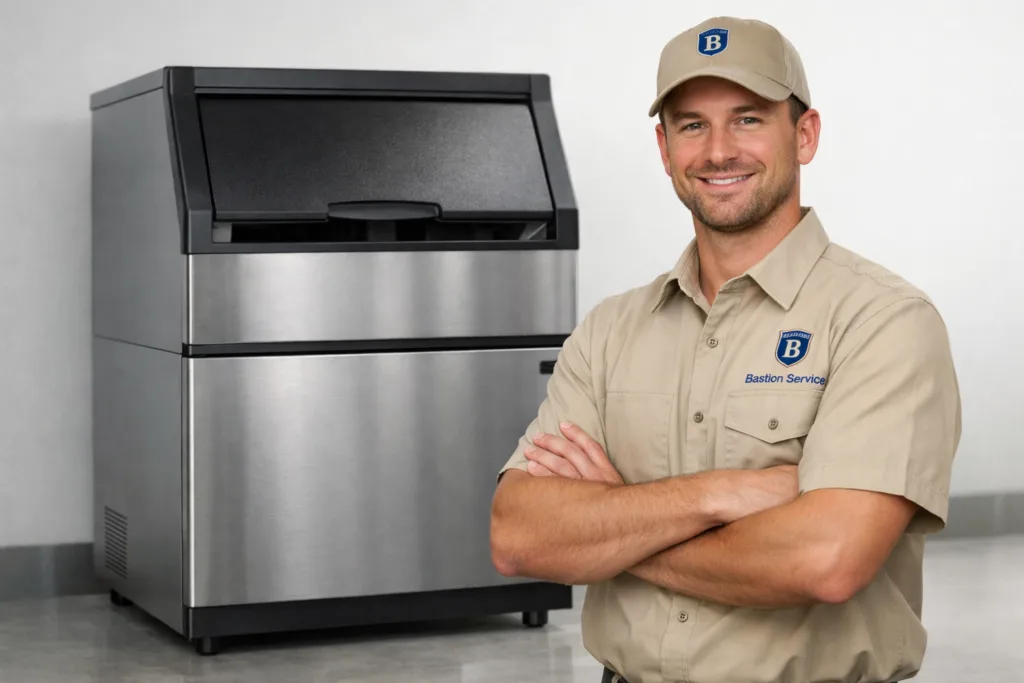




Ice machine problems rarely stay minor for long when a business depends on steady production throughout the day. If a Hoshizaki unit is slowing down, leaking, dropping poor-quality ice, or stopping mid-cycle, service should focus on the specific failure pattern so repairs address the real cause instead of chasing symptoms. For businesses in Sawtelle, that usually means scheduling diagnosis before low output starts affecting beverage service, prep routines, sanitation, or staff workflow.
Related commercial service paths in Sawtelle include Hoshizaki Commercial Repair in Sawtelle, Commercial Ice Machine Repair in Sawtelle, and Hoshizaki Refrigerator Repair in Sawtelle.
How service is typically approached for Hoshizaki ice machine problems
Hoshizaki machines can show several issues at once. A unit may still run while producing less ice, taking too long to harvest, making hollow or wet cubes, or leaving water where it should not. Those symptoms can come from different sources, including restricted water supply, scale buildup, drainage blockage, pump trouble, sensor or control faults, airflow restrictions, or refrigeration performance loss.
Bastion Service helps Sawtelle businesses narrow the problem down by looking at how the machine is actually operating on site. Freeze timing, harvest behavior, water fill, condenser condition, bin conditions, and shutdown patterns all help determine whether the repair is likely maintenance-related, component-related, or tied to deeper cooling performance.
Common symptom patterns and what they may mean
Low ice production or slow recovery
If the bin is not refilling fast enough, the machine may have a water feed problem, mineral buildup, poor heat transfer, dirty condenser coils, or a refrigeration issue reducing overall capacity. This often becomes noticeable during busy periods, when normal demand exposes that the unit cannot recover at its usual rate.
Slow production should not be judged by output alone. A machine that is technically still making ice may already be running longer cycles, struggling to complete harvest correctly, or producing smaller batches than expected.
Machine runs but the ice quality changes
Cloudy, soft, thin, irregular, or clumped ice can point to inconsistent fill, water quality issues, internal scale, temperature instability, or cycle-control problems. Ice appearance matters because it often reveals that the machine is no longer freezing or harvesting under normal conditions.
When cube quality changes, businesses often notice the operational effect before the technical cause. Drinks may be affected, ice may melt faster, or staff may find that stored ice is sticking together in the bin.
Water leaks, overflow, or drainage trouble
Water around a Hoshizaki ice machine may be caused by a clogged drain, slow pump-out, cracked tubing, fill problems, or ice formation that redirects water outside the normal path. Even a small leak deserves prompt attention because moisture around the machine can create cleanup issues, sanitation concerns, and added risk for surrounding equipment areas.
Drain-related faults can also interfere with cycle completion. If water is not moving out of the machine correctly, freeze and harvest performance may become inconsistent long before the unit stops entirely.
Freeze cycle or harvest cycle problems
Some machines freeze too long, fail to release ice cleanly, shut off during harvest, or restart unpredictably. In those cases, likely causes can include scale on critical surfaces, sensor misreads, control board issues, weak water flow, or other components operating outside normal range.
These issues are worth addressing quickly because repeated failed cycles put more strain on the system and can turn an intermittent complaint into a full loss of production.
Unusual noise, heat, or vibration
Buzzing, rattling, fan noise, pump noise, or excess heat around the unit can be early warning signs of restricted airflow, failing motors, loose hardware, or internal mechanical stress. A machine may keep producing ice for a while with these symptoms, but performance often gets less stable as the underlying issue worsens.
Why a partially working machine still needs repair
One of the most expensive ice machine situations is not always a complete breakdown. Often it is the unit that still makes some ice, but not enough, or not consistently, and forces staff to work around it every day. Production shortages, backup ice handling, cleanup from leaks, and longer recovery times all add hidden operational cost.
Continued use can also make the repair larger. A dirty condenser can push temperatures out of range. Scale can interfere with sensing and water movement. Drain restrictions can create repeated cycle problems. What starts as one service issue can place added stress on other components if the machine is kept in service too long without correction.
Signs it is time to schedule service
- The machine no longer keeps up with normal daily demand.
- Ice cubes are smaller, wetter, softer, or inconsistent.
- Water is visible around the unit or in areas where it does not normally collect.
- The unit stops unexpectedly, alarms, or short-cycles.
- Harvest is delayed, incomplete, or erratic.
- Staff have started changing routines because the machine cannot be trusted to keep pace.
Those are usually signs that the issue has moved beyond simple observation and should be professionally diagnosed before downtime gets worse.
What businesses can check before a repair visit
A few basic observations can help speed up service. Note whether the machine is making no ice at all or simply less than normal. Check if the problem is constant or only appears at certain times of day. Look for visible leaks, unusual noise, slow draining, or obvious heat buildup around the condenser area. If the machine has displayed shutdown or fault behavior, keeping track of when it happens can also help narrow the cause.
It is also useful to know whether the unit recently had cleaning, maintenance, filter changes, or any change in water conditions. That background can help separate a maintenance issue from a part failure or broader cooling problem.
Repair versus replacement decision points
Many Hoshizaki ice machine problems are repairable, especially when addressed before repeated failures stack up. Repair often makes sense when the machine still matches the business’s production needs and the problem is isolated to water flow, controls, drainage, sensors, pumps, airflow, or similar serviceable components.
Replacement becomes a more serious consideration when the machine has recurring downtime, multiple systems failing in sequence, repair costs building against equipment age, or output that no longer fits actual demand even when the machine is functioning. The right decision depends on current condition, repair scope, and how costly unreliable ice production has become for the operation.
Why symptom-based diagnosis matters with Hoshizaki equipment
Similar complaints do not always lead to the same repair. Low production can come from water restriction, scale, condenser problems, or refrigeration loss. Leaks may be drainage-related or tied to ice formation and overflow. Poor harvest may be caused by control issues, mineral buildup, or improper freeze conditions. Treating all of these as the same problem can lead to wasted time and unnecessary parts replacement.
That is why the most useful service call is one that starts with the exact symptom pattern, confirms what the machine is doing in real operating conditions, and then moves toward the repair that fits the failure instead of guessing. For a business in Sawtelle, that approach usually means less disruption and a clearer path back to normal production.
If your Hoshizaki ice machine is falling behind, leaking, cycling incorrectly, or producing inconsistent ice, scheduling repair early is usually the best way to limit downtime and avoid a bigger interruption later. A focused service visit can identify what is affecting production, what repair is actually needed, and what next step makes the most sense for keeping the machine reliable in day-to-day operation.


