
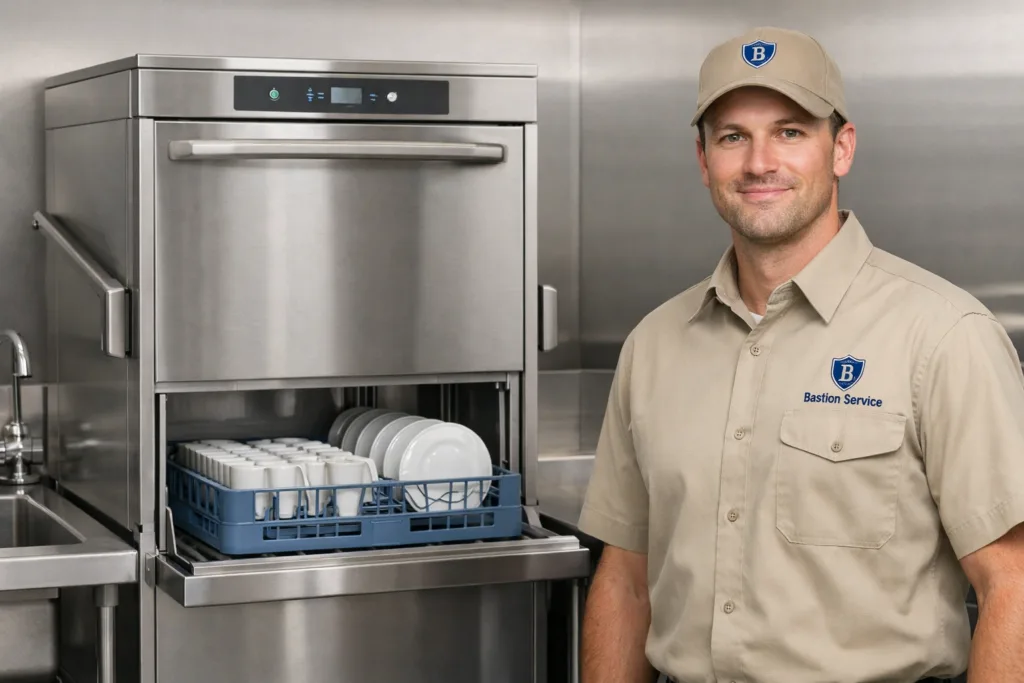




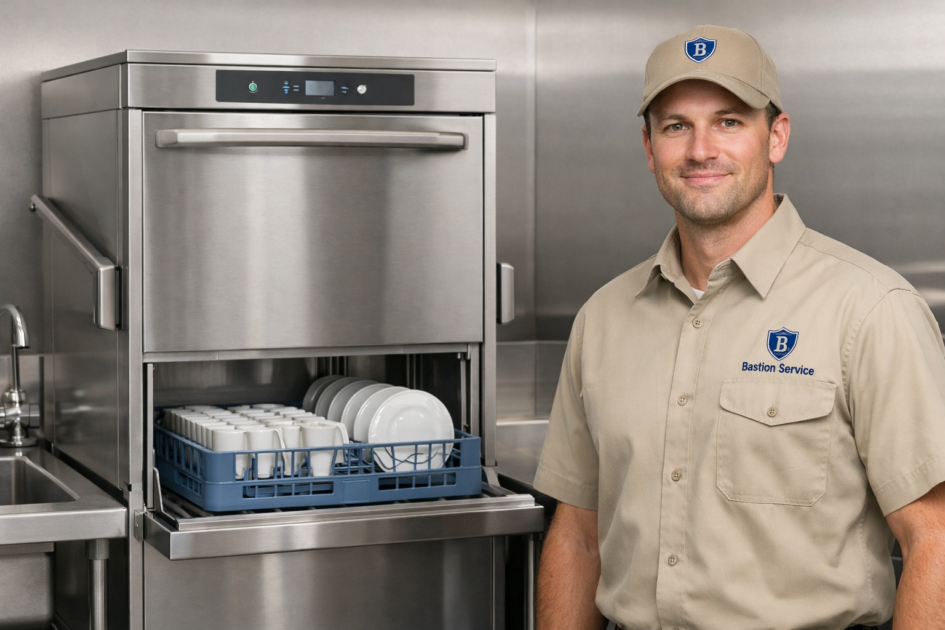
When a Hobart dishwasher starts interrupting the wash line, the best next step is service built around the actual failure pattern, not a guess at the first part that seems likely. In Santa Monica, dishwashing problems can slow ticket flow, create rewash volume, and put extra pressure on staff. Bastion Service helps businesses identify whether the issue is tied to wash performance, drainage, heating, pumps, controls, or a combination of faults so repair scheduling can be based on real operating risk.
Related commercial service paths in Santa Monica include Hobart Commercial Repair in Santa Monica and Commercial Dishwasher Repair in Santa Monica.
What Hobart dishwasher problems usually mean in day-to-day operation
A dishwasher can appear to be running while still failing where it matters most. A unit may fill but not circulate correctly, complete a cycle but leave soil behind, or drain partially and carry the problem into the next rack. For kitchens and other businesses in Santa Monica, that often shows up as slower turnover, manual rinsing, repeated cycles, or staff watching the machine more closely just to keep output moving.
That is why service should focus on the full sequence of operation: fill, wash, rinse, heat, drain, and reset. A problem in any one of those stages can affect the rest of the cycle and make the symptom look larger or smaller than it really is.
Common symptoms and what they can point to
Not washing properly
If racks come out dirty, streaked, spotted, or still carrying food residue, the cause may involve weak circulation, clogged spray components, pump wear, scale buildup, low water level, rinse issues, or temperature loss. Poor results are not always caused by a single bad part. In many cases, the machine is still operating, but not with the pressure, heat, or rinse performance needed for consistent results.
This type of issue should be checked promptly because staff often compensate by rerunning loads, which increases water use, labor time, and machine wear.
Not draining or leaving standing water
Slow drain performance, water remaining in the tank, or repeated drain-related interruptions can point to blockages, drain pump trouble, float issues, valve problems, or control faults. Standing water is more than an inconvenience. It can affect the next cycle, create sanitation concerns, and make the machine unreliable during busy periods.
If the problem is intermittent, that is still worth addressing quickly. A unit that drains sometimes and fails other times often has a developing fault rather than a one-time obstruction.
Low rinse temperature or heat-related performance issues
When a Hobart dishwasher is not reaching expected temperature, the issue may involve heating elements, thermostats, sensors, relays, contactors, wiring, or control sequencing. Some heat problems are obvious, while others are less visible because the machine still runs through its cycle but underperforms on rinse delivery or recovery time.
For businesses that rely on steady throughput, temperature-related faults can quietly reduce confidence in every load until the machine is properly tested.
Leaks, overflow, or water where it should not be
Leaks can come from hoses, seals, valves, fittings, pump assemblies, door-related wear, or overfill conditions. A small leak often gets ignored because the dishwasher still runs, but continued use can allow moisture to spread to surrounding surfaces and increase internal damage over time.
Overflow behavior deserves the same attention. If water level is not being controlled correctly, the root cause may involve the fill system, float components, or a control issue that needs more than a quick adjustment.
Cycle failures, shutdowns, or inconsistent starts
If the unit will not start, stops mid-cycle, or behaves unpredictably from one rack to the next, the problem may involve the door switch, controls, timer functions, power supply conditions, safety cutoffs, or component failure under load. Intermittent shutdowns are especially disruptive because the machine may seem usable until it fails at the worst possible time.
These symptoms usually call for testing rather than trial-and-error parts replacement, since multiple faults can create similar start and stop behavior.
Pump noise, vibration, or mechanical strain
Grinding, rattling, unusual humming, or stronger-than-normal vibration can signal pump wear, bearing issues, loose internal parts, imbalance, or circulation restrictions. Noise changes matter because they often appear before a complete mechanical failure. Catching the issue early may prevent a pump or motor problem from turning into a longer outage.
Why symptom-based diagnosis matters
A Hobart dishwasher may show one obvious problem while the root cause sits elsewhere in the system. For example, poor wash results might begin with pressure loss, but the larger pattern could also involve scale, improper fill, reduced heat, or a circulation fault. Drain complaints may be caused by a simple restriction, but they can also point to pump problems or control issues that affect the whole cycle.
Diagnosis matters because the repair decision should answer more than “what part failed.” It should also answer whether the fault is isolated, whether continued operation could worsen damage, and whether the repair is likely to restore stable day-to-day use.
When service should be scheduled right away
It makes sense to schedule service as soon as the machine begins affecting workflow, wash quality, or safe operation. That includes:
- Repeated dirty or poorly rinsed ware
- Water left in the machine after the cycle
- Low or inconsistent rinse temperature
- Water leaking onto the floor
- Mid-cycle shutdowns or failure to start
- Abnormal pump noise or vibration
- Overfill, overflow, or erratic fill behavior
Waiting usually turns a manageable repair into a broader interruption, especially when staff have already started using workarounds to keep the machine running.
When continued use can make the problem worse
Some dishwasher faults should not be pushed through another shift. If the unit is leaking, overheating, tripping protection, failing to drain, or making strong mechanical noise, continued operation can increase damage to pumps, motors, heating components, wiring, or nearby surfaces. A machine that stops unpredictably can also create unnecessary disruption if it goes down in the middle of active production.
In those situations, taking the dishwasher offline until it can be evaluated is often the more practical move.
Repair or replace?
Many Hobart dishwasher problems are repairable, but the right decision depends on the overall condition of the unit, not just the current symptom. If the machine has been stable and the failure is limited to one system, repair is often the sensible path. If the unit has a pattern of recurring breakdowns, multiple worn components, or declining performance across several functions, replacement planning may deserve discussion.
The key question is whether the work will restore reliable operation for the business, not simply whether the dishwasher can be made to run again for the moment.
How to prepare for a service visit
Before scheduling repair, it helps to note exactly what the machine is doing and when the problem appears. Useful details include whether the dishwasher fills normally, whether spray action seems weaker than usual, whether the issue happens every cycle or only sometimes, whether there is standing water afterward, and whether the machine is struggling with heat or rinse performance.
If staff have noticed leaks, unusual sounds, fault lights, or a change in cycle time, that information can help narrow the diagnosis faster. The more specific the symptom pattern, the easier it is to move from complaint to repair plan.
Service-focused support for Santa Monica businesses
For businesses in Santa Monica, Hobart dishwasher repair should lead to a clear next step: identify the failed system, understand the impact on uptime, and schedule the repair based on the severity of the problem. Whether the issue involves poor wash results, drainage trouble, low temperature, leaks, pump performance, or cycle failure, the goal is to get the machine properly evaluated so downtime does not spread into a larger workflow problem.


