
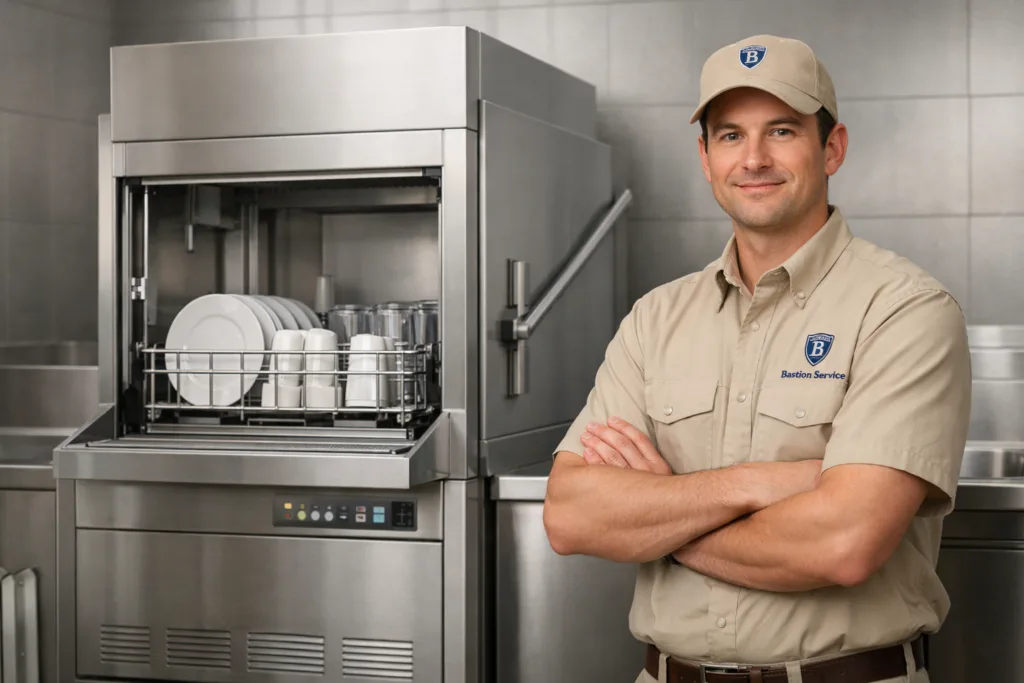




When a Hobart dishwasher starts slowing down dish flow, leaving residue behind, leaking onto the floor, or failing to finish cycles, service should focus on the specific fault pattern rather than guesswork. For businesses in Palos Verdes Estates, the main priority is usually restoring reliable operation quickly while avoiding extra damage from repeated resets, continued leaking, or running the machine below proper wash and rinse conditions. Bastion Service provides Hobart dishwasher repair based on symptom testing, component inspection, and repair scheduling that fits the urgency of the problem.
Related commercial service paths in Palos Verdes Estates include Hobart Repair in Palos Verdes Estates and Commercial Dishwasher Repair in Palos Verdes Estates.
What a Hobart dishwasher problem can disrupt
A dishwasher issue rarely stays isolated to one machine. It can slow rack turnover, increase manual rewashing, affect sanitation routines, and create pressure on staff during busy periods. Even when the unit still turns on, poor wash results, weak draining, low rinse temperature, or mid-cycle stoppages often mean the machine is no longer operating as intended.
In Palos Verdes Estates, service calls often involve one visible symptom that actually connects to several possible causes. A drain complaint may involve a pump problem, blockage, float issue, or control fault. Poor cleaning may point to spray arm obstruction, low fill, heating trouble, chemical feed issues, or declining pump performance. That is why repair decisions are more useful when based on tested findings instead of surface assumptions.
Why a Hobart dishwasher may not be washing, draining, or reaching temperature
These symptoms are among the most common reasons businesses schedule service, and they can overlap. A machine that is not washing properly may also have a temperature problem. A unit that does not drain completely may interrupt the next cycle or leave dirty water in the tank. When a Hobart dishwasher is not reaching expected performance, common causes can include:
- Blocked or damaged wash arms
- Pump wear or reduced pump output
- Improper water fill level
- Drain restrictions or drain valve problems
- Heating element or booster heater faults
- Temperature sensor or control problems
- Chemical feed or rinse delivery issues
- Electrical component failure affecting cycle progression
Because these problems can produce similar results, the most effective repair path starts with identifying where the cycle is failing and whether the issue is mechanical, electrical, hydraulic, or related to heat delivery.
Common symptom groups and what they often indicate
Dirty dishes, cloudy film, or poor wash results
If racks come out with food soil, film, or inconsistent rinse results, the machine may be circulating weakly or not operating at proper wash conditions. This can point to blocked spray components, low water volume, scale buildup, pump wear, heating issues, or chemical delivery problems. Sometimes the dishwasher appears to complete a normal cycle while still failing to clean effectively because one supporting system is underperforming.
Standing water or slow draining
Water left in the machine after a cycle usually means the dishwasher is not clearing the tank correctly. The cause may be a clogged drain path, drain component failure, pump trouble, or a control issue that stops the machine before the drain stage completes. Slow drainage should not be ignored, especially if staff are restarting cycles to compensate or if water is backing up repeatedly.
Cycle stops, stalls, or will not start correctly
When a Hobart dishwasher pauses mid-cycle, fails to advance, or starts inconsistently, the problem can involve door switch issues, float faults, timers, relays, sensors, or other control-related failures. Intermittent behavior often becomes more frequent over time. If the machine has to be reset to finish a load, the fault is already affecting dependable operation.
Low rinse temperature or sanitation concerns
If final rinse temperature is too low or the machine is not maintaining expected heat, service should be scheduled promptly. Heating problems may involve the booster system, heating elements, contactors, thermostatic controls, sensors, or wiring faults. Temperature complaints matter not only because of wash results, but because the machine may no longer be delivering the operating conditions the business expects from it.
Leaks, drips, or pooling around the base
Leaks can come from worn door gaskets, loose connections, cracked hoses, overfill conditions, pump seals, or internal component wear. Water on the floor creates more than a cleanup issue. It can affect nearby equipment, create safety concerns, and signal a condition that may worsen if the dishwasher continues running through full demand.
Noise, vibration, or rough operation
Grinding, humming, rattling, or abnormal vibration often suggests mechanical strain. Pumps, motors, obstructions, loose assemblies, and worn internal parts are common causes. A noisy machine that still runs should not be assumed to be fine. Changes in sound are often an early sign that a part is wearing down or that the unit is operating under stress.
Signs the machine should be taken seriously now
Some problems can wait for planned scheduling, but others should be treated as urgent because continued use can increase repair scope. Watch for these signs:
- Repeated incomplete cycles during normal use
- Water leaking onto surrounding flooring
- Persistent dirty results even after normal loading and operation
- Failure to heat or maintain rinse performance
- Burning smells, buzzing, or abrupt shutdowns
- Need to restart or manually intervene to complete loads
- Noticeable decline in speed, output, or consistency
If staff are adjusting workflow around the dishwasher instead of relying on it, the machine is already affecting operations enough to justify service.
What happens during diagnosis
Useful dishwasher service should do more than swap a likely part. The machine needs to be checked in relation to the reported symptom, cycle behavior, water movement, draining, and heating performance. That may include confirming fill operation, observing wash and rinse stages, checking for restrictions, evaluating pumps and valves, and testing electrical components tied to temperature or cycle control.
This process helps determine whether the fault is isolated or part of a broader wear pattern. That matters when a business needs to decide if the current issue is a straightforward repair, a sign of multiple failing systems, or a reason to plan more carefully around downtime.
Repair versus replacement considerations
Many Hobart dishwasher problems are repairable, especially when the failure is concentrated in a specific component or assembly. The better question is whether the repair restores stable performance or only addresses one symptom temporarily. Age alone does not decide the issue. Condition, service history, severity of the current failure, and the state of the machine’s core systems all matter.
Repair is often the practical choice when the machine has a defined pump, drain, seal, heating, or control problem without widespread deterioration. Replacement may deserve discussion when there are multiple major faults, chronic recurring issues, or signs that the unit has reached a point where repair costs no longer support dependable use.
How businesses can prepare for a service visit
Before service is scheduled, it helps to note exactly what the dishwasher is doing and when the problem occurs. Useful details include whether the machine fails at fill, wash, drain, or rinse; whether the issue happens every cycle or intermittently; whether leaks appear only during operation; and whether temperature, noise, or draining changed gradually or suddenly.
It is also helpful to identify:
- Any recent error behavior or shutdown pattern
- Whether the unit still powers on normally
- If wash quality changed before the main failure appeared
- Whether staff have been restarting cycles to keep the machine going
- If the leak is coming from the front, side, or underneath
Good symptom detail can shorten troubleshooting time and help the repair visit stay focused on the systems most likely causing the outage.
Service-focused next steps for Palos Verdes Estates businesses
When a Hobart dishwasher is affecting output, wash quality, drainage, or rinse performance, the right next step is to schedule service before the fault spreads into larger downtime. For businesses in Palos Verdes Estates, a proper repair visit should identify the actual cause, clarify whether continued operation risks additional damage, and outline the most practical path to restore dependable use. Whether the issue involves poor cleaning, pump trouble, low temperature, leaks, or cycle failure, timely diagnosis is the best way to protect workflow and make a sound repair decision.


